Story code: ST-001286
Part 3: The Paper Trail Tightens
Arthur Vance’s hand came down on the phone cradle, his palm pressing the hook switch back down to cut off the dial tone. He did not look at me; his eyes remained fixed on the county registry screen.
“Let’s not involve management over a database lag, Claire,” Vance said, his voice dropping to a low, tight whisper.
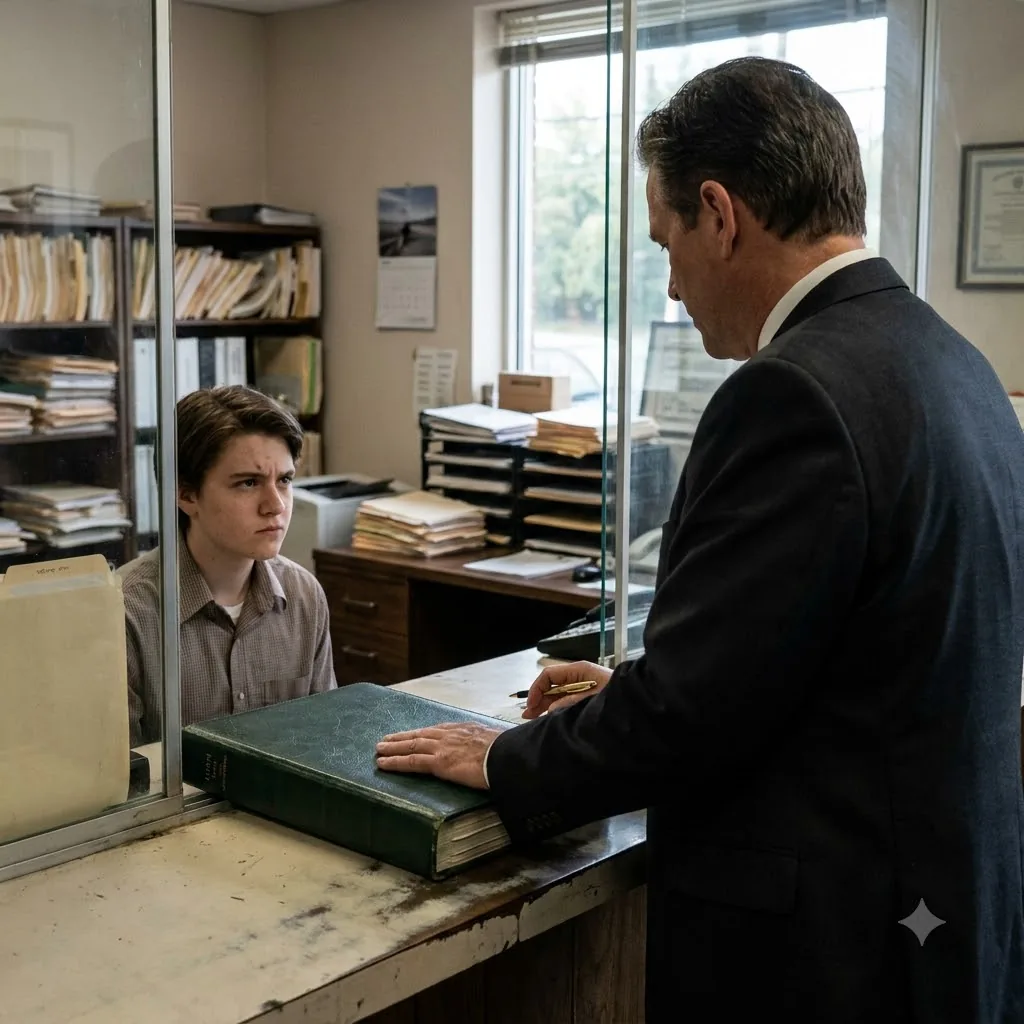
Behind him, Richard Sterling took another step forward. His leather shoes clicked sharply against the linoleum. He reached into his coat pocket, pulled out his handkerchief, and wiped the back of his neck. His gaze darted to the green leather ledger on the counter.
I kept my hands flat on the desk, right next to the ledger’s binding. “It is not a database lag, Mr. Vance. If you look at the middle of page forty-two, the transfer entry lists the municipal deed number for the primary Sterling estate as deed number ninety-two, zero, eight, four.”
Vance cleared his throat. “A standard property description.”
“The county office did not issue deed ninety-two, zero, eight, four until October fifteenth,” I said. “Our system pulls real-time registry logs. I am looking at the county’s public transaction log right now. That specific deed number was registered at ten in the morning on October fifteenth, a day after Thomas Sterling’s death certificate was signed.”
I leaned forward slightly, keeping my voice in a level, monotone delivery. “For Thomas Sterling to have signed this ledger entry on October twelfth, he would have had to record a deed number that did not exist for another three days, alongside a sequence code that was not generated until four days later. The physical document could only have been written, signed, and stamped on or after October sixteenth.”
Vance’s finger twitched against his gold pen. He looked at the green leather book, then back to the screen. He did not offer another explanation. The rhythm of his pen tapping had completely stopped.
I stood up from my chair and retrieved the printed copy of the death certificate from the tray, placing it next to the digital log of the transaction history.
“Every transaction requires a physical chain of custody,” I said. “If the IRS pulls the audit trail, they will see this system scan was initiated under our license. I cannot delete the log of the sequence mismatch. It is permanently tied to the Sterling estate file now.”
Vance stared at the printout. His lips parted slightly, but no sound came out. He adjusted his glasses, then slowly retracted his hand from the phone cradle.
Richard Sterling’s face had turned a deep shade of red. He stepped closer to the counter, his voice rising slightly. “Arthur, you told me this was standard procedure. You said the dates were a formality.”
Vance did not look at his client. He kept his eyes on the screen, where the red warning text of the sequence mismatch blinked slowly. “It is a matter of administrative interpretation,” Vance said, his defensive tone losing its strength.
“The state does not interpret automated transaction sequences,” I replied.
Richard Sterling grabbed the edge of the counter, his knuckles white. He looked at the green leather book, then at Vance. “We’re leaving,” he said, his voice flat. He grabbed Vance’s arm, pulling him back.
Vance reached out, his fingers hooking under the green ledger. He dragged the heavy book off the counter. The metal corners of the cover scraped against the wood grain, leaving a faint scratch. He clutched the ledger to his chest and walked toward the exit, his strides quick and uneven. Richard Sterling followed him, pushing the glass door open so hard it rattled against the frame.
I sat down and clicked the mouse, sending the file to the verification queue.