Story code: ST-000647
Part 2: The Room Started Watching His Hands
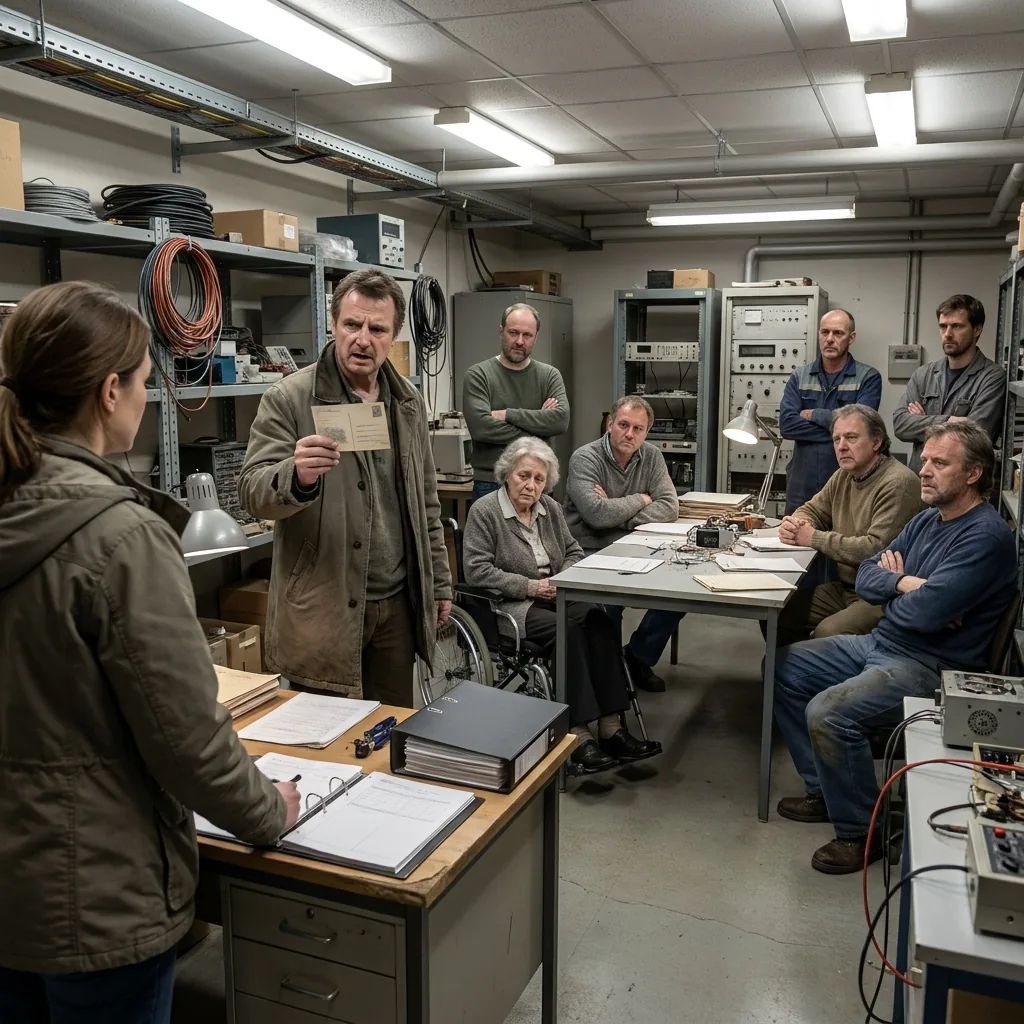
By the time I unclipped the care log from the supply crate, the room had gone quiet in that sharp basement way where every small sound gets louder. The tea urn clicked. A chair leg scraped concrete. Evan still had the postcard lifted chest-high, but now people were looking back and forth between the card in his hand and the clipboard in mine. I did not wave the log around. I set Lydia’s water cup in her hand, waited until she had it steady, and laid the clipboard flat on the back table beside the medication tray. “You said I made helping your mother depend on me,” I said. “So let’s do helping. Nia, can you read the time column.” Nia came closer. She wiped her palm on her jeans before touching the page. “April support night, six-fifteen, Lydia arrived with Mara. Six-twenty, tea prepared. Six-thirty, meds with crackers. Six-forty-five, lights lowered after hum complaint.” Evan cut in. “A list doesn’t prove kindness.” “No,” Dr. Ortega said from the whiteboard. “But it does prove sequence. Keep reading.” Nia kept going. “Seven-ten, bathroom assist, Mara and Nia. Seven-thirty, pickup delayed, Lydia stayed in reading corner. Eight-oh-five, ride home with Mara.” She looked down the sheet. “Next week. Same kind of entries. Then the week after that.” I pointed to the initials line at the right edge. “Who signed as witness on the nights I had to step out to take calls?” Nia glanced over, then read it. “Ben O. Twice. Me once.” Dr. Ortega gave a short nod without moving from his spot by the power strip. Evan took half a step toward the table. “You wrote that yourself. Anybody can write a routine and act like it means something.” “Then do the next step,” I said. I slid the pill organizer toward him, not the medicine itself yet, just the closed tray and the paper cup beside it. Lydia had already started tapping the chair arm again. Once. Twice. A little faster. “You say care got twisted into control,” I said. “Show the room what you mean by care. What does she take first?” He looked down at the organizer like the colors on the lids had changed since childhood. The labels were plain black marker. Mon, Tue, Wed. AM, PM. Water cup on the left, applesauce cup in the cooler sleeve if swallowing got difficult, lamp dimmed before the fluorescent buzz built up. He reached for the wrong compartment. “Not that one,” Lydia said. Her voice came thin but clear. Everybody heard her. Evan pulled his hand back so fast he bumped the paper cup. It rolled to the edge of the table and fell. Nia caught it before it hit the floor. “She used to take the blue one first,” he said. “That was before the adjustment in March,” I said. “You changed it.” He pointed at me with the postcard. “That is exactly what I’m talking about. You changed everything and called it necessary.” I opened the log to the March page and turned it so the table could see. No speeches. Just lines. Time, task, handoff. The date of the dosage change. The note that the updated order had been written onto the whiteboard after Dr. Heller’s office called. The initials from me and Dr. Ortega when we copied it down before support group began. I stayed with what was in the room. “The order changed on a Tuesday. The first support night after that, you were not here. The next week, not here. The week after that, not here either.” “I told you, I wasn’t gone the way you think I was.” That pulled a murmur through the folding-chair circle. He heard it and raised the postcard higher. “Because I came back with proof,” he said. “This was sent from a year nobody in this basement has seen yet. Read the postmark. Read the date. You want practical? Fine. The future bothered to warn people about her.” He held the card out again. This time Dr. Ortega crossed the room and took it himself. He did not rush. He adjusted his glasses, read the back, then flipped to the front and looked at the stamp under the light over the supply shelves. “Postmark’s smeared,” he said. “The date isn’t,” Evan snapped. “No,” Dr. Ortega said. “But the card stock is from the campus print shop. They changed vendors last fall. The old stock had a blue fiber in it. This one doesn’t.” Evan’s jaw tightened. He opened his hand, closed it again, then reached toward Lydia like he had remembered too late that she was the reason we were all standing there. “Mom, come on,” he said. “You know how she is.” Lydia did not take his hand. She looked at the water cup, then at me, then at the pill tray still sitting between us. I kept my voice low. “You can sit by her and steady the cup if you want.” He grabbed the chair beside hers and pulled it too hard. The metal feet shrieked across the concrete. Lydia flinched and pressed her lips together. That sound did more to the room than any sentence I had said. Nia stopped pretending to sort cups. One volunteer moved the medication tray a little farther from Evan’s elbow without making a show of it. Dr. Ortega set the postcard down beside the log, both of them now on the same table under the same light. Then he touched one line on my March page and looked at Evan. “This says basement access key returned by eight-forty on March twelfth because Mara left early to meet your train,” he said. “But your postcard is dated as if you were already here warning everybody two days before that.” Nobody spoke for a full second. Evan looked at the card, then at the key ring on my belt, then at the line Dr. Ortega’s finger was holding in place, and the whole room leaned toward the same.