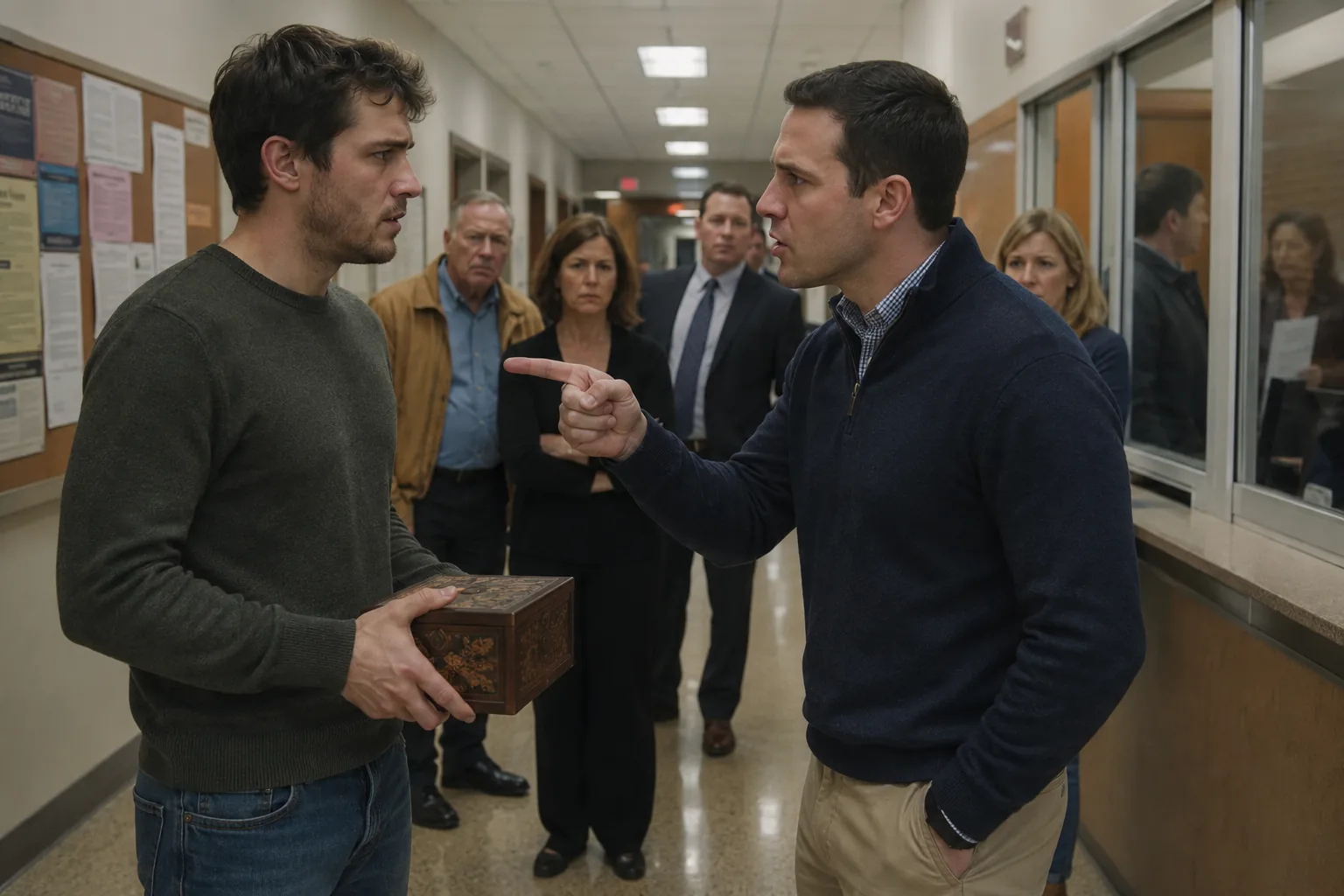
Story code: ST-000021
Part 4: The Hallway Changed Sides Without Saying Sorry
Nobody rescued him from that question.
Derek opened his mouth, shut it, and then tried the only move he still had left.
“This is still estate property,” he said, louder again. “She’s interfering with administration. She had no right to take possession.”
But it landed wrong now. He was no longer the first voice people had heard. He was the man standing over an open keepsake box, after publicly calling me a thief, with the proof of prior handling running right through the lid.
Tina did not raise her voice. She didn’t need to.
“Sir, step back from the chair.”
It was the first direct instruction anybody had given him.
He looked at her, then at me, then at the bystanders lined unevenly along the wall seating area. Nobody was murmuring approval for him now. Ron Bell had his hands on the back of the chair he had been sitting in, but he was no longer leaning toward me. He was looking at Derek the way people look when they realize they got recruited into somebody else’s lie for free.
Derek did not step back.
“I’m the executor,” he said.
Tina answered immediately. “And you used that to accuse her of theft in a public hallway. Now there’s a contradiction in front of us and you’re still trying to control the object. Step back.”
The words hit harder than if she had shouted them.
He finally moved one pace away from the chair.
I kept my hand on the side of the box. My voice came out steadier than I felt. “You said I was walking off with estate property. You said the box hadn’t been cleared. You said nobody opened it. But somebody removed the card case from the top, opened the lid, threaded the ribbon from inside, tied it shut, and then handed it to me before accusing me in front of strangers. I didn’t do that standing in this hallway.”
No one interrupted me, because there was nothing left to smooth over.
The woman under the court calendar stood up with her phone still in her hand but lowered at her side now. Ron said, flat and audible, “Then he knew she didn’t open it.”
That sentence crossed the hall like a dropped tray.
Derek swung toward him. “You don’t know what you’re talking about.”
“I know what I watched,” Ron said.
It was not a speech. That was why it worked.
Tina turned toward the check-in window and called, “I need a supervisor out here, please. Right now. Family property dispute, public accusation, possible handling issue by the reporting party.”
Derek’s head snapped toward her. “There is no need to do that.”
“There is now,” she said.
That was the irreversible moment. Not because anybody had declared me innocent in some grand courthouse way, but because the hallway itself was no longer his stage. He had pushed too hard in the exact place where he wanted easy authority, and now a courthouse employee was treating him as the problem to be documented.
A gray-haired woman from the window area stepped out with a badge clipped to her blazer. Tina gave her the short version in front of all of us, and she did not soften the order of events. She started with the accusation, not with family conflict.
“He publicly stated she was taking estate property,” Tina said. “The object shows prior handling inconsistent with his claim. He then attempted to retake it while changing the basis of the accusation.”
Derek tried to cut across her. “This is being blown out of proportion.”
The supervisor held up one hand without looking at him. “Are you the executor on the Jensen matter?”
“Yes.”
“Then you are not to conduct any further handoffs in this hallway today. If there are property exchanges, they go through documented scheduling and witness presence. For now, that box stays at the check-in window until your file note is reviewed.”
There it was. Visible, immediate, and public.
She looked at me. “Ma’am, your name?”
“Mara Jensen.”
She nodded once and repeated it while writing. Then she turned back to Derek. “And for the record, you do not accuse someone of theft in county space unless you are prepared to support it. Do you understand me?”
His face changed color in a way I had seen only once before at a family funeral, when he realized too late that everybody had heard him say the wrong thing. He said nothing for a beat too long.
“Do you understand?” she repeated.
“Yes,” he said.
The hallway did not rush in with comfort after that. No chorus of apologies. No tidy family lesson. Just a visible rearranging.
People who had been looking at me like a problem stopped looking at me that way. Ron let go of the chair back and avoided my eyes. The woman with the phone slid it into her purse. Tina lifted the box carefully from the seat and carried it to the window herself instead of letting Derek touch it.
That detail mattered more than anything anybody could have said.
Derek stayed where he was for a second, no longer blocking the path to the elevator, no longer directing traffic with his voice, no longer able to use executor like a club. The corridor noise came back in pieces around him: shoes on tile, a door opening, somebody’s name called from a hearing room.
My humiliation had happened in that hallway, in public, under fluorescent lights with strangers watching. So did the correction.
I did not thank him for anything. I did not offer him a private way out.
I just stood there while his access narrowed in real time and the room changed its mind where he could see it.