Story code: ST-000038
Part 2: He Kept Repeating It Louder
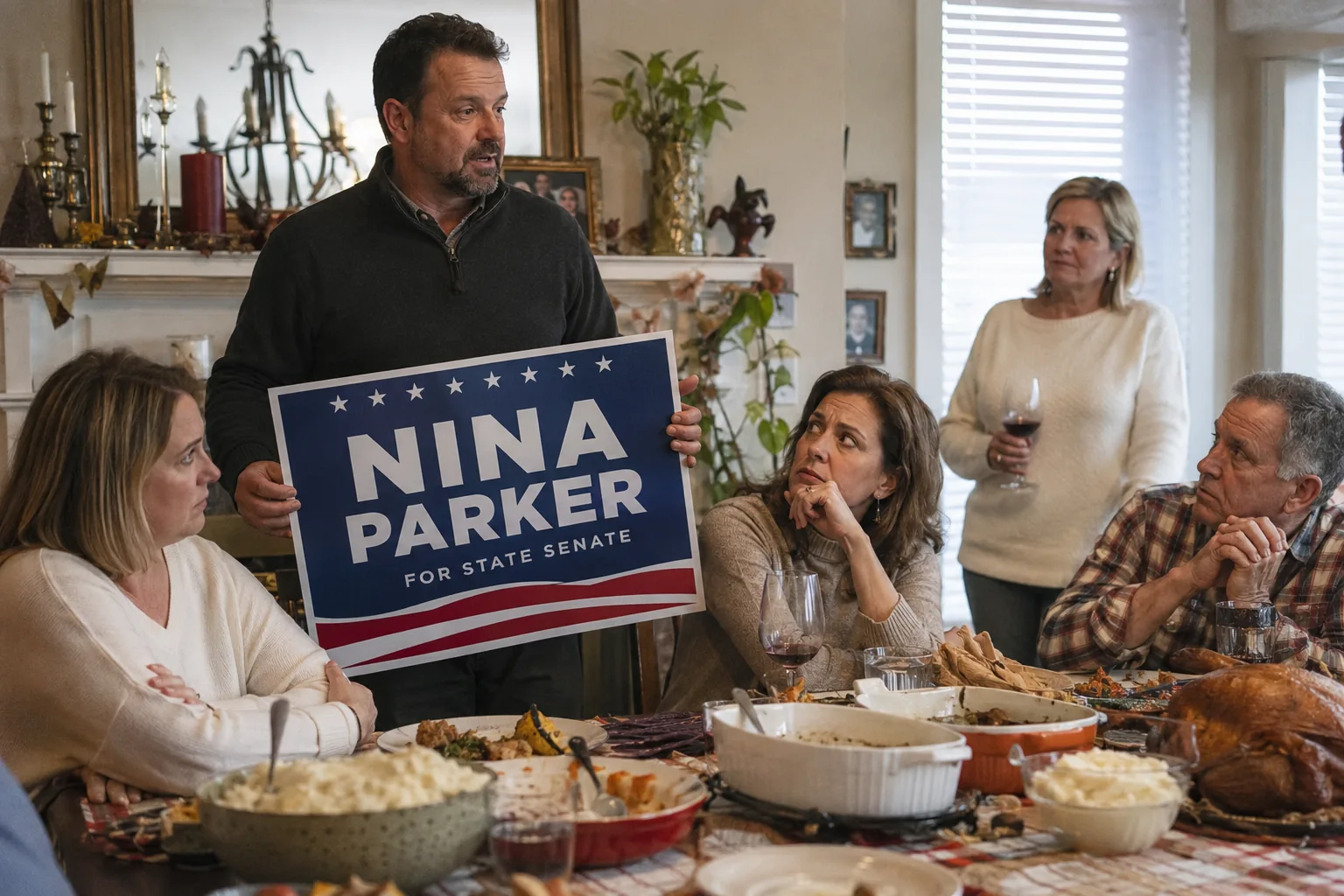
Mark’s fork stopped halfway to his plate when Nina asked where the county line was on the sign. He lowered it, dabbed the corner of his mouth with his napkin, and then answered with more words instead of a location.
“That’s not the kind of thing you can explain to somebody who doesn’t know the framework,” he said. “You have to understand reading order, field hierarchy, municipal cueing.”
Nina stayed still except for one small turn of her glass on the table. “You said anybody who knows election mechanics can see it. So show us where you’re seeing it.”
Denise stepped in fast with the cranberry dish. “Who wants more? Mara, can you bring the rolls?”
I went back two steps into the kitchen, grabbed the basket, and came right back to the doorway because nobody was talking about rolls. They were watching Mark and the sign.
He had shifted in his chair so his shoulder was angled toward the sideboard. He pointed again, only now he used his whole hand instead of a fingertip.
“It’s not one printed line,” he said. “It’s the implied county line created by the layout.”
Nina looked at him a second, then at the sign. “Implied by what?”
“By the distribution geometry.”
There was a short silence after that. Not a dramatic one. More like the room had reached the end of a hallway and found no door.
Grandpa Ron picked up his water, drank, and set the glass down carefully. Denise told everyone, “Please eat,” but she said it quieter than before.
Mark filled the space himself.
“This is what I mean,” he said. “People hear one technical term and think they can cross-examine because they saw a campaign office once. Signs are part of larger messaging architecture. Domestic display fields follow different rules than roadside placements. When she brought that inside, she changed the precinct orientation. That’s not an opinion.”
Nina said, “What precinct?”
He answered too fast. “The social precinct.”
“That’s not a precinct.”
“In common speech, no. In applied analysis, yes.”
He smiled again, that same tight little line, and looked around the table as if the room itself should settle it for him. Nobody nodded. Nobody challenged him either. Denise lifted the gravy boat, realized it was empty, and put it back down.
I set the rolls near Ron’s elbow. From there I could see the sign cleanly: candidate name across the center, slogan under it, no county line, no map, no district number, no anything except a union printer’s mark in one lower corner.
Nina saw the same thing I saw because she asked the next question without looking away from the sign.
“Where on that board is district bleed?”
Mark laughed once through his nose. “You’re still doing that literal thing. That’s the trap nonprofessionals fall into. Not everything visual is printed as a label. Some of it is encoded by relationship.”
“Relationship between what?”
“Positioning. Height. Household threshold. Viewer flow.”
He was speaking in clean, clipped pieces now, each word placed like a tile. But every answer was one step farther from the sign itself. That was plain enough even from the doorway.
Denise finally sat down instead of circling. “Maybe we should move on,” she said.
Mark didn’t look at her. He was still fixed on Nina. “Move on from what? She challenged a technical point. I’m explaining it.”
“You’re not explaining it,” Nina said. Her voice stayed even. “You’re renaming the room.”
That got a reaction. Not loud. Just visible. Ron’s chin lifted a little. Denise stopped touching the serving spoon. One of the cousins at the far end lowered his phone to the tablecloth face down.
Mark answered by going longer again.
“No, what I’m doing is trying to bridge a knowledge gap politely, and you’re making it impossible because you want this to be folksy. Politics isn’t folksy anymore. It’s systems, signals, layered communication. The sign in a yard says one thing. The same sign inside a holiday dining room says another. That’s why professionals track inversion events.”
Nina said, “Who tracks them?”
He blinked once and said, “Campaign people.”
“Which campaign people?”
“Serious ones.”
“Name one office that calls it an inversion event.”
He reached for his drink and missed the stem on the first try, tapping the base with two fingers before gripping it. He took a sip, then set the glass down harder than the others had been setting theirs down.
“You can always tell who has never been in a strategy room,” he said.
Nina gave him exactly one beat. “I’ve been in strategy rooms. I’m asking you to show us one real thing on that sign that matches one real term you used.”
Mark turned to Denise as if appealing upward. “Are we seriously doing this?”
Denise looked at the sign, then at Nina, then back at her plate. “If it’s simple, just answer her simple.”
That changed the table more than if she had banged a spoon on a glass.
Mark sat back, then forward again. He picked up his fork and used the handle to gesture at the lower edge of the sign.
“Fine,” he said. “I’ll prove the inversion event right now. Bring it here and don’t touch the orientation.”