Story code: ST-000332
Part 2: The Wrong Child in the Frame
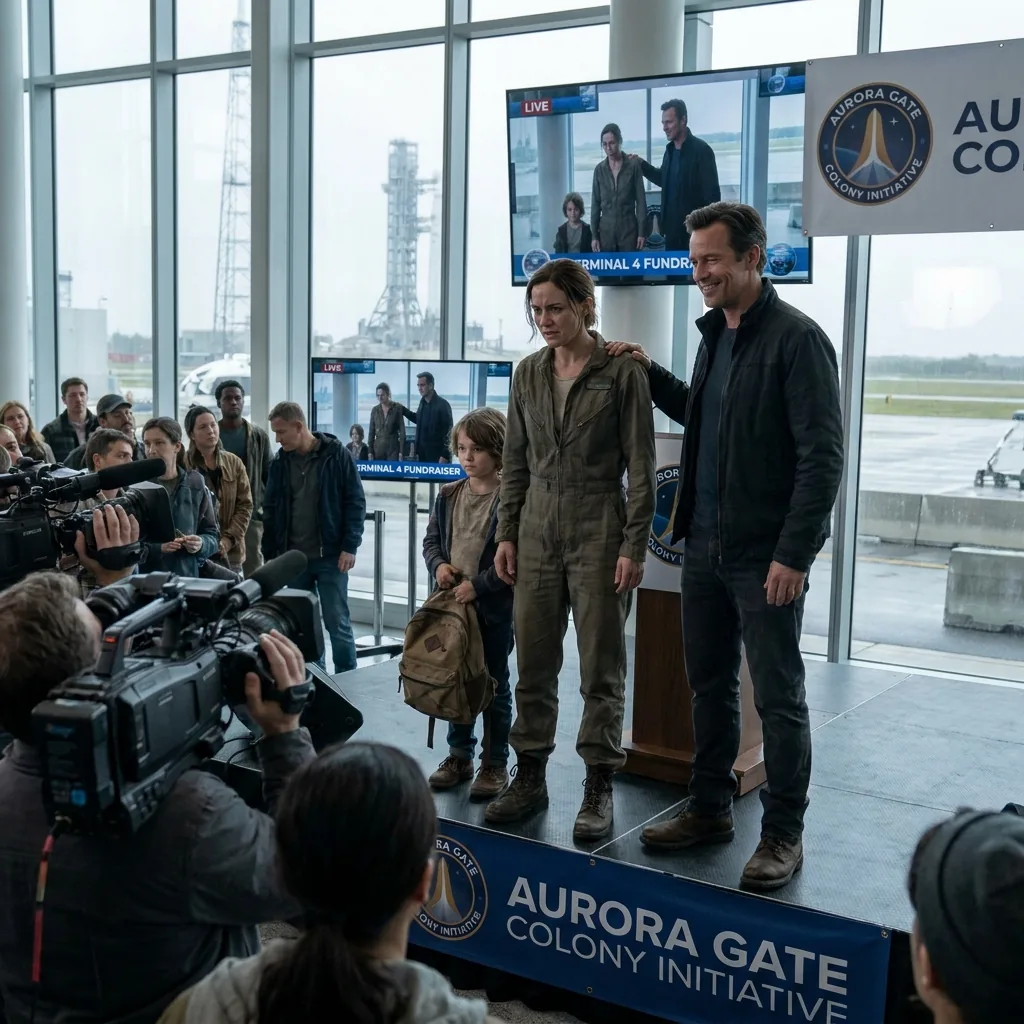
By the time the donor walk started, Leah no longer watched the Mercer family like a passing distraction. She watched them the way she watched a jam forming at a scanner line, because the problem was small from a distance and wrong in every practical detail up close. Grant kept announcing togetherness for cameras while Owen stayed in the center lane with a credential around his neck, and Mara kept getting pulled into photos, then edged back out before anything that looked like actual boarding happened.
A brass quartet from the fundraising committee struck up something bright near the gate windows. Ordinary travelers rolled suitcases around the rope line and slowed just enough to stare. The press riser tilted phones toward the family holding lane. Every few minutes a producer asked for another angle in front of the New Horizon Colony Initiative backdrop, and every time Grant adjusted his face before the red light came on.
Leah took the long route with a tray count she did not need, just to stay near the transition point between performance and procedure.
“One more with the son,” a photographer called.
Grant obliged instantly. He tucked Owen in at his side, sponsor badge facing forward, mission pin bright against his jacket. Diane stepped Mara inward only when the photographer widened the frame. As soon as the shutter burst ended, Diane touched Mara’s elbow and eased her back toward the edge again, close enough to look included, too far to look central.
The move repeated so often it stopped feeling accidental.
Leah saw Mara ask for her pass once. It was not dramatic. No raised voice. Just a small extension of the hand toward the folio while the host thanked a biotech donor. Diane kept smiling at the cameras and said, out of the side of her mouth, “In a minute.” The folio stayed shut.
Owen’s credential remained out where everyone could see it.
That alone did not prove anything. Printed passes and active credentials could mean different stages of the same itinerary. Families were sometimes processed in sequence. Last-minute updates happened. Leah knew all of that. But she also knew how people moved when they expected to clear a gate together. They clustered around the same official. They asked the same questions. They carried the same kind of access. The Mercers did none of that.
Grant and Owen drifted naturally toward the boarding scanner posts each time the rope opened for staff movement. Mara was redirected toward cameras, donors, or the side of the family lane. Even the language around her sounded different.
To Owen: “Stay close.”
To Mara: “Just for this part.”
To Owen: “You’ll go up when they call.”
To Mara: “Don’t make a scene.”
Leah heard that last one while refilling a display cooler by the concessions corridor rail. Grant had stepped half behind a sponsor banner again, microphone off, smile gone. Mara was facing him this time. Leah could not hear Mara’s reply, only the clipped shape of it. Grant answered in the same low hard tone Leah had heard before.
“You promised me we would get through today cleanly.”
Diane looked toward the nearest camera before she said, “People are watching.” Then she placed two fingers on Mara’s sleeve and turned her back toward the host as if resetting a mannequin.
The host announced the symbolic pre-boarding moment. Applause started. A stream graphics tech crouched near the cables. Grant raised his arm and thanked the donors for “sending this family forward.” But as the family moved toward the family holding lane beside the boarding scanners, Rafael Kent approached from the gate desk with his tablet already awake.
Leah knew Rafael by reputation and by habit. He checked the screen before he checked a face. He did not speed up for title badges or slow down for money.
“Mercer party, I’ll need active credentials ready for gate pre-clear,” he said in his flat professional tone.
Grant kept smiling for the phones clustered nearby. “Of course. Happy to do whatever the process requires.”
Owen lifted his lanyard at once. Diane opened the folio, but not toward Rafael. Toward Grant first.
It was brief, less than a second, but Leah saw both adults look down into the folio before either one produced anything. Mara had already taken one step toward Rafael when Diane’s hand stopped against her forearm.
“Hold,” Diane said softly.
Rafael waited with the tablet angled up. He did not fill silence for them.
Grant reached for composure the way other people reached for railings. “We’re finishing the media walk. Can we do her after the sponsor closeout?”
Her.
Not us.
Rafael glanced from Owen’s ready credential to Mara’s empty hands, then back to the screen. “Pre-clear is for all listed passengers entering the controlled lane,” he said. “If someone is not entering now, keep them outside the barrier until called.”
The words were procedural, almost dull. But they landed on the family tableau like a crack line in glass.
Grant’s smile held too long. Diane shut the folio again instead of handing anything over. Mara stood still beside the rope, no pass visible, while Owen remained inside the lane opening with his credential already raised.
Then Rafael checked his tablet a second time and said, with the same flat voice, “I’m showing one active Mercer credential in this group at this checkpoint. Who is presenting the second boarding record?”
No one answered him right away, and Leah realized the contradiction had finally left the level of posture and entered the system.