Story code: ST-000197
Part 3: The Rule Could Not Cross the Sink
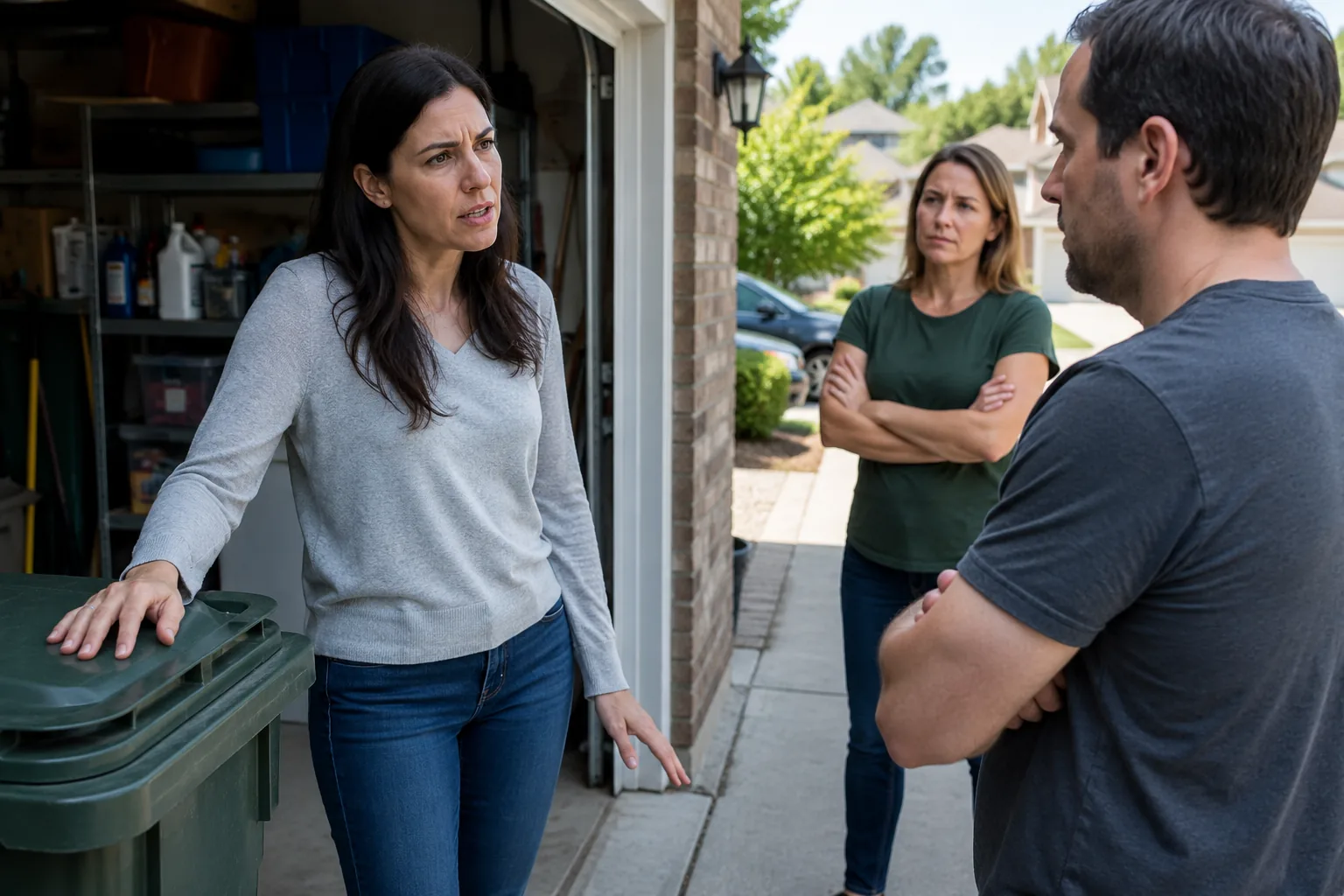
Dan did not move the sack. He stayed in the driveway with all three bins in view and asked Maya to say the rule the same way twice. Maya did not answer from the garage this time. She walked to the side door, looked into the kitchen through the screen, and pointed back toward the herb bin by the steps. “That one is still fine,” she said. Dan followed the line of her hand. The herb bin sat where it had all afternoon, tidy and labeled, with the lid sitting half an inch open from the latch not quite catching. “You said all bins were part of the same system,” he said. “Now that one is fine again?” Maya stepped back onto the driveway. “It is for sorted scraps. The garage bin is for mixed waste.” Linda moved from the threshold to the porch step and rested one hand on the rail. She did not touch any bin. She looked from the garage can to the herb container to the kitchen door and then said, “You just changed the category again.” Maya did not deny it. She pointed at the kitchen door instead. “And the sink is not for compost, either.” That was the first time the rule crossed a line nobody had mentioned before. Dan turned and looked through the open screen door. A bowl of vegetable peelings sat on the counter by the sink, beside a coffee mug and the cutting board. It was ordinary kitchen mess, visible from the driveway if a person stood in the right place. Maya looked at the bowl, then at the garage bin, then back at Dan. “The scraps have to stay with the designated container,” she said. Dan held his hand out toward the bowl through the doorway. “So the kitchen can keep them?” “No,” Maya said. “Then where?” She answered with the same firm tone. “Not there.” Linda let out a short, sharp laugh that stopped as soon as it started. She pointed once at the sink. “If the kitchen bowl is part of the same system, that means the system has to reach into the kitchen now.” Maya looked at her and said, “It already does.” Dan walked one step closer to the door, then stopped at the threshold. The bowl by the sink had no label. The compost bin in the garage had a label. The herb bin had a label. The driveway pail had a label, too, though Maya had already changed what counted as valid more than once. He asked for the line that made the kitchen bowl different from the garage bin, and Maya said the bowl was only a temporary holding spot. Dan asked how long temporary lasted. Maya said until the household standard was followed. “By who?” he asked. Maya looked at the bowl, then at the garage bin, then at the driveway pail. “By everyone.” Linda crossed her arms and looked at the bowl again. “Then put the same rule on the sink,” she said. “Or take it off the bin.” Maya reached for the compost bin lid, but instead of opening it, she pulled her hand back and said the garage bin had already been overused. That made the reason change again. The bin was no longer paused because of contamination. It was paused because it had been used too much. Dan asked how a bin could be too used to use. Maya said that was exactly why it had to stay closed. The explanation did not hold long enough to finish the sentence. Dan set the sack down beside the garage bin and opened the top with two fingers. The scraps inside were plain kitchen peelings, apple cores, and a few coffee grounds. Nothing looked mixed wrong. Nothing looked spoiled. Maya saw the open lid and stepped toward it, but Dan stopped her with one hand held flat in the air. “You can call it contamination,” he said, “but you keep moving the definition when I point at the object.” Maya did not answer that. She turned toward the kitchen and looked straight at the bowl on the counter. Then she reached for her phone, unlocked it, and held it low by her side. She did not show the screen to anyone. She did not need to. The next thing she said was, “The kitchen scraps are going in the backup container.” Dan looked at the driveway pail. Maya was already walking toward it. The backup container sat empty beside the hose reel. The way she said it made the decision sound already made. Then Linda said, “What backup container?” Maya stopped with her hand on the pail lid. She opened it, looked inside, and closed it again. There was nothing in it. No liner. No bag. No label change. She stood there with her phone still in her other hand and said, “The one I set up.” Dan asked when she set it up. Maya gave no date. She looked at the kitchen bowl once more, then at the garage bin, and said the proof was simple: the designated space had been closed, so the scraps had to move. There was no mention of any post, any note, or any family agreement that anyone else in the driveway had seen. That was the point where the private policy became impossible to hide in the visible objects. Maya had a spare container she had not mentioned, and she had a new place for the scraps that did not exist a minute earlier. Dan stood between the garage bin and the kitchen door and asked one more time which container was actually official. Maya looked at the phone in her hand, then at the bowl by the sink, and said, “Whichever one I tell you to use.” The sentence sat there longer than the earlier ones because it finally described the whole thing. It was not about compost anymore. It was about who got to assign the bin after the fact.