Story code: ST-000892
Part 2: The Bin Started Telling On Her
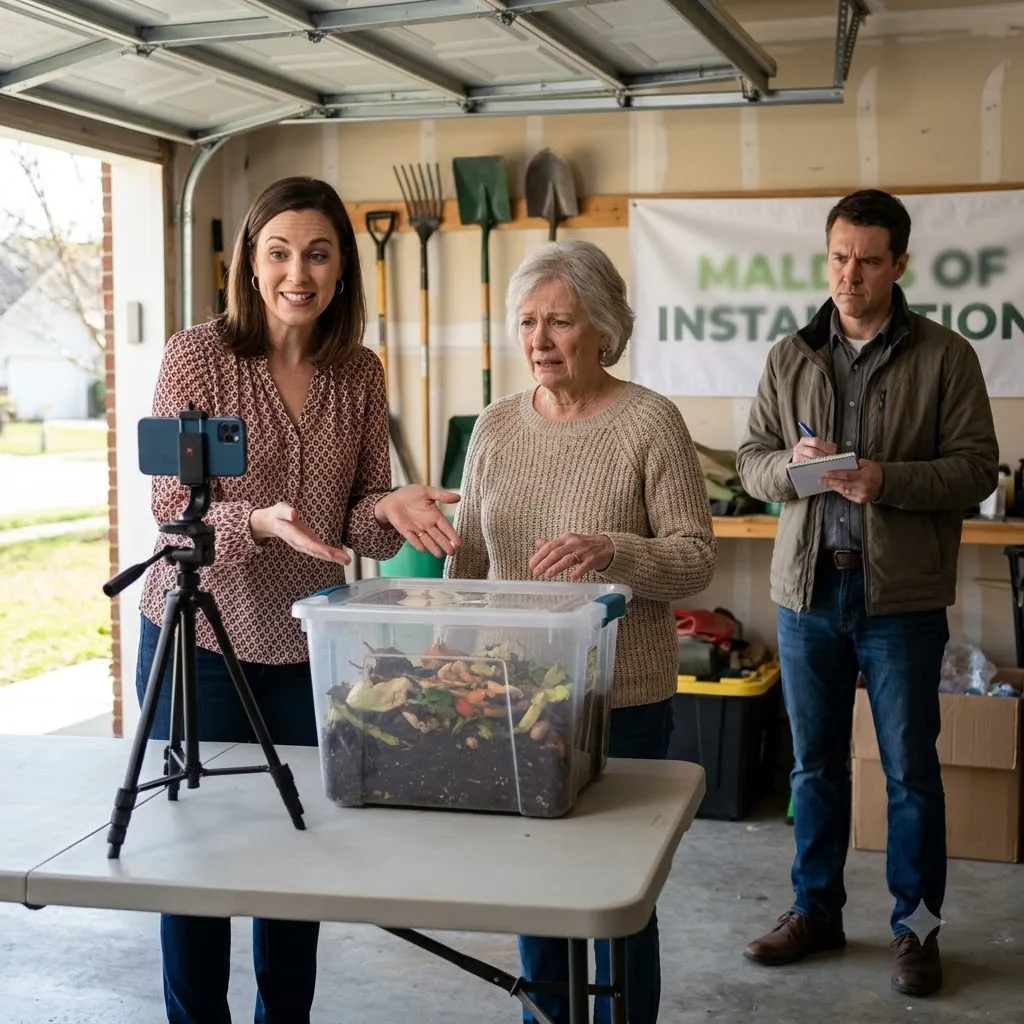
By the time Maya went back into her host voice, the garage had split into two scenes at once. On camera, she was still the zero-waste daughter standing beside a spotless compost bin and talking about simple systems. Off camera, there was a black bag tucked behind the labeled tubs, Elaine’s hands moving too fast at the side shelf, and one sentence hanging in the air that I had no way to unhear: put the wet stuff on top and dump the cups in the black bag first.
I did not say anything right then. I picked up the extra folding chairs I had been moving and carried them to the wall by the freezer, because if I stepped into the middle of her stream with half a picture, she could turn me into the guy causing drama at a fundraiser. So I watched the process instead.
That was where the gaps started stacking up on their own.
Maya held up a paper cup and told the viewers, “Most compost confusion comes from people thinking food residue ruins the sorting. It doesn’t if you know what you’re doing.” Then she dropped the melon rinds into the clear bin but kept the cup in her other hand a beat too long. She turned toward Elaine, shielding the movement with her body from the tripod angle, and passed the cup low. Elaine took it without looking up and moved it toward the side shelf.
A minute later, a man from two houses over finished a brownie, folded the waxy wrapper, and asked, “Compost or landfill?”
Maya answered before he reached the tubs. “Compost, because we’re handling mixed food waste here.”
Ruth’s head turned at that. She had been checking donor totals near the driveway, but she walked a little closer to the demonstration table and watched the tubs instead of the phone screen.
The man dropped the wrapper where Maya pointed. Elaine picked it back out almost immediately, glanced toward the tripod, and shifted it behind the side shelf.
That caught another guest’s eye. “Wait,” the woman said, pointing with a cookie in her hand, “I thought that one was compost.”
Maya gave the same bright laugh she used earlier with her mother. “We’re just rebalancing the moisture layer for the demo.”
That answer might have worked if the labels and the motions matched. They didn’t. The COMPOST tub on the shelf stayed oddly empty except for dry-looking scraps near the top. The clear display bin stayed pretty because Maya kept adding photogenic food waste to the surface. But the messy event stuff – cups with frosting smears, napkins stuck to orange peels, snack wrappers with crumbs still inside – kept disappearing below table level or behind the black bag.
Once I noticed the pattern, it became mechanical. Guest asks. Maya answers in broad slogans. Item changes hands. Elaine redirects it out of the visible line. Maya turns back to the camera and says some version of “zero waste is just habit.”
I walked over to the water table and caught Ruth near the signboard.
“Did you hear what she said off to the side?” I asked.
Ruth did not answer right away. She looked past me at the tubs, then at the tripod, then at Elaine moving a stack of used paper cups off the table.
“I heard enough just now,” she said. “Keep talking only if you can be specific.”
So I kept it exact. I told her where I was standing, what Maya said about wet stuff on top, what she said about dumping cups in the black bag, and what I had seen since then. No speeches. No guessing.
Ruth gave one short nod and moved closer to the demonstration area. She did not confront Maya. She watched.
That made the next five minutes worse for Maya without anybody raising a voice.
A teenager tossed a banana peel into the clear bin and asked where his smoothie cup should go. Maya said, “Same place, we’re keeping it all organic-adjacent for education.” Ruth looked directly at the label on the LANDFILL tub when she heard that. Elaine stepped in, reached for the cup, and her hand shook enough that the lid slipped to the concrete. It skidded under the folding table.
When Elaine bent to get it, the black bag behind the shelf opened wider. From where I stood near the driveway threshold, I could see a pile of used paper cups, snack wrappers, and damp napkins inside. Not one or two. A stack.
The woman with the cookie saw it too. “I thought this was zero waste,” she said, not loudly, but loud enough that the people nearest the signboard stopped talking.
Maya answered fast. “It is. That’s pre-sort overflow. We separate after the educational segment.”
Ruth said, “Then why tell people on stream that everything is being composted as demonstrated?”
Maya turned toward her and spread both hands, still smiling, but the smile had started to look fixed. “Because that’s the goal of the system. The live part is simplified for clarity.”
No one had to explain the problem after that. The proof was sitting in plain sight: the clean top layer in the clear bin, the hidden bag swallowing the ugly items, Elaine correcting the process after Maya made claims, and guests now watching the shelf instead of the phone.
Then the stream itself made it harder to contain. Somebody near the ring light said, “Your comments are asking why your mom keeps removing stuff off camera.”
Maya pivoted toward the tripod. Elaine froze with two cups in her hands. Ruth stepped all the way up to the table.
And I realized the next problem wasn’t whether Maya had been caught saying one wrong thing. It was whether she could keep the demonstration going at all once the room started watching the bin instead of listening to her.