Story code: ST-000977
Part 4: The Lock That Ended It
Once Lt. Marcus Vale framed it that way, nobody at the counter needed a speech about fairness. The next steps were mechanical.
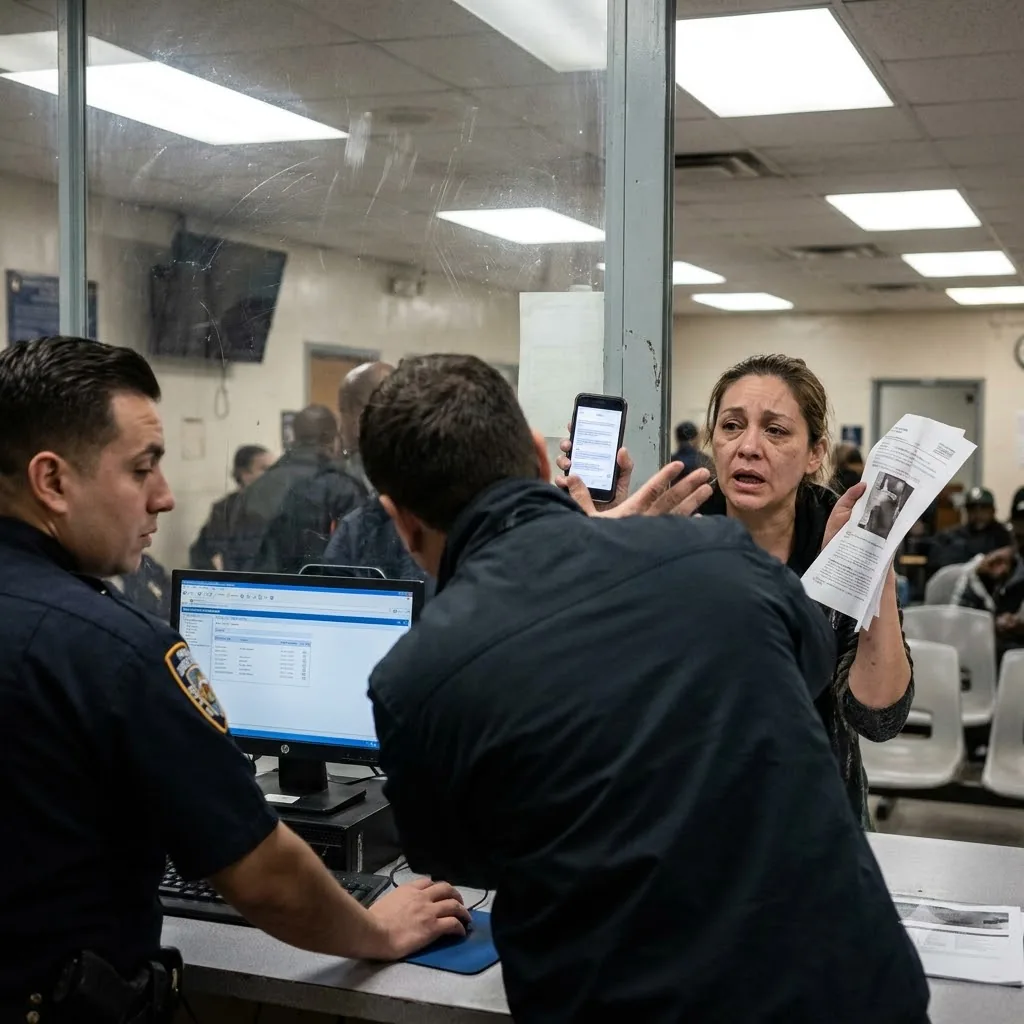
Desk Sergeant Nina Carver opened the report while Officer Ben Rourke pulled an incident worksheet and started reading back the basics for accuracy: reporting party name, account email, time of deletion notices, time of the message, type of threatened exposure, and current recovery deadline. The printer kicked once and fed out the first page. Vale remained at the station, one hand near the keyboard, treating the whole thing like a checklist that should have been started an hour earlier.
Trent tried one more time to turn it back into fog.
“You can’t just let her seize control of shared digital material,” he said. “There are mutual files in old backups.”
Vale answered without changing tone. “Then define the account relationship precisely. Are you an authorized user on her account, or are you not?”
Trent’s mouth opened, then closed. He glanced toward Carver, but she was no longer carrying the claim for him. She was typing from Alyssa’s printouts into the report field.
Vale repeated the question. “Authorized user or not?”
“Not on paper,” Trent said.
Vale gave a small nod, the kind that closes one box and moves to the next. “Then we are done with the policy fiction.”
He asked Alyssa for the account provider name and the recovery contact options showing on her phone. She read them off. He had Carver note the active deletion recovery window and the threatened leverage message. Then he told Rourke to witness the visible steps.
What happened next was not dramatic. That was exactly why it worked.
Vale had Alyssa open the security page for the account while standing at the public counter where everyone could see the sequence. Current password. Recovery email. Trusted devices. Recent sign-ins. The older recognized device Trent had kept talking around was still listed as able to receive prompts. Vale asked one clean question.
“Can the account owner remove that device from the trusted list right now?”
Alyssa tapped into the menu and said yes.
Vale looked at Trent. “If you claim that device is rightfully tied to the account, state the basis and we document it. If you do not, she removes it now and we record that the recovery channel was secured during intake after unsupported interference claims.”
Trent said, “You are making this look criminal when it was shared.” His voice had lost the practiced rhythm from earlier. “At least let me pull the copies that are mine.”
Vale’s reply came flat. “No one here is authorizing you to access her account again. State your lawful account basis or stay silent.”
Trent stayed silent.
Vale turned back to Alyssa. “Remove the device. Change the recovery number. Change the backup password. Save each confirmation screen until the report is complete.”
She did it in order. Remove trusted device. Confirm. Replace recovery number. Confirm. Generate a new password. Confirm. The blue bars and check marks flashed one after another on the screen. Rourke wrote down the times as they appeared. Carver printed the incident number and attached the note that the reporting party secured the account in the presence of department staff after a false intake restriction delayed reporting.
Then came the part that landed like a steel door.
When the provider prompted that removing the trusted device would sign out that session and block further recovery attempts from it, Vale asked Alyssa to read the line aloud for the report. She did. The wording was plain enough for the whole counter to understand.
“This device will lose access immediately and cannot be used for account recovery unless reauthorized by the account owner.”
Vale said, “Proceed.”
Alyssa tapped confirm.
There was no speech after that. No crowd moment. No apology tour. Just process finishing what argument had dragged out.
Rourke logged the time of the lockout. Carver slid the case sheet under the glass along with the report number she should have issued at the start. Vale instructed her to add a supervisor note that no relationship-based front-desk restriction existed for initiating this category of report and that the prior delay was unsupported. Then he had Trent’s attempted policy screenshot described in the narrative as an unverified source used to interfere with intake.
Trent asked, “So that’s it?”
Vale answered, “For your access to that account, yes.”
The line had started moving again by then. A woman at the far chair stood when Rourke called next. Somebody fed another form into a clipboard. Phones kept ringing behind the counter. Ordinary desk noise came back first, but it sounded different once the made-up rule was gone and the actual record existed.
Alyssa took the case number, the attached property of her own phone and printouts, and the short list of follow-up instructions without saying much. Her shoulders were still high when she gathered everything, but the repeated thumb-flick back to the deleted backups had stopped. What she had now was tighter than reassurance. The report was open. The account path was sealed. Trent no longer had the device route he had spent all morning trying not to describe.
She left the counter with the papers squared in one hand and her phone in the other, and the relief in the room came from how cold the ending was. Nobody rescued her with a speech. The system finally did its job, and the moment it did, his leverage ended on a confirmation screen.