Story code: ST-000546
Part 4: The Account Lock
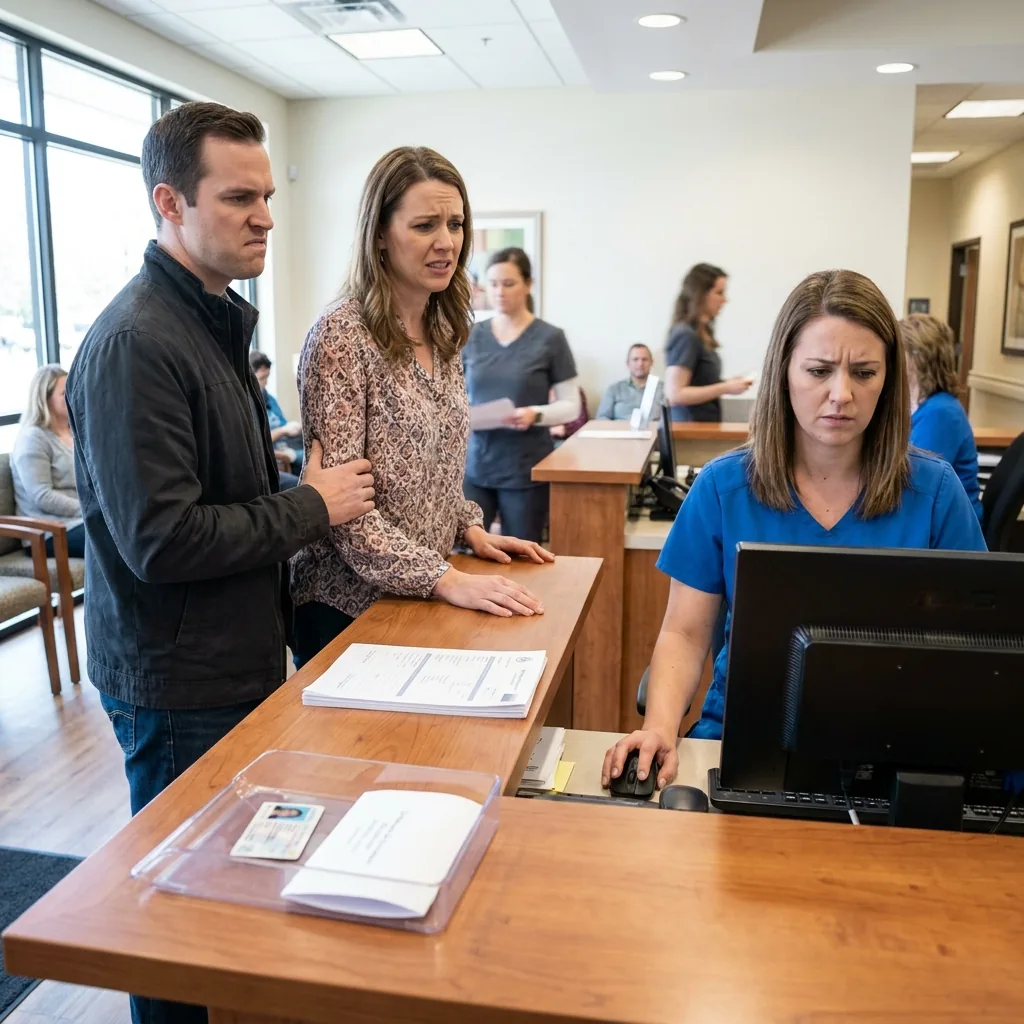
Dr. Neha Patel did not arrive in a rush. She came out of the administrative office with a badge clipped to a dark jacket and stopped at the counter only after Rachel handed her the embryo consent form packet, the tablet, and the short version of the sequence. Tina stood beside them. Melissa remained a few steps back. Emily stayed where Rachel had told her to stay, just inside the waiting area, close enough to hear every word. Derek stayed at the counter edge with one hand flat on the laminate.
Dr. Patel did not start with opinion. She started with the chart.
“Read me the order,” she said.
Rachel did. Inbound call at 4:31 to front office. Spouse portal access at 4:36 to the consent section. Intake-line contact at 4:39. Hold note entered at 4:42. No matching clinical callback to Derek before the note. No exception handoff on batch prep. Consent packet scanned at 4:58 through front office auxiliary, not the normal nurse coordination path. Emily called with active instructions at 5:03. Portal instructions sent at 6:11. Morning treatment packet printed at 6:26.
Dr. Patel took the paper packet from Rachel and checked the scanner header herself. Then she looked at Tina.
“Can a partner direct front office to place or validate an embryo-related hold outside documented consent review?”
“No,” Tina said.
She looked at Rachel. “Can nurse coordination proceed on unsupported partner instruction when the charted pathway does not match?”
“No.”
Then she looked at Derek.
“Can you show me a documented clinic authorization matching the hold sequence you claimed at check-in?”
Derek said, “I spoke to your staff.”
“That is not a document.”
“I was trying to stop something before it went wrong.”
Dr. Patel kept her voice even. “The issue here is not your phrasing. The issue is that a hold appeared before the supporting consent object entered the queue, after linked spouse portal access, and before any valid handoff. Then the packet was physically routed in a way that made the chart look more complete than it was. That is interference with clinic process around embryo handling.”
Derek opened his mouth again, but she did not pause for it.
“Effective now, spouse-level portal access on Emily Harper’s account is suspended pending compliance review. Front office will remove shared communication permissions. Nurse coordination will communicate only with the patient directly unless and until written authorization is re-established under review. Add a chart restriction note: no treatment-direction changes accepted from Derek Harper by phone, counter contact, or portal proxy access. All embryo-consent communication routes through documented patient verification and supervising staff only.”
Tina was already typing. Rachel was already entering the restriction note. The speed of it changed the room more than anyone raising their voice would have.
Derek turned toward Tina. “You can’t just lock me out.”
Tina kept her eyes on the screen. “Your portal proxy is being removed now.”
He looked at Rachel. “We are married.”
Rachel said, “The chart follows authorization and sequence, not insistence.”
Dr. Patel turned to Emily then, and for the first time the tone shifted by a degree, not into warmth, but into clarity.
“Mrs. Harper, today’s transfer cannot proceed on the original timeline,” she said. “The consent pathway was contaminated by contradictory handling. We will not move embryos under a broken sequence. My office will have nursing rebuild the file directly with you, and we will reschedule under restricted access.”
It was not a rescue speech. It was worse and better than that. The treatment was still delayed. The pressure at the counter still had a cost. But the route that had let Derek stand there and steer the morning was gone while they watched it happen.
Tina printed a one-page account update and placed it on the counter in front of Emily, not Derek. The top line read that spouse portal privileges were revoked pending review and that contact permissions had been changed to patient-only communication. Rachel clipped the embryo consent form packet behind a red administrative review cover instead of the routine transfer sleeve.
Derek reached toward the paper. Tina put her hand on it first.
“This copy is for the patient,” she said.
He drew his hand back. “So that’s it? You just believe her over me?”
Dr. Patel answered before anyone else could. “We believe the documented order of events.”
No one added anything to soften it.
Emily took the update sheet with both hands. Her folder, her phone, her water bottle, and the printed notice all fit awkwardly together, but she did not ask Derek to hold any of it. Rachel stepped out from behind the counter and said she would walk Emily to a consultation room for direct rescheduling and a fresh consent review path. Derek started to follow.
Tina said, “Sir, not past this point.”
He stopped because there was nowhere procedural left to push.
As Emily turned away from the counter, the waiting room noise came back in pieces: the printer, the phones, a chair leg on tile, somebody being called for bloodwork. The embryo consent form was no longer a tool he could wave around in public. It sat under a red cover in Rachel’s hands, locked inside the clinic’s version of final.
Emily went with Rachel toward the consultation hall while Tina finished removing the last shared contact line from the account. The hold that had blocked her that morning was still real, but now it belonged to the clinic instead of to him, and the difference showed in every closed screen.