Story code: ST-000546
Part 3: Rachel Rebuilds the Missing Step
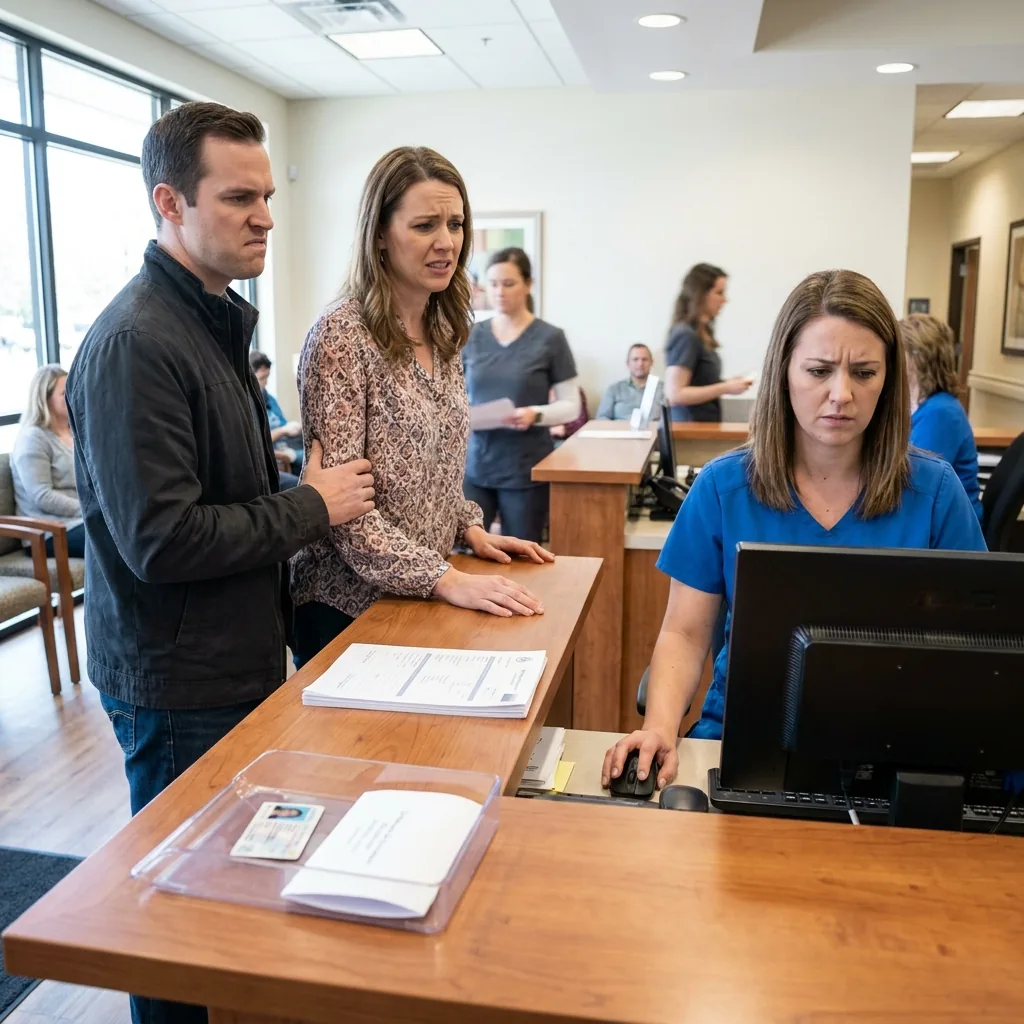
Rachel Kim did exactly what she said she was going to do. She took the embryo consent form packet from the front office counter, walked it back to nurse coordination, and started lining up every visible trace that touched it. Emily stayed in the waiting area beside the counter with her folder in her lap and her phone faceup. Derek remained standing for a minute, then sat, then stood again when Tina asked him not to follow staff past the badge door.
The clinic kept moving around them. Names were called. A printer started and stopped. Someone rolled a cart down the hallway toward lab. But Rachel’s reconstruction pulled the center of the room away from the normal morning flow.
Ten minutes later she came back with the packet, her tablet, and another staff member from the evening team who had already clocked in for the day. Tina cleared a small space at the counter. Rachel placed the paper packet flat between them like evidence and spoke in the same narrow tone she had used before.
“I need witnessable handoffs only,” she said. “No assumptions.”
She started with Tina. The front office batch packets had been dropped at the counter the night before in standard morning order, with no exception marker on Emily’s file. Tina repeated that and pointed to the routing sticker still attached to the outside sleeve. Rachel marked the time.
Then she turned to the evening staff member, a coordinator named Melissa, who had brought the stack forward before close. Melissa identified the sleeve by Emily’s label and the orange routing tab used for transfer-day charts. She said the packet had not come from her printer already flagged. It had come from the nurse coordination tray with routine prep papers behind the embryo consent form, including the printed itinerary Tina had already referenced.
Rachel asked one question at a time.
“When did you first see an exception note?”
Melissa said, “This morning. Not last night.”
“Did anyone stop you from batching this packet as active transfer flow?”
“No.”
“Did anyone pull this chart aside for contradictory consent review before close?”
“No.”
That tightened one side of the sequence. If the hold had been complete and real the way Derek kept presenting it, the packet should have broken out of routine movement before the front office ever got it.
Rachel set the tablet down and opened the portal audit. She angled it so Tina could confirm what she was seeing. Emily’s account showed the 6:11 p.m. instruction message, but it also showed something else: a portal login from Derek’s linked spouse access at 4:36 p.m., six minutes before the hold note was entered. Not a clinical message. Not a nurse response. Just account access and page views on the consent section.
Rachel looked up. “Mr. Harper, did you log into the portal at 4:36 yesterday?”
Derek answered without sitting down. “I have access to our account.”
“That is not what I asked.”
He paused, then said, “Yes.”
Rachel tapped once more. “At 4:39 there is a call from your phone to the direct fax-and-scan intake line. Twenty-one seconds. That line does not create chart notes. It only receives document traffic and routing questions.”
Derek said, “I was trying to get someone to correct the problem.”
Rachel did not respond to the explanation. She slid the paper packet half an inch and exposed the scanner cover sheet beneath the consent form. In the top corner was the standard machine header with received time 4:58 p.m. and origin marked as front office auxiliary scanner, not patient portal upload and not nurse station intake.
Tina frowned at that. “Front office auxiliary? We don’t scan consent packets from check-in unless somebody physically hands them to us.”
Rachel nodded. “Exactly.”
Now she rebuilt it in order, piece by piece, so no one could pretend the gap was still abstract.
Derek called the main line at 4:31. He logged into the spouse-access portal at 4:36 and viewed the consent section. He reached the scan intake line at 4:39. A hold note appeared in the chart at 4:42 without a matching scanned consent object, without a documented nurse callback to him, and without an exception handoff to front office batch prep. The actual embryo consent packet tied to today’s transfer did not hit the scanner queue until 4:58, and when it did, it came through the auxiliary front office scanner pathway, meaning someone had physically routed paper outside the normal nurse coordination sequence. Then nurse coordination still called Emily at 5:03 and sent active instructions at 6:11 because the treatment flow around the packet had not been reconciled.
Rachel lifted her eyes to Derek. “There is the missing event,” she said. “A hold was entered first. Then the packet was moved afterward to make it look supported.”
Nobody filled the silence.
Tina looked down at the machine header again. Melissa said quietly, “If front office auxiliary got this at 4:58, somebody walked it up after the note was already in.”
Rachel turned the packet over once more and stopped at a handwritten initial beside the routing line. Tina’s face changed before she spoke.
“That isn’t mine,” she said. “And it isn’t Melissa’s.”
Rachel did not raise her voice. “Whoever added this tried to create a paper trail after the hold. Mr. Harper, you were not authorized to direct staff workflow, route embryo consent materials, or generate a stop through the chart by pressure at the desk or phone.”
Derek stepped toward the counter. “You’re making this sound like I did something to your system.”
Rachel answered, “I am saying your version depends on a sequence the system does not support.”
Then she picked up the packet, looked at Tina, and said the sentence that pushed everything into the last stage.
“Get Dr. Patel. We have a reconstructed interference event tied to embryo consent handling and linked spouse access on an active transfer chart.”