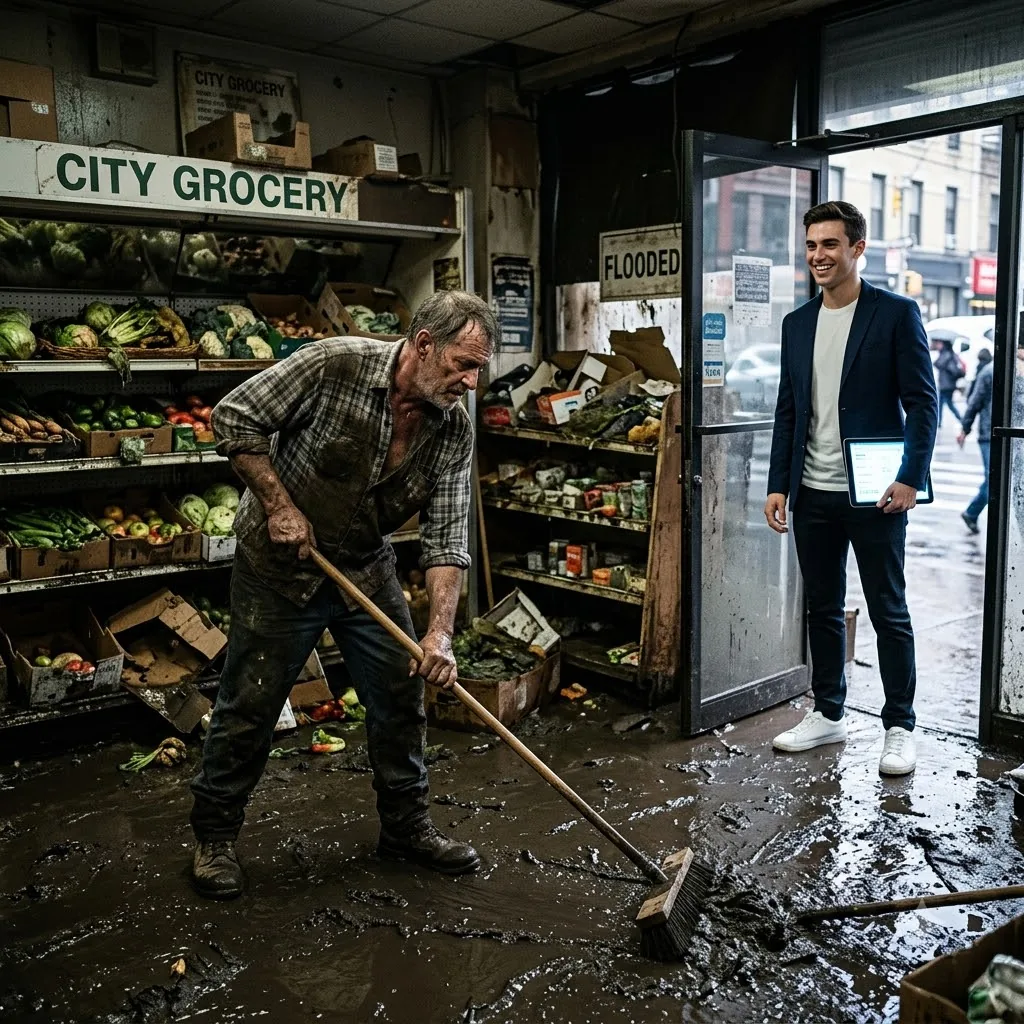
Story code: ST-000891
Part 2: The Casualty Clause
“NOTICE OF LEASE TERMINATION,” the bold text screamed from the crisp, illuminated screen. Beneath it, a smaller, equally devastating line read: “CASUALTY AND DESTRUCTION OF PREMISES.”
Mateo’s heavy rubber boots felt as if they were sinking straight through the warped linoleum and into the bedrock of the city. He blinked, a drop of dirty, stinging sweat rolling into his left eye, desperately hoping the aggressive block letters would magically rearrange themselves into the commercial insurance forms he had been promised. They did not change. The stark black text remained fixed against the glaring white background of the PDF, sharp and uncompromising.
“Section eight, clause C of your original commercial agreement,” Bryce said, his voice entirely too bright and melodic for a room that smelled like a mass grave for fermented produce and spoiled dairy. The landlord used the side of his expensive digital stylus to tap a densely packed paragraph halfway down the glowing screen. “In the event of a catastrophic casualty where structural damage exceeds fifty percent of the total property value, the lessor retains the unilateral right to immediately dissolve the tenancy.”
Mateo stared blankly at the tablet. The rushing sound of blood in his ears briefly drowned out the hum of the city traffic outside the shattered storefront. “Dissolve,” Mateo repeated, his voice sounding hollow, scraping against his exhausted throat. “You’re terminating our lease? We have three years left.”
“The flood terminated the lease, Mateo,” Bryce corrected gently, offering a sympathetic, tight-lipped smile that didn’t reach his cold, calculating eyes. He casually adjusted his grip on the tablet, stepping back slightly to ensure the edge of the device didn’t accidentally brush against Mateo’s mud-caked flannel shirt. “I’m just executing the necessary paperwork. Honestly, it’s a massive relief for you and your parents. Rebuilding a low-margin retail operation in a heavily water-damaged unit? The debt would ruin your family. This way, you can just walk away. It’s a clean break.”
“Walk away?” Mateo’s grip tightened on the wooden broom handle until his knuckles turned a mottled, bloodless white. He looked around the cavernous, stinking room. His parents had sacrificed their youth to this exact square footage. They had worked fourteen-hour shifts, seven days a week, standing behind the deli counter until their knees gave out, just to put Mateo through night classes. His mother had extended a line of credit to half the neighborhood when times were tough. This wasn’t a low-margin retail operation to them. It was their entire life. “My parents aren’t walking away. We called the commercial structural engineers yesterday. The foundation is completely solid. We just need the state disaster relief funds to replace the drywall and buy new compressors.”
Bryce sighed, a performative, exaggerated sound of disappointment, acting as if he were explaining basic fractions to a stubborn child. He swiped his thumb flawlessly across the screen, turning to the second page of the dense legal document. “That’s the fundamental misunderstanding we really need to clear up today. The state disaster relief funds are strictly designated for property rehabilitation. I am the property owner. Your family merely rented the airspace inside it.”
“The adjuster said the relief check was joint,” Mateo argued, his chest tightening with a new, sharper panic that pushed through his physical exhaustion. “He sat right there on a milk crate and told my father the state issues the emergency payout jointly, specifically so the tenants can replace ruined inventory and fixtures.”
“And the adjuster was absolutely correct,” Bryce said smoothly, reaching his free hand into the pocket of his crisp, dry chinos. He pulled out a folded piece of heavy stock paper and flicked it open with a snap of his wrist. It was a physical check, printed with the official watermarked seal of the state emergency management agency.
Mateo’s eyes immediately locked onto the bold numbers printed on the right side. It was enough. It was more than enough to rent the massive commercial dumpsters, buy three new industrial refrigerators, and entirely restock the front shelves.
“The state issued this joint disbursement this morning,” Bryce explained, holding the paper just out of Mateo’s reach. “Both our names are on it, which means neither of us can deposit it into a bank without the other party’s legal signature.”
Mateo reached out, his mud-stained fingers trembling with a mix of fury and relief, but Bryce smoothly folded the check back in half and slid it deep into his pocket.
“However,” Bryce continued, his cheerful demeanor finally hardening into a sharp, uncompromising businesslike edge. “Because I am exercising my legal right to terminate the lease due to the total casualty of the premises, you are officially no longer a tenant here. You have no legal claim to rehabilitate this space. I already have a commercial architecture firm drafting plans to gut the entire block. We’re pivoting to a high-end, fast-casual artisan concept. Exposed brick, natural wine, small plates. The neighborhood demographics have shifted, Mateo. You have to see that.”
The heavy stone in Mateo’s gut dropped into a bottomless abyss. The blank canvas. That was why Bryce was smiling at the toxic mud and the destroyed inventory. The flood had done his dirty work for him. Bryce hadn’t been able to legally evict them because their thirty-year lease was practically ironclad, locked in at a neighborhood rent control rate from two decades ago. The toxic river water had provided the ultimate, unbreakable loophole. It had destroyed the store just enough to trigger the casualty clause, allowing Bryce to legally wipe them out and gentrify the building without buying them out.
“You’re stealing our disaster money to build a wine bar,” Mateo said, his voice dropping to a low, dangerous register.
“I am reclaiming my property,” Bryce countered effortlessly, completely unfazed by Mateo’s brewing anger. He tapped the tablet screen again, bringing up a flashing signature line at the bottom of the PDF. “But I am also a reasonable man. I know you need capital to deal with this unfortunate transition.” He gestured vaguely at the rotting, sludge-covered mountains of cardboard boxes. “The biological hazard in here violates multiple city health codes. If this rotting food isn’t removed in forty-eight hours, the city will red-tag the property, and I will personally sue your family for the cost of the hazardous waste mitigation.”
Mateo stared at the floating, spoiled milk crate gently bumping against a submerged metal shelf. The commercial dumpsters alone would cost four thousand dollars-money his parents simply did not have in their currently drained savings accounts.
“Here is my offer,” Bryce said, holding out the tablet and extending the silver digital stylus toward Mateo’s chest. “Sign this surrender agreement. It officially terminates the lease and waives your right to the standard thirty-day eviction notice. You agree to clear out the biological waste and vacate the premises entirely by Friday at noon. In exchange, I will endorse the state relief check, take my legal portion for the property damage, and allow you to keep the remaining twenty percent to cover your inventory loss and the immediate cost of the dumpsters.”
Mateo didn’t move. He looked from the gleaming silver stylus to Bryce’s perfectly white, expectant smile.
“If you refuse to sign right now,” Bryce added, his cheerful voice dropping all pretense of friendliness, “I won’t endorse the check at all. The funds will sit frozen in escrow for years while we fight in court. You won’t have a dime to pay for the waste removal, the health department will fine your parents into personal bankruptcy by next Tuesday, and you’ll still lose the store. The choice is yours, Mateo.”