Story code: ST-000852
Part 2: The Basket Kept Telling on Him
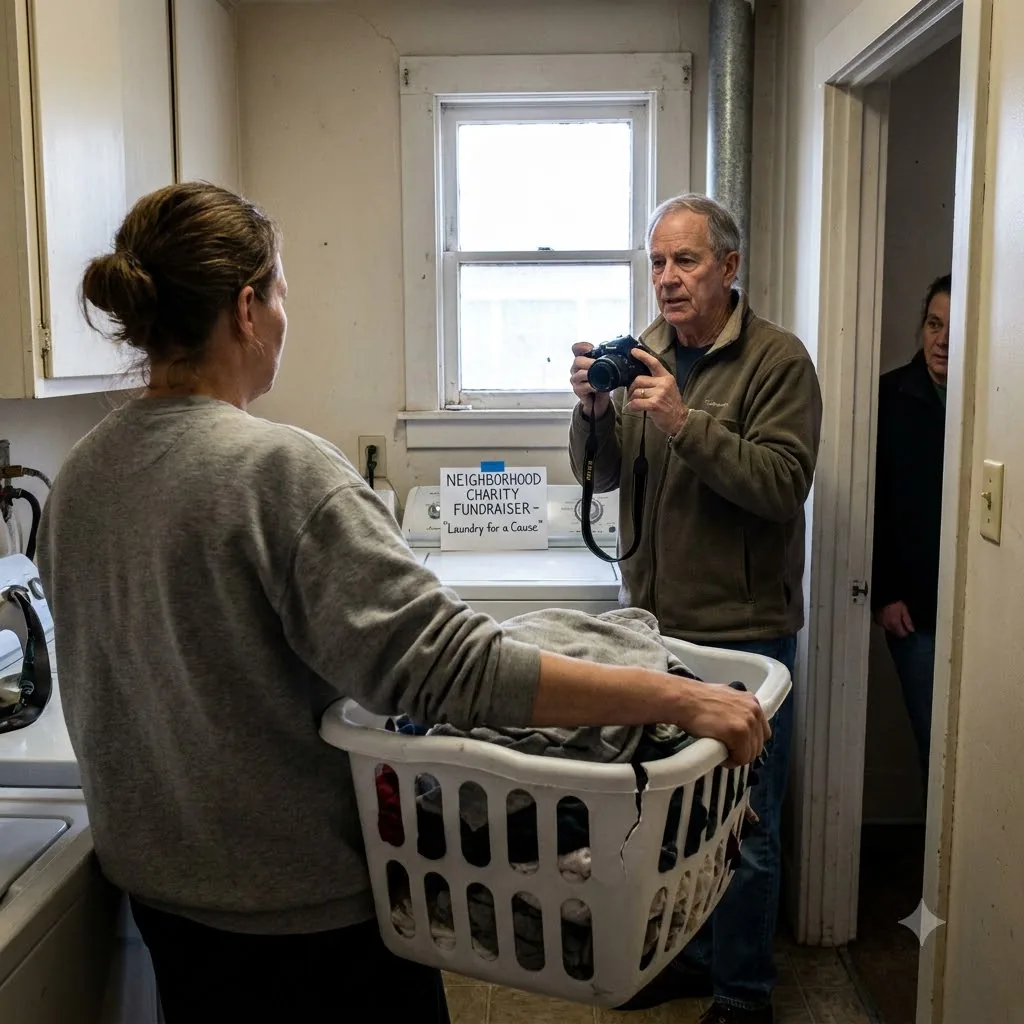
By the time the first volunteer car pulled up near the curb, the problem was no longer just that Graham Pike had touched Nora Delgado’s laundry basket. It was that every move he made after that had to agree with the story he was already telling, and the basket kept showing where the story did not line up. Once Tasha heard him say Nora needed to “seem surprised,” every little adjustment in the duplex started looking less like help and more like staging. The utility nook sat halfway between private routine and public view. From the shared side walkway, you could see the washer lid, the folded card table, and the basket near the open door. From the front steps, with a phone angled just right, you could catch all of it and still call it spontaneous. Eli Mercer arrived with the ring light and phone clamp under one arm and a roll of extension cord dragging behind him. He was young, focused, and speaking in short setup sentences. “Graham said donor drop-in first, then the stream, then the handoff shot,” he said to nobody in particular. That wording mattered too. Handoff shot. Not laundry. Not tenant use. Not a real interruption. Something planned. Nora stood with one hand on the washer lid and watched Graham slide into his public version of himself. He came around the front of the card table smiling, carrying a case of bottled water he did not need to carry at that exact moment, and started giving directions while looking past people instead of at them. “If we keep the ring light near the steps, we can still catch the side entry,” he told Eli. “I want the duplex to feel lived in. Nora may come through with her basket, and we can show how practical support matters here.” Nora answered before Eli could. “May? That’s my basket. It’s already here because I’m doing laundry.” Eli glanced at the basket, then at Graham. “Oh. I thought we were bringing donation supplies through there.” Graham gave a short laugh. “Same idea. We just want authentic movement.” Tasha had come back up the walkway, this time without pretending she was just passing through. She leaned one shoulder against the wall near the dryer and looked straight at the basket. The cracked handle was visible now because somebody had turned it back halfway during the shuffle. The blue bath towel still hung over the rim, but the corner had slipped, exposing the mesh bag of socks tucked below. It looked exactly like what it was: a tenant’s laundry waiting to be washed, not a symbol of landlord generosity. Graham saw that too. He crossed the space, pinched the towel corner, and spread it wider with two fingers. “Let’s neaten this up,” he said. Nora said, “Stop arranging my things.” He did not step back this time. He kept his hand on the towel one beat too long, then withdrew it slowly because Eli was close enough to notice. Eli shifted the ring light box to his other hip. “Do you want the basket in the frame or not?” Eli asked. That should have been an easy question. If the basket happened to be there naturally, nobody would need to discuss it. But Graham answered like a man trying to patch over two versions at once. “Not in the frame exactly,” he said. “Adjacent. Enough to show context.” Tasha let out one dry breath that was not quite a laugh. Marlene Cho arrived a few minutes later in a tan blazer with a slim folder under her arm, donor neat without looking formal. She greeted Graham, then Eli, then the tenants. Her attention moved the way some people’s does at public events: not to the biggest gesture first, but to who had been placed where. Graham started in immediately. “Marlene, this is exactly the kind of real-need moment I mentioned. Nora was managing laundry, and we’ve been helping coordinate around that while getting the supply drive ready.” Nora stayed still. Tasha looked at the basket, not at Graham. Marlene’s eyes followed Tasha’s line of sight. She took in the washer running, the basket by the open side door, the towel smoothed too carefully over clothes that were obviously personal, and Graham standing nearest all of it as if he had to guard the arrangement. “Coordinate around what?” Marlene asked. Graham answered quickly. “Space. Timing. Accessibility. The usual.” But the setup itself had begun to argue back. If he was merely giving a tenant space, why was her basket posed near the walkway instead of by the machine? If this was ordinary, why had Eli been told to capture the side entry? If Nora had simply walked into a helpful moment, why did everyone keep hearing instructions about where she would stand? Eli set the ring light down and looked from the front steps to the utility nook. “If she’s actually doing laundry, the cleanest shot is just to keep the nook clear and stream from the curb,” he said. “Otherwise it looks staged.” Nobody answered him for a beat. Graham moved first, too fast, reaching for the basket handle with the practiced ease of somebody trying to restore his own version of events through motion alone. The cracked side caught against his palm. The basket tipped, rocked, and thudded back against the dryer with the towel sliding off the rim and the mesh sock bag spilling into plain view. “I said leave it,” Nora said. The washer kept running. Water thumped behind the lid. Tasha straightened from the wall. Then she said, in the same practical tone she used to ask for dryer sheets, “That’s not what you said on the phone. You said to leave the basket where it was and bring her out once Marlene got here.” No one raised their voice. No one had to. Eli’s hand stopped on the ring light stand. Marlene looked at Graham, then at Nora, then back at the basket still.