Story code: ST-000852
Part 3: He Could Not Stop Directing the Lie
After Tasha repeated Graham Pike’s phone instruction out loud, nobody rushed to rescue him. That was the part that changed the pressure. The stream had not even started yet, but the fundraiser scene had already turned into the kind of public setup where every next motion counted.
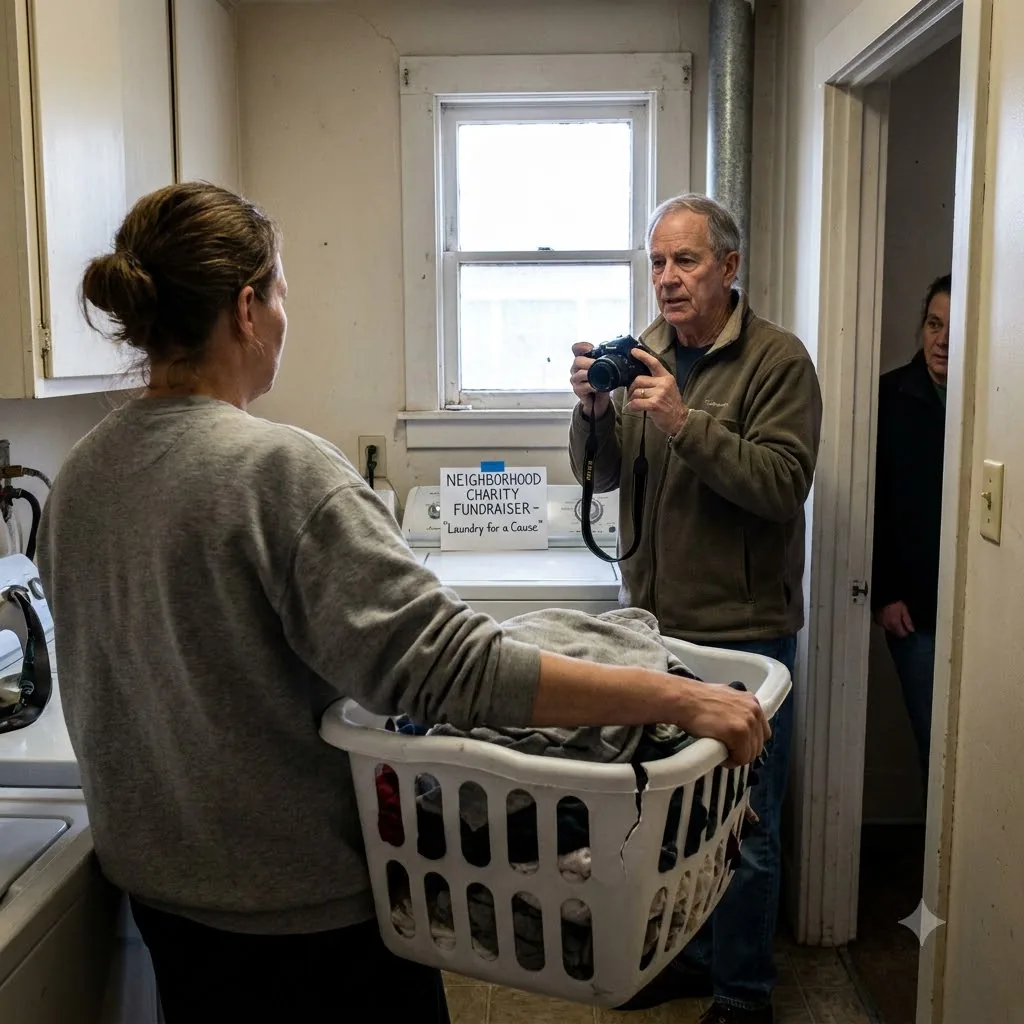
Graham kept one hand near the basket rim without touching it. The white plastic side still leaned against the dryer. The blue towel had slipped low enough to show the mesh bag of socks. The cracked handle faced outward now, easy for anyone standing in the walkway to see.
“You’re mixing up what you heard,” Graham said to Tasha. His voice came out level, but too quick. “I was talking about keeping traffic clear before Marlene came through.”
Tasha did not move from the wall. “You said bring Nora out once Marlene got here.”
Eli looked from Tasha to the basket, then to the phone clamp still boxed under his arm. “Do we need to reset this?” he asked. He was speaking to Graham, but the question hung over the whole scene.
Marlene answered before Graham did. “I need to understand what is being shown before anything goes live.”
That sentence forced the story back onto visible facts. Nobody had to argue about character. The utility nook itself was enough. The washer was running. Nora’s detergent cap still sat on top of the machine. The basket was not where a person using it would normally keep it. The landlord was the one closest to it, the one who had been correcting how it looked.
Nora spoke in the same controlled tone she had used from the start. “I brought it down to do laundry. I left for detergent. When I came back, he had rotated it, pulled it toward the side door, and told me to stay quiet for ten minutes so he could make this look nice.”
Graham turned toward Marlene with a short open-palmed gesture, the kind he had been using all week on the front steps. “I said we’d highlight real tenant needs. That’s not the same as coercing anyone.”
“Then why hide the socks?” Eli asked.
It was a small question, but it landed cleanly because the mesh bag was sitting in plain view now. Graham looked at the basket and then away from it. “Because clutter reads poorly on camera,” he said.
Marlene’s eyes stayed on him. “So this was camera management.”
“It’s a fundraiser,” he said. “Of course it’s camera management.”
That answer might have worked if the basket had been a donation prop or a stack of supplies. Instead it was Nora’s laundry, halfway through an ordinary chore, with a towel smoothed by someone else’s hand.
Eli finally set the ring light box on the card table. “I’m not putting a tenant in frame if she says no,” he said. “We can stream from the curb with the supplies only.”
Graham shifted immediately. “Nobody asked for drama. Nora, just carry it through once and then take it back. We lose thirty seconds, that’s it.”
There it was again: instruction first, ownership second. He had moved from saying the basket happened to be there to saying she should carry it through for the shot. The two versions could not sit together anymore.
Nora did not touch the basket. “So now you do want it in frame.”
He looked at her, then at Marlene, then toward Eli’s boxed phone clamp as if the order of witnesses might change the answer. “I want a normal moment,” he said.
Tasha pushed off the wall and pointed, not at Graham, but at the basket handle. “Normal would have left that crack facing the dryer, because that’s how she keeps it from catching her sleeve when she walks in. You turned it out when she was gone.”
That detail tightened the whole chain. It was not just that the basket had moved. It was how it had moved, by someone who wanted the cleaner side facing out and did not know the practical reason it was usually turned in.
Marlene took one step closer to the utility nook, careful not to crowd Nora. “Eli, don’t start the stream yet,” she said. Then to Graham: “If your donor message depends on arranging a tenant’s laundry and prompting her reaction, we are not using that framing.”
He tried to recover the event by reaching for logistics. He picked up a flyer, set it down, then lifted the ring light box as if repositioning equipment could flatten what had just been said. “Fine,” he said. “We’ll move outside. Everyone’s making this bigger than it is.”
But he still needed the image. That much had become visible in the way he kept circling back to the basket with his eyes. The front steps were already dressed for the fundraiser. The curbside table was stacked. Donors would arrive expecting the tidy story he had been promising.
Then he made the mistake that locked Part 4 into place.
He turned to Eli and said, with Marlene and both tenants still standing there, “Set the phone by the steps. I’ll carry the basket out myself and explain that we’re making room for Nora. It’ll read cleaner that way.”
Nobody interrupted him this time. He had just said, in front of all of them, that he would complete the exact act he had spent the last ten minutes pretending had never been planned.