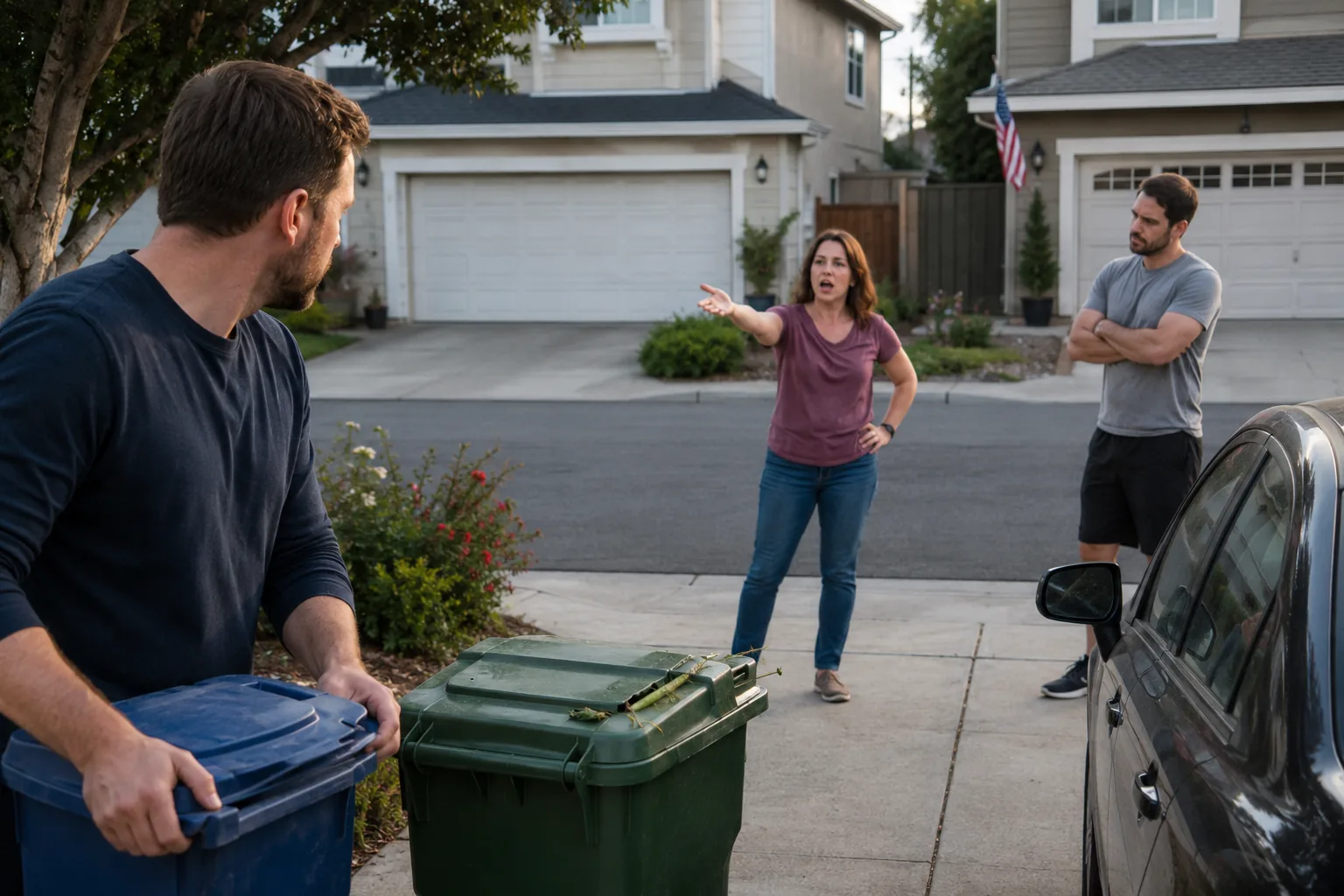
Story code: ST-000004
Part 4: I Let the Space Tell the Truth
When I opened the door, Derek said, “Why’d they take yours and not mine?”
Not hello. Not any version of the story he had been telling other people. Just that.
I stayed behind the screen door. “Because mine was in the pickup zone.”
He frowned. “It is in the pickup zone.”
“No,” I said. “It isn’t.”
He turned and looked back down the driveway, then back at me. “It’s where they always go.”
“It’s where you put it when mine already shows you where to put it.”
He opened his mouth, shut it, and then said, “Can you just show me?”
That was the cleanest moment in the whole thing. No audience. No joke. No borrowed ownership. Just the exact question he had spent weeks hiding inside other people’s assumptions.
I said, “No.”
He stared at me through the screen, one hand still wrapped around his bin handle. “You’re being ridiculous.”
“Maybe,” I said. “But I’m done running your side for free.”
I closed the inside door and left him there.
Through the kitchen window I watched him try three different positions. He edged the recycling closer to the curb, then too far into the gutter, then back at an angle that left the wheels crooked. The truck did not come back for it. Around four, he dragged it up again without looking toward my house.
The next week was the one that ended it.
I put my own system on a tighter schedule. Monday night, I wheeled my bins from the garage-side area through my latched gate to the front walk, then down to the curb from there instead of using the shared strip near his side. It took me an extra minute and a half. I timed it. Worth it.
The gate stayed shut. The wheel stops kept my bins tight inside the garage edge. The shelf with straps and bags stayed out of his reach. There was no reason for his boxes to appear by my recycling, no reason for his lid to be leaning against my wall, no reason for him to stand over my row and act like he was managing it.
He tested it anyway.
On Tuesday evening I came home and found one flattened box propped against my gate. Not inside. Just there, like a question. I picked it up, walked it across the driveway, and set it against his garage door.
The next morning his trash bin was parked partly over the line where the driveway split. Not blocking me enough to start a fight, just enough to make me stop the car, get out, and move it if I wanted to leave cleanly.
I backed out, put the car in park, stepped out, and rolled his bin straight back onto his side. Then I drove away.
When I got home, there was a bright orange city tag hanging from his handle.
OVERFILLED / LID MUST CLOSE / PLACE AT CURB CORRECTLY.
I stood there and read it twice, not because it was complicated, but because of how ordinary it was. No speech. No witness statement. No showdown. Just a printed tag swinging from the bin he had been using as a costume.
Derek came out while I was unloading groceries. He saw me looking at the tag and pulled the bin closer to his leg.
“They’ve gotten picky,” he said.
“Maybe,” I said.
He waited, like he wanted more from me than that. A trick. A tip. A rescue. The old handoff.
I lifted a grocery bag and went inside.
After that, the change was visible because it was so plain.
His bins stopped appearing near my garage-side area. His cardboard stayed stacked by his own wall until he broke it down properly or drove it somewhere else. On pickup mornings he moved his cans later than I moved mine, and sometimes he got it wrong. Once his yard-waste bin sat out an extra day with the lid tipped back after a rain. Once his trash can stayed too close to the mailbox and got skipped until he corrected it. Nobody made a public event out of any of it. People just saw what they saw.
A few days later Tina caught me while I was wiping down my recycling handle.
She nodded toward Derek’s side, where one loose bag had slumped against his overfull can. “I guess I had that backward before.”
I kept wiping. “Seems like it.”
She gave a small, awkward smile. “Yours always did look different.”
That was as close to a correction as I needed.
The real payoff came in the quiet. My gate stayed latched. My bins stayed in their marked spots. My side of the driveway stopped being a place he could step into and borrow a finished picture from. If he wanted his row to look right, he had to do every part himself, starting before anybody was there to clap for it.
He never knocked to ask again.
We still live next door. We still share the first stretch of concrete. But now the line is visible in a way it was not before. His bins stand where he puts them. Mine move through a route he cannot use. The story he had been telling with my work has nowhere to stand anymore.
And every Tuesday night, when I latch the gate after rolling my bins into place, the click sounds better than any apology would have.