Story code: ST-000020
Part 1: He Said I Owed Him for My Own Kitchen
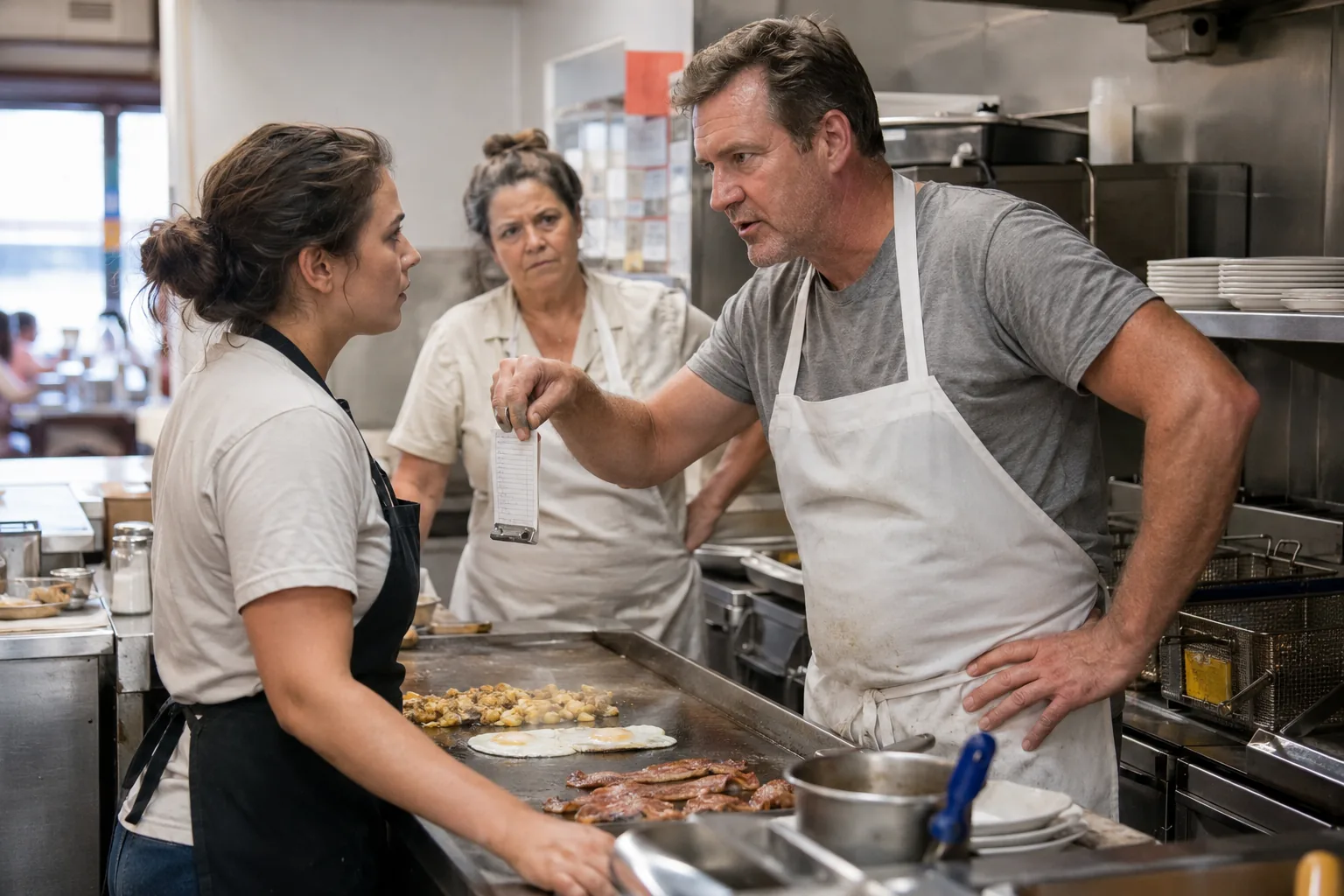
Gordon Pike stood beside my grill during the breakfast rush, one hand on our clipped prep list, and started reciting every favor he had ever done for my family like he was reading charges in court. While bacon popped and DeShawn called for more sliced tomatoes, Gordon said I needed to stop acting like the diner was mine alone because I was already operating on money I owed him. The shock wasn’t that he said it out loud. The shock was that he said it in my kitchen, in front of my line, like the stained prep sheet clipped by the pass was somehow proof against me instead of the one thing I still trusted.
I kept flipping eggs because ticket times do not care if somebody is trying to rewrite your life.
“You don’t need to do this right now,” I said.
Gordon gave me that low, careful voice he used when he wanted to sound reasonable in front of other people. “Right now is exactly when I need to do it, Nina. Every time this place got in trouble, I stepped in. Food costs. Emergency runs. Payroll gaps. Covered prep when you were buried. At some point a favor becomes an obligation.”
He tapped the prep list with two fingers.
That list hung from a bulldog clip beside the expo window every day. I wrote the daypart at the top, then proteins, produce, soups, backup substitutions, rush notes, who prepped what, what got eighty-sixed, and what we had to stretch. Grease pencil marks from the cooler sometimes ended up copied onto it. DeShawn added short notes when I was on the flat top. Rosa would glance at it from the coffee station and ask what needed to be cut thinner or pushed later. It was the most ordinary object in the diner until Gordon started touching it like it belonged to him.
Rosa came through the pass with two plates of over-easy eggs and saw his hand there. “Not during service,” she said.
Gordon didn’t move. “I have been patient during service, after service, before service, and every time there was a problem. I am not asking for gratitude anymore. I am asking for acknowledgment.”
There were six tickets hanging, hash browns burning at the edge, and a delivery box of onions still half-open by dry storage because nobody had time to break it down. It was regular diner chaos, except now every clang felt like it was giving him cover.
“Acknowledgment of what?” I asked.
“That this place stayed open because I kept catching you when you fell.”
DeShawn slid a pan of home fries over without looking at Gordon. “Need these walked?”
“Yeah,” I said.
Gordon watched that exchange and smiled like he was indulging children. “See? Even now. Everybody moves because I made sure there was enough product to move.”
That got Rosa to stop cold at the pass. “Enough,” she said.
But she said it the way people say enough when they want to get through the next twenty minutes, not the way they say it when something is finished.
Gordon turned toward her. “Rosa, I am not your enemy. When the fryer oil bill hit, who covered the gap? When your produce order got cut short, who brought cases over? When Nina was drowning on a Saturday and needed another set of hands in back, who stepped in?”
He said each one like a bead on a rosary.
The ugly part was that none of those things were fully made up. He had shown up with oil once. He had brought boxes in. He had taken an apron off the hook and worked the cold side during two ugly rushes. He had also started reminding us of those moments more often than the moments themselves had lasted.
I scraped the grill clean and looked at him. “Helping in an emergency is not the same as me agreeing to owe you personally.”
His face didn’t change. “No, Nina. You agreed when you kept accepting it.”
That landed harder than I wanted it to because it was designed to. Gordon never shouted. He laid words down softly and let everybody else hear the accusation for him.
Rosa set the plates down too hard and yolk slid toward the rim. “We are not doing family business in front of staff.”
“Silent partner business,” Gordon said. “Since that title seems to matter only when bills are due.”
He reached for the prep list again and read the top section aloud. “Turkey club prep doubled. Soup extended with extra stock. Bacon split between breakfast and lunch pull. This is exactly what I am talking about. Every time I filled a hole, it saved this kitchen.”
Something in the way he said it made me look at the page instead of at him.
Today’s list had my handwriting, DeShawn’s square block letters, and one older notation I had circled two nights ago: USE LAST CASE ROMAINE FOR LUNCH / SUB CABBAGE MIX FOR SIDE PREP. Under that, in grease pencil transfer, was another note from a week earlier that I had copied over before tossing the cooler sheet: GORDON TO DROP CHICKEN? NO SHOW BY 5:10 / CUT MENU.
I stared at it for half a second too long.
Gordon was still talking. “I am done pretending this was charity. If I have to keep carrying this place, then we need to settle what you owe me and what authority comes with that.”
What authority comes with that.
He said it beside my stove, while I was the one covering the line, while DeShawn was the one marking substitutions, while Rosa was the one carrying plates and coffee because we were short on a server again.
I pulled the prep list off the clip before he could touch it again. “You don’t get to turn help into ownership after the fact.”
His eyes dropped to the paper in my hand. “Then you better prove that’s what I did.”
I looked back at the page, at all the scratched-out items and replacement notes and little survival decisions we made every shift, and for the first time I had the hard, ugly sense that the same list he was using to corner me might show something else entirely.
Because one of the favors he had just claimed as rescue was sitting right there in my own handwriting as a shortage he caused us to absorb.
Gordon Pike stood beside my grill during the breakfast rush, one hand on our clipped prep list, and started reciting every favor he had ever done for my family like he was reading charges in court. While bacon popped and DeShawn called for more sliced tomatoes, Gordon said I needed to stop acting like the diner was mine alone because I was already operating on money I owed him. The shock wasn’t that he said it out loud. The shock was that he said it in my kitchen, in front of my line, like the stained prep sheet clipped by the pass was somehow proof against me instead of the one thing I still trusted.
I kept flipping eggs because ticket times do not care if somebody is trying to rewrite your life.
“You don’t need to do this right now,” I said.
Gordon gave me that low, careful voice he used when he wanted to sound reasonable in front of other people. “Right now is exactly when I need to do it, Nina. Every time this place got in trouble, I stepped in. Food costs. Emergency runs. Payroll gaps. Covered prep when you were buried. At some point a favor becomes an obligation.”
He tapped the prep list with two fingers.
That list hung from a bulldog clip beside the expo window every day. I wrote the daypart at the top, then proteins, produce, soups, backup substitutions, rush notes, who prepped what, what got eighty-sixed, and what we had to stretch. Grease pencil marks from the cooler sometimes ended up copied onto it. DeShawn added short notes when I was on the flat top. Rosa would glance at it from the coffee station and ask what needed to be cut thinner or pushed later. It was the most ordinary object in the diner until Gordon started touching it like it belonged to him.
Rosa came through the pass with two plates of over-easy eggs and saw his hand there. “Not during service,” she said.
Gordon didn’t move. “I have been patient during service, after service, before service, and every time there was a problem. I am not asking for gratitude anymore. I am asking for acknowledgment.”
There were six tickets hanging, hash browns burning at the edge, and a delivery box of onions still half-open by dry storage because nobody had time to break it down. It was regular diner chaos, except now every clang felt like it was giving him cover.
“Acknowledgment of what?” I asked.
“That this place stayed open because I kept catching you when you fell.”
DeShawn slid a pan of home fries over without looking at Gordon. “Need these walked?”
“Yeah,” I said.
Gordon watched that exchange and smiled like he was indulging children. “See? Even now. Everybody moves because I made sure there was enough product to move.”
That got Rosa to stop cold at the pass. “Enough,” she said.
But she said it the way people say enough when they want to get through the next twenty minutes, not the way they say it when something is finished.
Gordon turned toward her. “Rosa, I am not your enemy. When the fryer oil bill hit, who covered the gap? When your produce order got cut short, who brought cases over? When Nina was drowning on a Saturday and needed another set of hands in back, who stepped in?”
He said each one like a bead on a rosary.
The ugly part was that none of those things were fully made up. He had shown up with oil once. He had brought boxes in. He had taken an apron off the hook and worked the cold side during two ugly rushes. He had also started reminding us of those moments more often than the moments themselves had lasted.
I scraped the grill clean and looked at him. “Helping in an emergency is not the same as me agreeing to owe you personally.”
His face didn’t change. “No, Nina. You agreed when you kept accepting it.”
That landed harder than I wanted it to because it was designed to. Gordon never shouted. He laid words down softly and let everybody else hear the accusation for him.
Rosa set the plates down too hard and yolk slid toward the rim. “We are not doing family business in front of staff.”
“Silent partner business,” Gordon said. “Since that title seems to matter only when bills are due.”
He reached for the prep list again and read the top section aloud. “Turkey club prep doubled. Soup extended with extra stock. Bacon split between breakfast and lunch pull. This is exactly what I am talking about. Every time I filled a hole, it saved this kitchen.”
Something in the way he said it made me look at the page instead of at him.
Today’s list had my handwriting, DeShawn’s square block letters, and one older notation I had circled two nights ago: USE LAST CASE ROMAINE FOR LUNCH / SUB CABBAGE MIX FOR SIDE PREP. Under that, in grease pencil transfer, was another note from a week earlier that I had copied over before tossing the cooler sheet: GORDON TO DROP CHICKEN? NO SHOW BY 5:10 / CUT MENU.
I stared at it for half a second too long.
Gordon was still talking. “I am done pretending this was charity. If I have to keep carrying this place, then we need to settle what you owe me and what authority comes with that.”
What authority comes with that.
He said it beside my stove, while I was the one covering the line, while DeShawn was the one marking substitutions, while Rosa was the one carrying plates and coffee because we were short on a server again.
I pulled the prep list off the clip before he could touch it again. “You don’t get to turn help into ownership after the fact.”
His eyes dropped to the paper in my hand. “Then you better prove that’s what I did.”
I looked back at the page, at all the scratched-out items and replacement notes and little survival decisions we made every shift, and for the first time I had the hard, ugly sense that the same list he was using to corner me might show something else entirely.
Because one of the favors he had just claimed as rescue was sitting right there in my own handwriting as a shortage he caused us to absorb.