Story code: ST-000020
Part 2: The List Started Arguing With Him
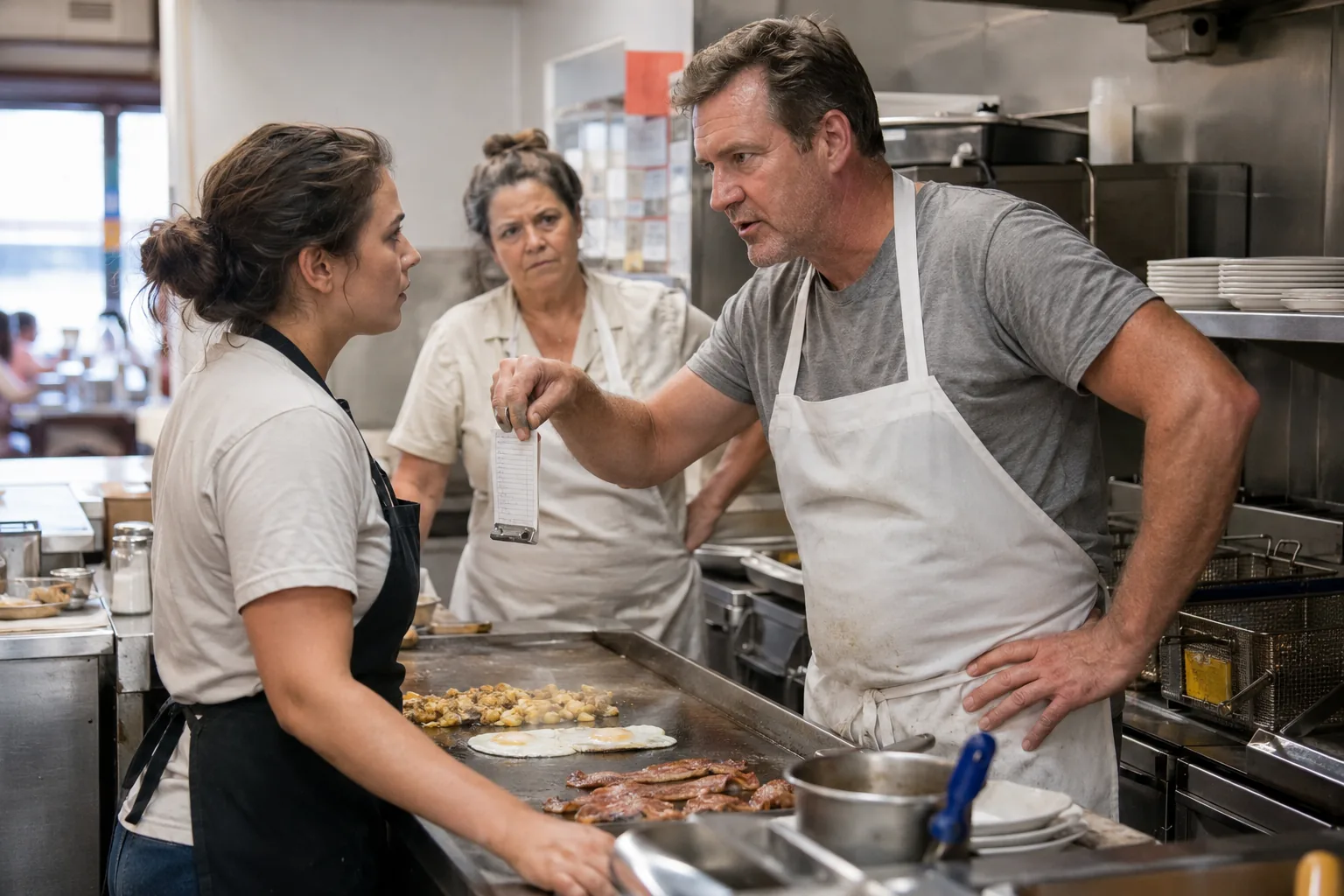
After Gordon said I better prove it, he walked out to the dining room like he’d just finished a normal conversation. I stayed on the line with the prep list folded once in my apron pocket, feeling the paper knock against my thigh every time I turned from grill to pass. He had made his point in front of Rosa and DeShawn: not just that he had helped us, but that he meant to count every bit of help as a debt I had chosen.
Breakfast did what breakfast always does. It kept coming.
DeShawn dropped a six-pan of sliced pickles into lowboy storage and said, without looking up, “He wasn’t the one who saved that Saturday chicken run.”
I glanced at him. “You remember that?”
“I remember cutting half the menu because he never showed when he said he would.” He tore masking tape with his teeth, labeled a backup tub, and stuck it to the lid. “You wrote it down.”
That was all he said.
Rosa moved through the pass topping coffee and not meeting my eyes for a minute longer than usual. Finally she stopped near the soup well. “He has helped,” she said quietly.
“I know he has. That’s not what he said back here.” I wiped the edge of a plate and kept my voice level. “He said I agreed to owe him because I accepted help during service.”
Rosa pressed her lips together and looked toward the dining room opening. “You know what this place looked like three winters ago. You know what it cost us to keep the lights on.”
“I know exactly what it cost,” I said.
That was the problem. I knew the cost because the kitchen carried it in pieces. Stretch the soup. Swap the side. Run breakfast sausage into lunch scramble. Dice bruised tomatoes for chili. Pretend being short two cases of chicken was a creative choice instead of a hole. Every bad week left marks on the prep lists, the cooler walls, and the board by dry storage.
When the rush finally thinned, I took the list to the back door office nook, the narrow spot with the metal desk, invoice tray, and the spare key ring hanging on a hook too close to the mop sink. I flattened the page and pulled older prep sheets from the crate under the desk. I kept them because nobody else ever thought kitchen paper mattered after the shift was over, but the lists made sense to me later in a way memory sometimes didn’t.
I started with the days Gordon had named out loud.
Fryer oil bill week. There it was: switch onion rings to chips after 2 p.m. Save fry space. Beneath that, in my handwriting, DELAY OIL CHANGE / G. ADVANCE COMING TOMORROW. He had fronted the payment, yes. But the note below it was mine too: HOLD DINER DEP ON MONDAY ACCOUNT REVIEW. That wasn’t abstract to me. Gordon’s money did not float in from the sky. He timed it around whether the diner’s account could clear and stay open.
Then the produce shortage. He had said he brought cases over when our order got cut short. The old sheet showed what happened before that: HIS VENDOR TOOK OUR SLOT / 11:30 DELIVERY MISSED. Then later, ROMAINE FROM GORDON / PREP EXTRA COBB FOR DINNER. I read those lines twice.
I couldn’t know why his vendor got our slot. I couldn’t know what happened on his end beyond what we saw. But I could see the sequence sitting there in pen and grease smudge. We lost product through his channel, then he arrived with replacement product and got thanked for rescue.
I heard the back door hit and looked up. Gordon stepped into the nook carrying his coat over one arm, like he had every right to drift in and out of our storage spaces while I stood there with my own records spread open.
“Doing homework?” he asked.
I put my hand over the top page. “Looking at our prep.”
He leaned against the doorframe. “Same thing, in this family. Everybody acts like I enjoy having to be the adult when numbers get tight.”
That word again. Adult. Like covering a gap gave him the right to decide what role the rest of us played.
“You mean when the kitchen cleans up a shortage,” I said.
“I mean when I keep the place alive.” His eyes dropped to the stack. “You can comb through all the lists you want. It won’t change the fact that without me, there would’ve been days you couldn’t serve half the menu.”
“There were days we couldn’t serve half the menu,” I said.
He gave a short smile that didn’t reach anywhere else. “And yet you’re still here because I stepped in enough to stop the bleeding.”
Rosa called his name from the dining room. He pushed off the frame but didn’t leave yet.
“Nina, don’t do that thing where you confuse pride with math,” he said. “A favor repeated enough times becomes structure. Structure deserves a return.”
Then he walked back out.
I looked down at the list under my hand. On another sheet, from the Saturday he bragged about covering prep, DeShawn had written in black marker across the top corner: GORDON ON GARDE / NINA RAN HOT SIDE SOLO. Under that, in my writing, PREP LATE BECAUSE HE PULLED CHICKEN FOR HIS OTHER LOCATION FIRST. I had forgotten writing the last part because by the end of that shift my hands were shaking from speed and heat.
I stood there reading it again.
He had told the story as if he jumped in to save us from drowning. The list showed something meaner and simpler. He showed up late after serving himself first, then stood in our kitchen long enough to be called the reason we stayed open.
When I brought those pages back to the line, DeShawn wiped his hands and read the top note. He let out one quiet breath through his nose.
Rosa read the same line, then looked toward the dining room where Gordon’s voice carried soft and even over the coffee cups.
Nobody said much for a second.
We didn’t have the full chain yet. But we had enough to see the shape of it: his favors kept arriving right where the damage landed, and more than once the damage had bent in his direction first.
I slid the oldest list underneath today’s sheet and clipped both to the board by the pass.
If Part 1 was him telling me I owed him for saving the diner, Part 2 was me realizing the kitchen record might show he was billing us for problems that somehow always ended with him in position to be the hero.