Story code: ST-000929
Part 2: The Name Under the Tape
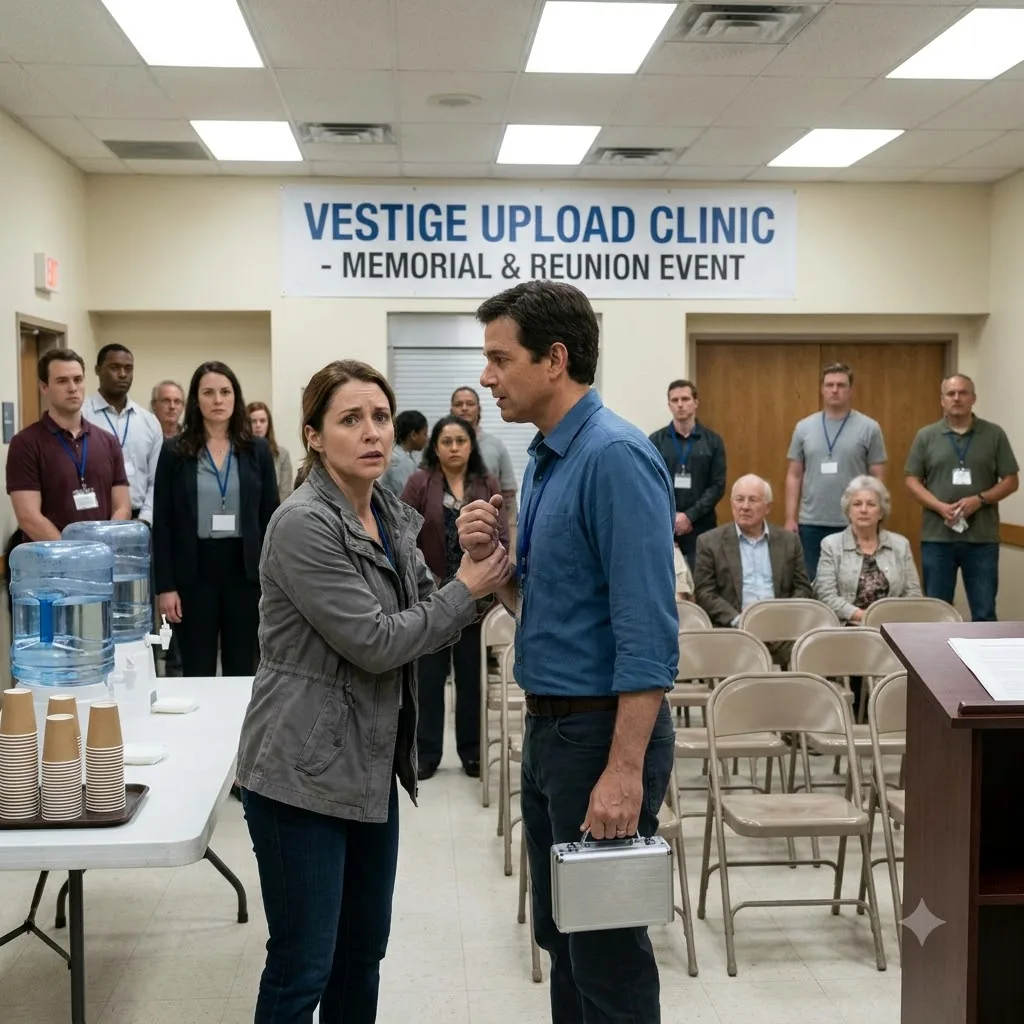
Nobody answered Jonah right away. The lounge noise thinned out around us until the water dispenser and the soft loop from the memory plinth sounded louder than people. Celia recovered first. She folded her hands at her waist and used that same clinic-trained calm. “The designation was corrected during pre-ceremony review. I asked that the room reflect continuity stewardship as already established. We don’t need to derail Ms. Bennett’s archive reception over an unverified object.” Jonah did not nod. He tapped his tablet once. “Who made the correction in the system?” “I flagged the inconsistency,” Celia said. “Your desk processed it.” That was not the same answer. He let the silence sit there long enough for everyone within three rows to hear the difference. Rina looked from the face-down chair card to me. “That tag was up when I came in,” she said. “I was here before the cousins from Fremont got their coffee. It had Mara’s name on it then.” Celia’s head turned toward her. “Rina, please don’t guess in a controlled setting.” “I’m not guessing,” Rina said. Her voice stayed small, but she did not step back. “I read it because I thought maybe you two had worked things out.” Jonah asked me, “Show me the item without opening playback.” I handed him the case. He did not palm it like a keepsake. He held it the way staff hold anything that might become record. The brushed metal was scratched along one side, and the latch had been replaced with a tiny flat screw years ago. He turned it over. There was a strip of yellowed tape on the underside, old enough that one corner had curled. “You can lift that,” I said. He looked up once, then used his thumbnail carefully. Under the tape was my mother’s handwriting in blue marker, blocky and rushed: FOR MARA – HOLD TILL THEY ASK WHO STILL KNOWS MY VOICE. Nobody said anything for a beat after that. Celia spoke into the quiet. “Handwriting on a case is not chain of custody.” “No,” Jonah said, still looking at the label. “But it is not random memorabilia either.” He asked me where I got it. I answered only with what happened in front of witnesses because that was all that mattered in a room like this. “Three years ago, same clinic, before her final intake block,” I said. “She had the reunion jacket over her arm because the air in here was too cold for her. We were in the family staging alcove. Tray numbers were on the counter then too. She took this out of the inside pocket and said I was the one who’d know if the voice map drifted from the way she actually talked at home. She put it in my hand.” Celia cut in. “There is no protocol where family members privately audit voice continuity.” “I didn’t say protocol,” I said. Rina lifted two fingers a little, like she was in school. Jonah gave her a look that meant go ahead. “I remember the jacket,” she said. “Thanksgiving after the first consult, Aunt Evelyn kept checking the inside pocket because she said she never trusted clinic trays with small things. Mara was the one she kept sending back for it when she’d leave it on a chair.” She looked at the garment bag in the staging alcove. “That same green jacket.” One of our mother’s cousins murmured, “It is the same jacket.” Another relative leaned out to see better, not at me, but at the tray. Celia moved fast without touching anyone. She stepped half a pace so she blocked the direct line between the lounge and the alcove. “This is exactly why clinics have structure,” she said. “People confuse familiarity with legitimacy. Ms. Bennett appointed a steward for her posthuman continuity. That role is documented through her activation plan. The family circle should reflect that plan, not whoever walks in carrying sentimental hardware.” That was the best version of her argument, and for a second it worked on the room. Not fully, but enough that people stopped shifting toward me and looked back to Jonah for the real answer. He asked, “Did you disclose this item during intake today?” “No,” I said. “Why not?” “Because I came to watch my mother’s handoff, not fight for permission to stand where daughters stand.” I kept my eyes on him. “And because I didn’t know my seat had been taken until she said I didn’t belong.” He accepted that without agreeing with it. Then he asked the question that mattered more. “Has this drive ever been loaded, reviewed, or transferred into Vestige custody?” “No,” Celia said immediately. I said, “Not by me.” Jonah looked up. “That’s not the same answer either.” The room changed after that. You could see it in little things. A cousin lowered his phone. One staff member near the glass wall stopped pretending to sort programs and started watching Jonah’s screen. Celia’s shoulders stayed squared, but she repeated herself more slowly. “The approved legacy materials are already in clinic custody,” she said. “If we pause for every object someone claims is meaningful, the ceremony becomes noncompliant.” Jonah handed the case back to me but did not tell me to put it away. Instead he opened a side panel on his tablet and scanned the tray numbers in the staging alcove. “Ms. Bennett’s custody inventory is showing a gap note from prior intake,” he said. Celia’s chin lifted a fraction. “A what kind of gap note?” He read exactly as written. “‘Personal voice-reference unit released to family hold pending claimant verification at ceremony stage.’ No assignee name entered. No closure recorded.” The cousins started talking under their breath then, not loud, just enough to turn the lounge from a ceremony room back into a family room with staff inside it. Celia took one step toward Jonah. “Then the hold needs to be resolved by the designated steward. That’s me.” He did not move. “Not if claimant.