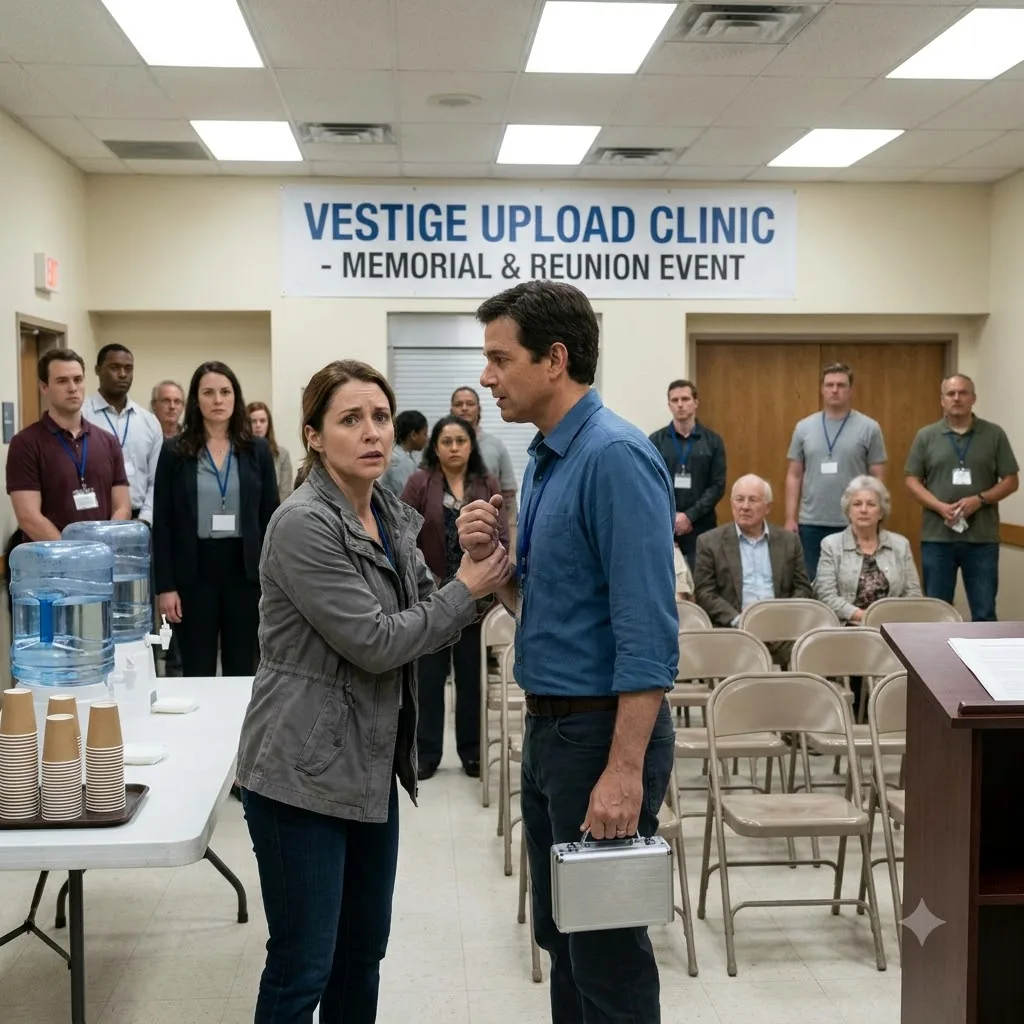
Story code: ST-000929
Part 3: The Claimant Verification
“Not if claimant verification is still open,” Jonah said.
He said it to Celia, but he angled the tablet so the nearest relatives could see the line on the screen. Vestige used large text for live ceremony steps. Even from where I stood, I could read enough: PRIOR INTAKE GAP. VOICE-REFERENCE UNIT. FAMILY HOLD. CLAIMANT VERIFICATION REQUIRED AT CEREMONY STAGE.
Celia’s hand came up, not touching the tablet, just stopping short of it. “Then verify the steward of record,” she said. “The activation plan names me for continuity stewardship.”
“Continuity stewardship and claimant verification are not the same field,” Jonah said.
That landed in the room because he used the same flat tone he had used for seat assignments and hydration timing. No drama. Just separation. Celia’s language had been carrying both ideas together all morning, and now he had pulled them apart in public.
I kept the drive case in my palm. “What makes someone a claimant here?”
Jonah looked at me, then at the case. “Supported relevance to the item and supported relationship to the decedent in the ceremony record,” he said. “If the item affects archive representation, we determine whether it belongs in display custody, restricted review, or return-to-holder.”
“And if it changes who is recognized in activation?” I asked.
He did not answer right away. He tapped once more, then said, “Then the participation roster has to match the supported record.”
Rina let out a breath through her nose. One of the cousins stopped pretending to read the printed program entirely.
Celia shifted her weight and went back to the words she trusted. “This is becoming exactly the kind of family confusion Ms. Bennett wanted insulated from transition procedure. Mara was not managing her archive process. Mara was not at the ethics consults. Mara was not designated to speak for her posthuman continuity.”
“I didn’t come to speak for it,” I said. “I came because she put that in my hand and wrote my name on it.”
“A name on tape does not establish ceremonial standing,” Celia said.
“Maybe not,” I said. “But it does establish that you knew this wasn’t random when you saw it.”
That got a few faces to turn back to her. She answered too fast. “I knew it was an object you would use to make this messy.”
Jonah asked, “Ms. Bennett, had you previously disclosed to staff that a family-held voice-reference unit might appear today?”
Celia’s eyes moved to him. “I disclosed that unscreened personal artifacts should not alter the activation lane.”
“That’s not what I asked,” he said.
Nobody helped her then. The room had gotten careful. Even the staff member by the glass wall had stopped shuffling programs.
I looked at the staging alcove and the green sleeve visible through the garment bag zipper. The jacket and the drive had belonged together in my mind for years, and now the room finally had both in sight. “Check the jacket pocket inventory from prior intake,” I said. “If the gap note came from the same session I was there for, the garment item should be listed with it.”
Jonah turned to the tray log. He asked a staffer for the physical item number instead of sending anyone away with it. That mattered. Everything stayed in view. The staffer read the tag from the garment bag: “Legacy textile item, tray twelve.”
He matched it on the screen. “Associated notes,” he said, then read: “Patient requested reunion jacket remain visible at family-stage handoff. Secondary note: voice-reference unit removed from inner pocket before tray seal.”
Rina spoke before Celia could. “That’s what Mara said happened.”
Celia’s mouth tightened and smoothed again. “The note still doesn’t assign the item to her.”
“No,” Jonah said. “It assigns the release to family hold pending claimant verification at ceremony stage. Which is now.”
Then he did the thing Celia had been trying to avoid since I walked in. He moved from speeches to steps.
“I need observable support from the claimant,” he said to me. “No playback. No open archive merge. Just relevance testing.” He pointed to the memory display plinth. “If this is a voice-reference unit tied to Ms. Bennett’s archive, it should contain a pre-ingest calibration prompt set. Those prompts are useless without context unless the holder knows the context.”
Celia straightened. “You are going to authenticate family through a quiz?”
“I’m going to classify an unresolved legacy item in the room where it was required to be classified,” Jonah said.
He asked the staffer to bring the plinth out of passive memorial mode and into restricted object review. The soft blue loop vanished. A plain authorization panel came up with three blank prompt fields and a red notice at the bottom: CEREMONY DELAY WILL BE LOGGED.
That red line changed the air more than any raised voice could have. Delay meant record.
Jonah looked from me to Celia. “Only one claimant can answer first,” he said. “If the designated steward contests the claimant’s standing, the steward may take first attempt on the calibration prompts. Failed relevance entry will be recorded as a contested misclassification event attached to today’s ceremony file.”
He didn’t dress it up. He just stood there with the tablet in one hand while the notice glowed on the plinth.
Celia had spent the whole morning speaking as if the room already belonged to her. Now the clinic was asking whether she wanted that confidence attached to the record.