Story code: ST-000929
Part 4: What the Record Kept
For a second Celia did not move at all. Then she said, “If I decline the stunt, proceed with the planned activation.”
Jonah shook his head once. “Not with an unresolved claimant verification tied to a legacy item and a challenged participation roster. We either classify the unit now or suspend the family activation sequence and note cause.”
He turned the tablet so she could see the options. I could not read every line from where I was standing, but the labels were big enough: STEWARD ATTEMPT. CLAIMANT ATTEMPT. CEREMONY HOLD.
Celia looked at the room before she looked back at the screen. That was the first time all morning she checked the audience like they might not stay arranged for her.
“Fine,” she said. “I’ll do it.”
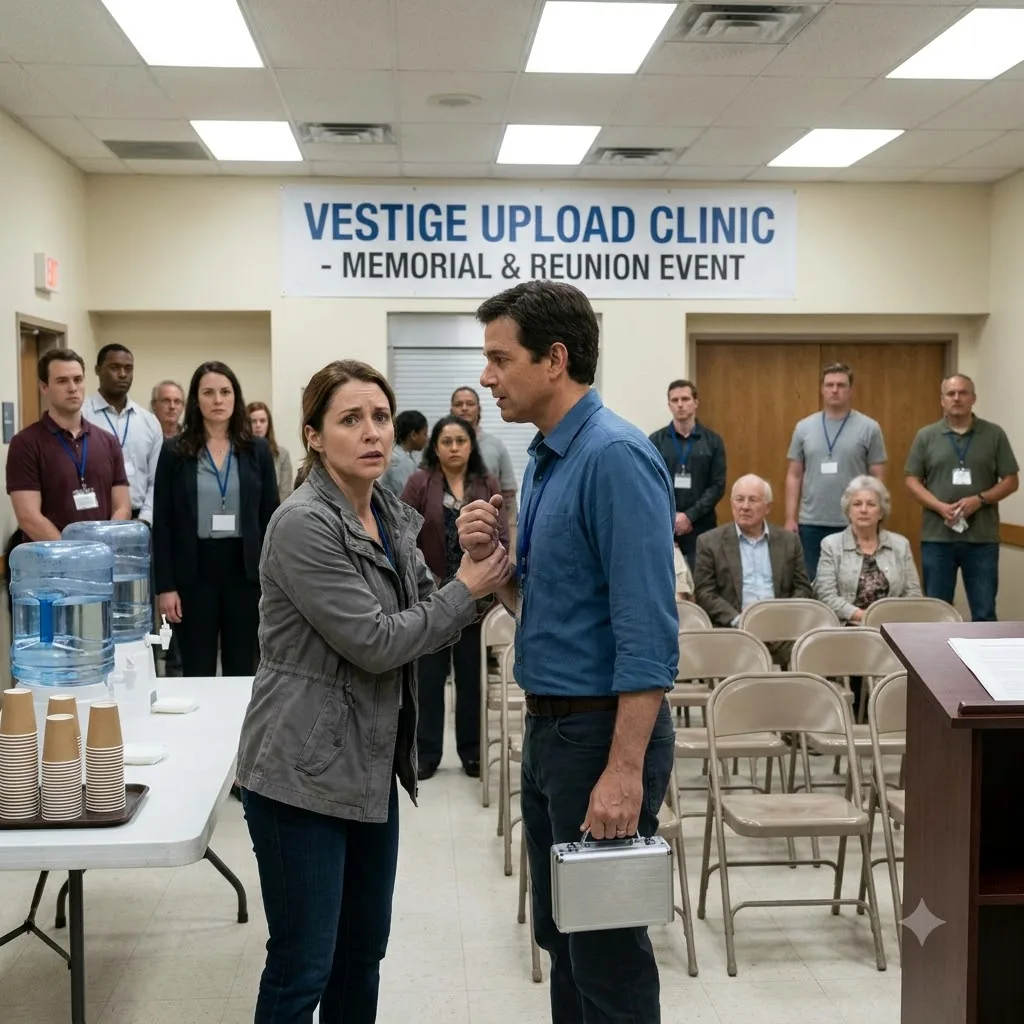
Jonah did not hand her the drive. He asked me to place it on the plinth myself. I set the little metal case in the center cradle. The plinth gave a small accepting tone, nothing dramatic, just enough to confirm contact. A panel opened on the screen with text prompts and answer fields locked to staff input.
Jonah read the instructions aloud for the room. “Restricted relevance test. No playback. Prompt response only. First claimant answers three calibration references associated with the unit’s label set. If responses mismatch the stored prompt keys, attempt records as failed relevance claim.”
Celia said, “Read them.”
He read the first prompt from the screen. “Complete the phrase as recorded in family reference: ‘If you leave the reunion jacket on a chair, check the…'”
Celia answered right away. “Pocket.”
Jonah looked at the screen and said, “Insufficient. Prompt key requires exact referent.”
He waited.
She added, “Inside pocket.”
He did not nod. “Mismatch.”
A cousin near the second row made a small sound and then covered it with a cough.
Jonah read the second prompt. “When preparing for cold clinic rooms, Ms. Bennett called the green jacket her what?”
Celia paused. “Her armor.”
The screen stayed amber. Jonah said, “Mismatch.”
Rina lowered her eyes to the floor. Nobody else spoke.
Jonah read the third. “Who still knows my voice?”
That one sat there between us. It was on the tape. It was also more than the tape. Celia kept her chin up and said, “The steward overseeing continuity.”
The plinth flashed red.
Jonah entered the result with two taps. He did not soften his tone. “Steward attempt failed. Contested relevance claim recorded.”
The words went into the room cleaner than shouting would have. They stayed there.
Celia turned toward him. “This proves nothing except that your prompts are sentimental and badly framed.”
“It proves your contest is now attached to the file,” Jonah said. “Claimant attempt follows.”
He looked at me. “You may answer.”
I did not touch the drive. I kept my hands at my sides.
“Inside left pocket,” I said to the first prompt.
The screen turned green.
“Portable Florida,” I said to the second.
Green again. A couple of our cousins looked at the jacket and then at each other. My mother used to say it every winter, usually while patting that wool sleeve like it was a heater she could wear.
Jonah read the third prompt once more. “Who still knows my voice?”
I answered the way the tape had answered it already. “Mara.”
Green.
No playback started. No ghostly message filled the room. The proof stayed exactly where it had to stay: prompt, answer, classification. Jonah entered the result on the tablet and the plinth returned to a neutral white screen.
Then came the part that did the damage.
He opened the participation roster, restored the face-down seat electronically, and said, “Claimant verification satisfied. Legacy unit classified as family-held voice-reference support relevant to Ms. Bennett’s archive representation. Mara Bennett is recognized for family activation participation.”
He tapped again. “Celia Bennett’s prior contest remains in today’s ceremony file as unsupported stewardship override attempt resulting in ceremony delay. Her lead role in call-forward is removed. General family participation only.”
Nobody gasped. Vestige did not produce scenes for people. It produced amended entries.
A staff member crossed to the front row, lifted the card that had been turned down, and set it upright again: Mara Bennett. Then she took the card with Celia’s special speaking mark off the first chair and replaced it with a plain family participant tag.
That was all. Paper. Screen. Record.
Celia stayed standing where she was. She did not get marched out. She did not apologize. Her badge clip was still on her blazer, but it no longer matched the room. One cousin shifted sideways to make space for me in the front row. Rina touched my elbow once as I passed and then let her hand fall away.
I picked up the drive case from the plinth and held it flat in my palm. Jonah asked whether I wanted the unit placed into restricted display custody for the activation segment or kept on my person as verified family hold. “On me,” I said.
He entered that too.
When the ceremony resumed, the blue memorial loop came back on the plinth and my mother’s name returned in white over it. The call-forward included mine this time. No one clapped. Chairs scraped. Programs rustled. The clinic moved on because that is what clinics do after they change something permanent in front of witnesses.
Celia sat one chair down from me and did not speak during the handoff. On the overhead display, a small status bar noted delayed start due to claimant verification. That note would stay in the event log longer than anybody’s memory of who had poured water and who had stood by the glass.
By the time we stood to leave the lounge, my place had been restored and hers had been reduced in writing. That was enough. Not joy. Not repair. Just the kind of relief that can stand up straight, hold a small metal case, and stop arguing with the record.