Story code: ST-000790
Part 2: The Room Started Repeating Her Edit
Before anyone found the full clip, the waiting room started repeating Leah’s version like it had happened to them personally. That was the part I did not expect at a licensed upload clinic: not the phone itself, but how fast a private intake exchange turned into something people felt invited to judge. And the first crack in her story came from the clinic’s routine, not from any speech she couldn’t interrupt.
Security did not arrive immediately. The damage moved faster than the hallway.
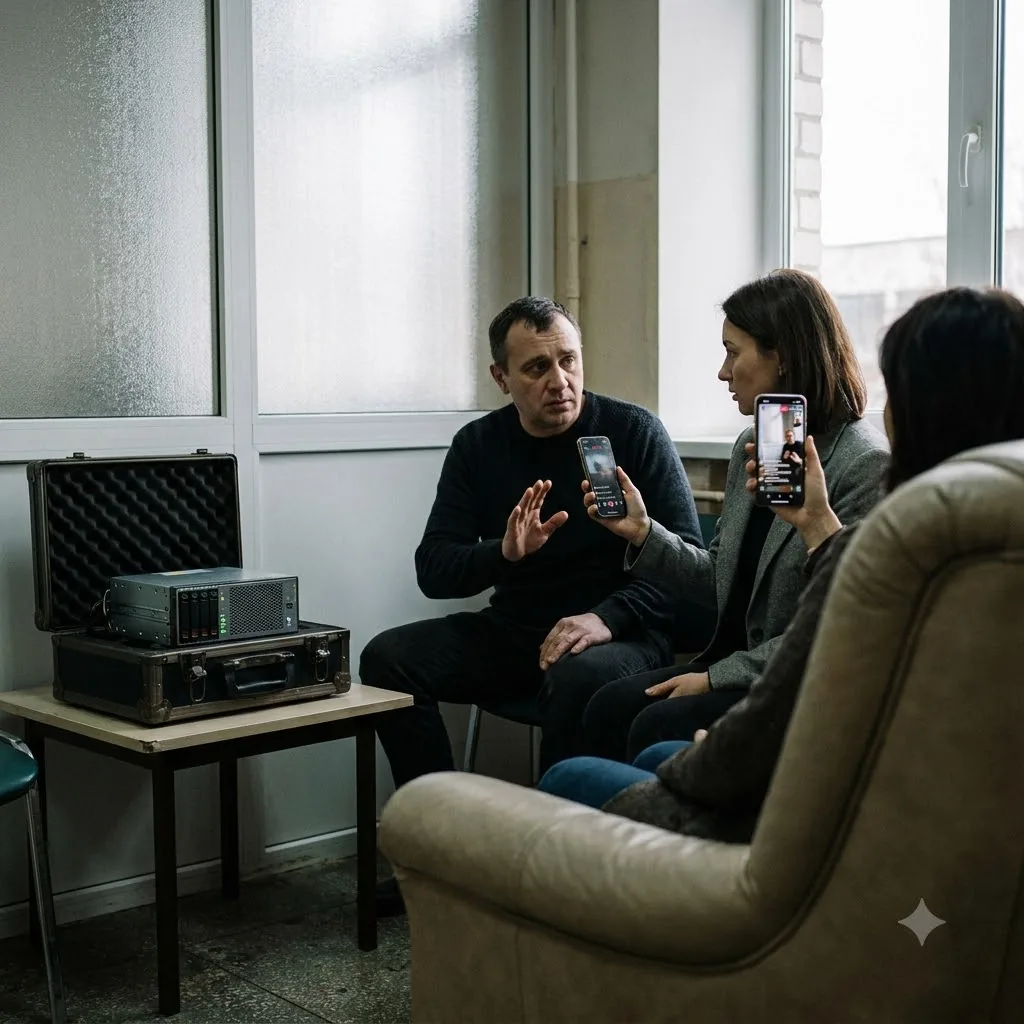
Rina stayed at the intake threshold with the door half closed behind her and kept her voice level. She asked me if I wanted to pause intake. I said yes. She asked Daniel to keep the drive with him and not place it on any public surface. He shifted the black case under his arm and nodded. Leah was three chairs away now, still holding her phone high enough to show she had an audience, though she had stopped narrating in full sentences.
That pause told me something important. If this had been the kind of hidden procedure her clip was suggesting, the clinic would not have been openly freezing the process because of a recording dispute in the waiting area. Rina also made no move to take us into the room. She kept everything in sight, in sequence, and verbal.
“For clarity,” she said, loud enough for the nearby chairs, “the patient was asked a standard privacy preference question before protected intake began. No transfer steps have started. No final consent has been taken in this space.”
Leah spoke over her. “That’s not what people heard.”
Owen looked from one to the other and said, “I heard her say private.” He wasn’t helping, but he was useful. He was the first proof of how the room had locked onto a single word and built a whole accusation around it.
“Right,” Leah said, turning her screen slightly toward him as if she were presenting an exhibit. “Because they don’t want witnesses.”
Daniel answered before I did. “Witnesses to what? A standard intake question with a posted no-recording rule behind it?”
Leah gave him the look she uses when she wants the argument itself to sound like evidence. She kept her body angled toward the phone, not toward us. The comments still moved on her screen. I could not read all of them, but I caught enough: Ask if she was pressured. Save the live. Screen record this.
Rina asked Leah to stop filming a second time and identified the boundary more precisely. Waiting area, public-adjacent. Intake threshold, protected. No recording directed at patient intake activity without consent. That detail mattered because it narrowed the story to something visible and procedural. Leah had not exposed a crime. She had crossed a clinic line and attached a story to it before anyone could restore the sequence.
Then another gap opened.
A middle-aged man near the charging station said, “If she just started streaming when she answered, how’d she catch the coordinator stepping into the question?” He gestured toward Leah’s phone. “The clip I saw started with the patient already answering.”
Leah snapped her screen back toward herself. Too late. Daniel heard it, and so did I.
Because that was exactly the missing piece. The phone angle on the stream showed Rina already in the doorway and me already turned toward her. If Leah had only reacted in outrage to my answer, the lead-in should have been chaos and movement. Instead, her frame was steady from the first second that viewers saw.
Rina seized that opening the way only procedural people can.
“Ma’am,” she said, “were you recording before the patient answered?”
Leah did not answer the question directly. She said families had a right to document. She said clinics hide behind policy language. She said people online had seen enough. Every sentence slid around the one thing Rina had actually asked.
That was when Owen switched sides, or maybe just switched clips.
“No, hold on,” he said. “When you first showed us, there was a scrub bar at the bottom. I thought you had rewound it.” He looked at Daniel, then at me. “I figured you all were arguing about what she’d already posted.”
Leah told him not to speculate. Owen lifted both hands, palms out, and sank back in his chair, but the room had already changed again. Not in our favor, not fully. Just enough that people started looking at Leah’s phone instead of at me.
Daniel asked Rina if the clinic cameras covered the waiting area. Rina said they covered reception flow and doorway timing, not patient audio, and any review would go through internal procedure. Another useful limit. No magical footage. No instant rescue. Just time stamps, positions, and who moved where.
Leah laughed once through her nose and said, “So convenient.”
“Convenient for you,” Daniel said. “You cut in after the setup and sold the room a lie.”
She held the phone tighter. “I went live because nobody here was going to say what this looked like.”
That was the cleanest thing she had said so far, because by then the room itself showed what she meant by looked like. Screens were still up. People were still watching. Some had probably forwarded the clip already. The entertainment value had survived even the first contradictions.
Rina asked one more direct question. “Do you have the full recording on that device?”
Leah didn’t answer right away. She glanced at the top corner of her screen, then down at the bottom, where the playback bar flashed again before she covered it with her thumb.
Daniel saw it and stopped arguing. He just said, “You do.”
Leah locked the phone, pressed it flat against her chest, and took one step back from the intake doorway.
She had spent ten minutes telling the room that our family was hiding the truth. Then she became the only person in the clinic who was visibly holding the missing part of it.