Story code: ST-000114
Part 3: The Proof Was That She Wouldn’t Stop
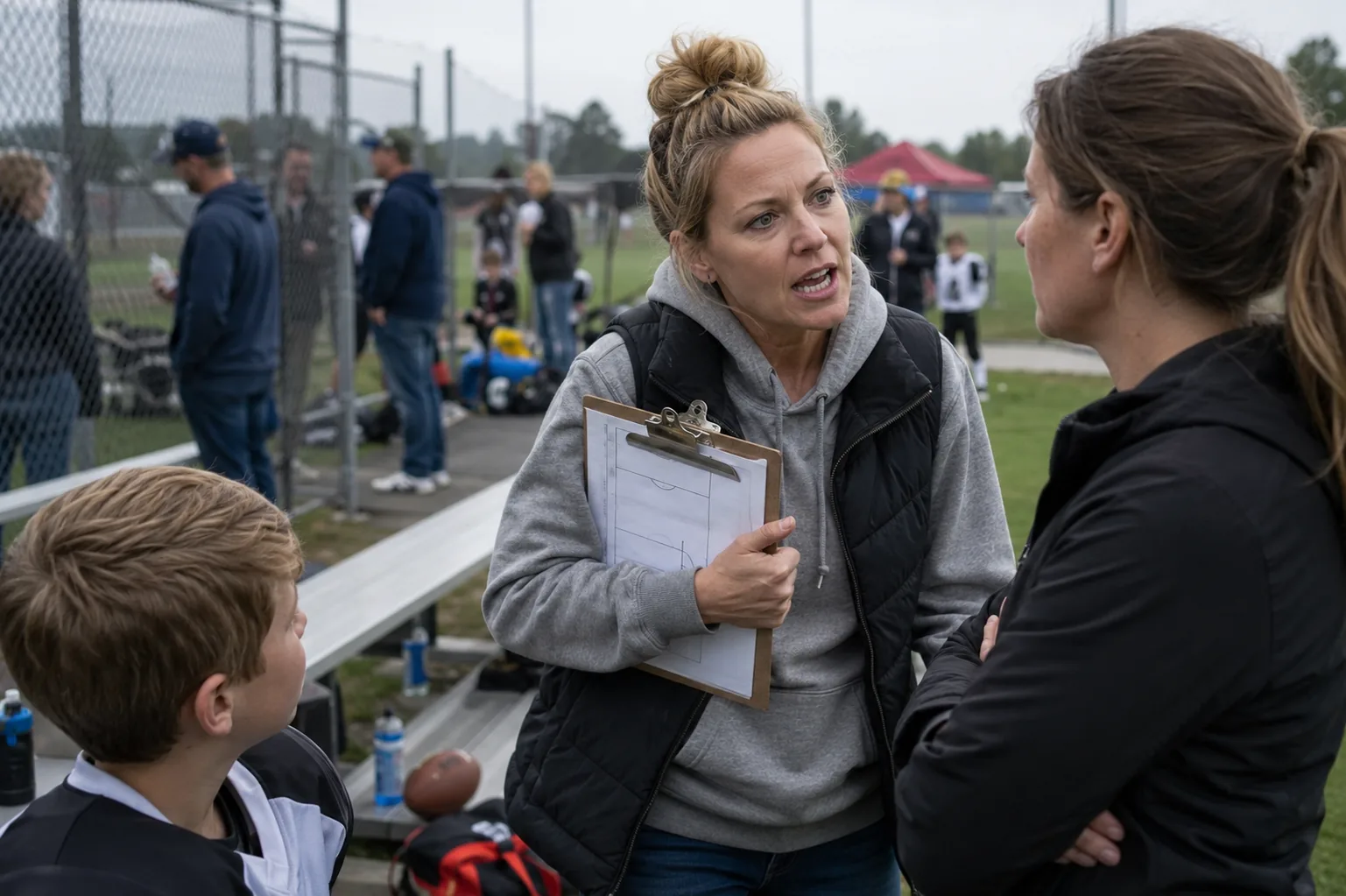
I didn’t answer Dana right away. Coach Raul Bennett was sending the boys into scrimmage sides, and the bench area broke into that usual practice noise again: bottle caps cracking open, parents shifting bags with their feet, a little brother dragging a cone he wasn’t supposed to touch until his grandmother took it from him. Dana still had the lineup clipboard pinned to her chest like I had accused her of stealing it.
I said, “Then don’t bring Eli into this again.”
Her face changed in that small, quick way I’d started noticing with her. Not surprise. Not embarrassment. Just that tightening around the mouth she got when I stepped outside the role she had assigned me.
“I’m trying to help you,” she said.
“No,” I said. “You’re trying to keep me grateful enough not to push back.”
She gave a short laugh and looked past me toward the field, as if somebody else might rescue the conversation by overhearing the right line. “You always twist things,” she said. “I’ve spent months making sure this team runs. People appreciate that. Most parents understand you don’t get to benefit from somebody’s effort and then act hostile.”
There it was again. Benefit. Effort. Hostile. She kept arranging those words like they proved she had a claim on us.
I kept my voice level. “If your help comes with this kind of speech, then it’s not help to my family. So hear me clearly. Do not do anything for us that you plan to mention later.”
She shifted the clipboard under one arm and pulled the pen from the top clip. “That is such an ugly way to look at this.”
“Then it should be easy to stop.”
Instead of stopping, she opened the clipboard again. Not to write anything. Not because Coach Raul had asked for it. She just opened it between us, glanced down at the page, and said, “You don’t seem to understand how much invisible work there is behind getting kids into the right spots.”
That was the cleanest proof I was going to get. Every time I offered to remove my family from her burden, she reached harder for the burden itself. She needed me standing there as the parent who owed her. She needed the clipboard in the conversation, even when it had nothing to do with whatever Coach Raul was doing on the field.
I looked down at the page. Eli’s name was still there in black marker. A couple of positions had arrows beside them. Dana’s pen hovered over the margin, but she didn’t write. She just let it hang there long enough for me to see it.
I stepped back instead of leaning in. “Close it,” I said.
She blinked. “Excuse me?”
“Close the clipboard if this conversation is personal,” I said. “If this is about your feelings, then stop using team paperwork as a prop. And if it’s about team logistics, then you can talk to Coach Bennett, not me.”
That landed. I could tell because she didn’t answer for a second. She looked at me, then at the field, then back down at the clipboard still open in her hands.
One of the dads who had been near the water cooler walked past us toward the trash can. Dana waited until he was a few steps away and lowered her voice. “I have done too much for people to be talked to like this.”
“You keep saying that like somebody chained you to the bench,” I said. “I’m the one telling you to stop.”
Her grip tightened on the board. “You think you can just opt out when it’s convenient?”
That question told me more than anything else she had said. Not opt out of rides. Not opt out of volunteering. Opt out of the debt.
I said, “Yes. I can opt out of being managed through gratitude.”
Coach Raul blew the whistle and called for a quick reset. Players jogged in, then spread back out. Eli looked over once from the sideline, saw me standing apart from Dana instead of crowded in close, and turned back to the field.
Dana snapped the clipboard shut. “Fine,” she said, but she said it with that flat edge people use when they want the word to mean the opposite. “If that’s how you want it, then handle everything yourself.”
“That’s exactly what I’ve been saying.”
She stared at me another beat, then said, “Don’t text me asking for schedule changes, lineup clarification, late updates, or favors. I won’t keep rearranging things for people who don’t respect the work.”
I had never felt clearer in my life. She still wasn’t letting go. She was naming the door because she wanted me to hear what access she thought she controlled.
So I took it from her.
I said, “Good. Starting now, don’t contact me about Eli through your phone at all. If Coach Bennett has team information for us, he can send it through the team app or tell Eli at practice. Do not message me privately about my son again.”
Her chin lifted a little. “That is unnecessary.”
“No,” I said. “It’s the boundary.”
She opened her mouth, closed it, and looked down at the clipboard one more time like it could still settle the question for her.
It couldn’t. And I knew exactly what I was doing next when practice ended.