Story code: ST-000804
Part 2: The Answer He Needed Was Sitting Beside Him
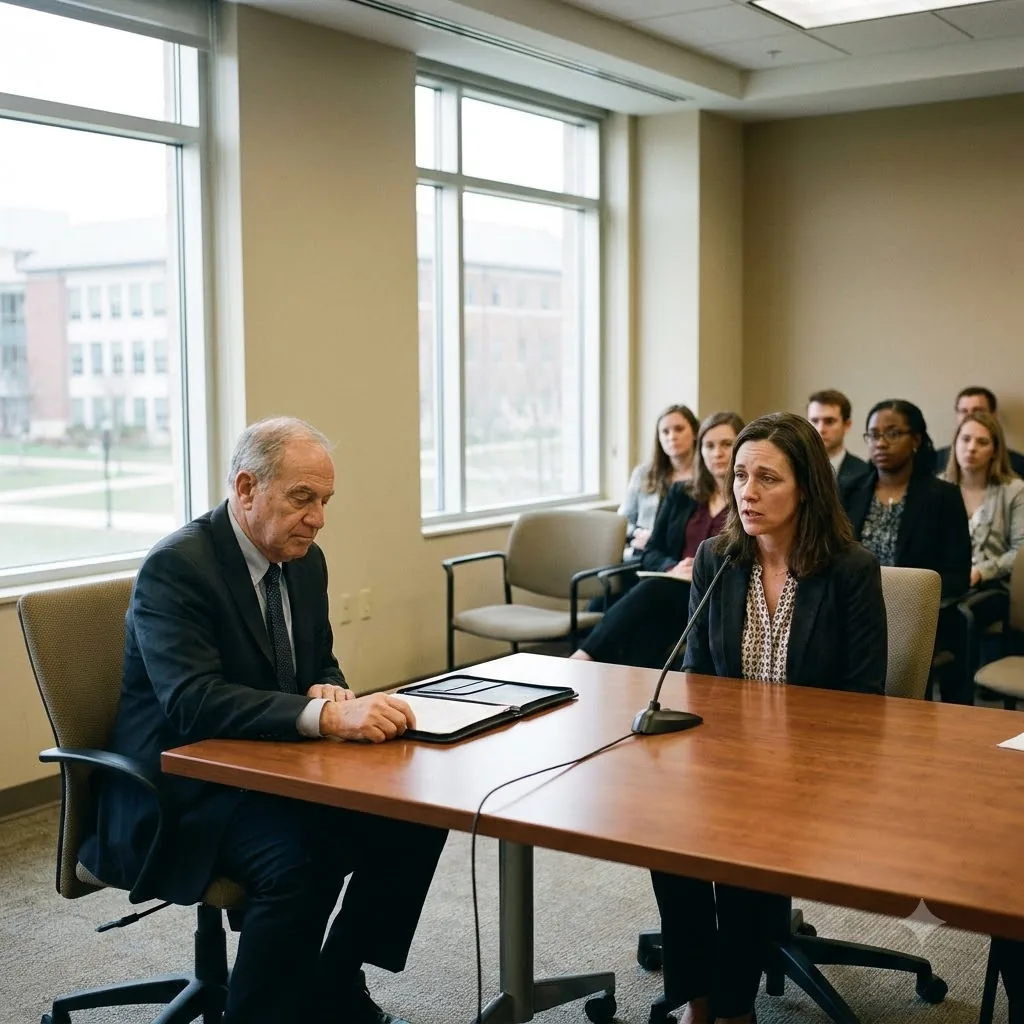
Grant did not answer Eli right away. He lifted his water glass, set it down untouched, and adjusted the page in front of him like the wording might change if he gave it another look. In a hearing room, silence gets loud fast. I could hear a binder ring click somewhere behind me. Eli Mercer repeated the question in the same calm voice. “Which coded identifier system, Dr. Voss? And where, physically, would the board find the March viability hold samples?” Grant cleared his throat. “Those samples were maintained within the secured lower inventory section pending final review.” That was not an answer. It was the shape of one. Eli glanced toward the chair, then back to Grant. “Lower inventory section is not a freezer coordinate.” Naomi Pike did not lean in or frown. She only said, “Please answer as specifically as you can.” Grant tried again. “The freezer map is organized to protect the study, so some of the internal shorthand may not be meaningful outside the lab context.” That should have sounded sensible. Instead, it left the room flat and still. He was talking as if the board had asked for a philosophy of storage instead of a location. I knew exactly where the March viability holds had been. Not because I had memorized a chart for a test, but because I had built the workaround after the left bay started frosting over enough to threaten quick retrievals. I moved those holds to the right-side middle banks, then split them by access order instead of date because pulling the front row first kept the back row from warming during repeats. We still used coded identifiers, but not the set Grant had just implied. I had changed that too after a duplicate segment label nearly caused a mismatch. None of that was in my face. None of it was in his mouth either. Eli turned a page. “Who maintained the internal shorthand?” Grant’s jaw tightened once before he answered. “It was maintained under my supervision.” That phrase again. Under my supervision. As if management were the same thing as knowing where somebody’s hands had been. Eli looked toward me. “Ms. Ellison, were you the person who physically handled freezer placement for those samples?” I waited for Naomi Pike to direct me. She gave a small nod. “Yes,” I said. “Did the March viability hold samples sit in a lower inventory section?” Grant shifted beside me. I kept my eyes on Eli. “No,” I said. “Not by the time we were in the March sequence. They were on the right side, middle banks, in positions that reduced repeat door-open time during retrieval.” Eli did not react beyond one note in the margin of his binder. “Who made that change?” “I did.” Grant spoke before the next question landed. “With my approval.” Naomi Pike turned her head toward him. “You will have an opportunity to clarify after the answer is complete.” He stopped. The microphone caught a quick breath and nothing else. Eli kept going. “Why was the change necessary?” “Because the left bay iced harder,” I said. “If we kept the viability holds there, the retrieval time widened whenever the inner latch dragged. That increased exposure on repeats.” One board member, a man with silver frames and a yellow legal pad, finally looked up from his notes. Eli asked, “Inner latch?” “The left interior latch,” I said. “It needed an extra lift before seal. If you did not know that, the door looked closed when it wasn’t seated correctly.” Grant’s hand moved to his binder tab. He did not open it. Eli’s voice stayed courteous. “Was that operating detail reflected in standard posted procedure?” “No,” I said. “It was something you learned by using that freezer.” That answer hung there longer than the others. Naomi Pike folded her hands. “Dr. Voss, had you personally worked with that latch issue?” Grant answered too quickly. “The team briefed me on all relevant operational concerns.” “That wasn’t my question,” she said. His chair made a small sound against the floor when he shifted. “I was aware of the issue.” Aware. Not worked with. Not corrected. Not tested. Just aware. Tess Rowan was called next for a limited question about access timing. She stepped to the witness chair with a stack of scheduling printouts and kept smoothing the top sheet with her fingertips. Eli asked who usually requested after-hours freezer room entry during the clone trial handling windows. “Ms. Ellison, mostly,” Tess said. “Sometimes security had Dr. Voss attached as sponsor approval, but she was the one I usually saw going in and out for the actual handling blocks.” “Did you ever personally observe Dr. Voss performing freezer placement?” Eli asked. Tess looked at the paper, then up again. “I saw him in the area for tours and check-ins. I didn’t personally see him doing placement.” Grant stared forward while she spoke. His face stayed composed, but he had stopped touching his water glass. The board was not giving me victory. Nobody in that room rushed to apologize. That was not how these places worked. What changed was smaller and somehow harsher. The questions no longer treated Grant’s ownership as the starting point. They treated it like a claim that had to survive contact with the actual freezer. Eli came back to him after Tess stepped down. “Dr. Voss, to keep the record clean, I’d like you to describe the current logic of rack assignment for clone trial samples held for viability review. You may use the exhibit if needed.” That was the kindest version of a trap I had ever heard. Because the exhibit he had in front of him was one of my old summary sheets, not the living logic I carried in my head. The rack labels meant one thing if you glanced at them and another if you had ever had to move samples around frost buildup, latch drag, and retrieval order without breaking chain integrity. Grant looked down at.