Story code: ST-000804
Part 3: He Reached for My Map and Found My Hands
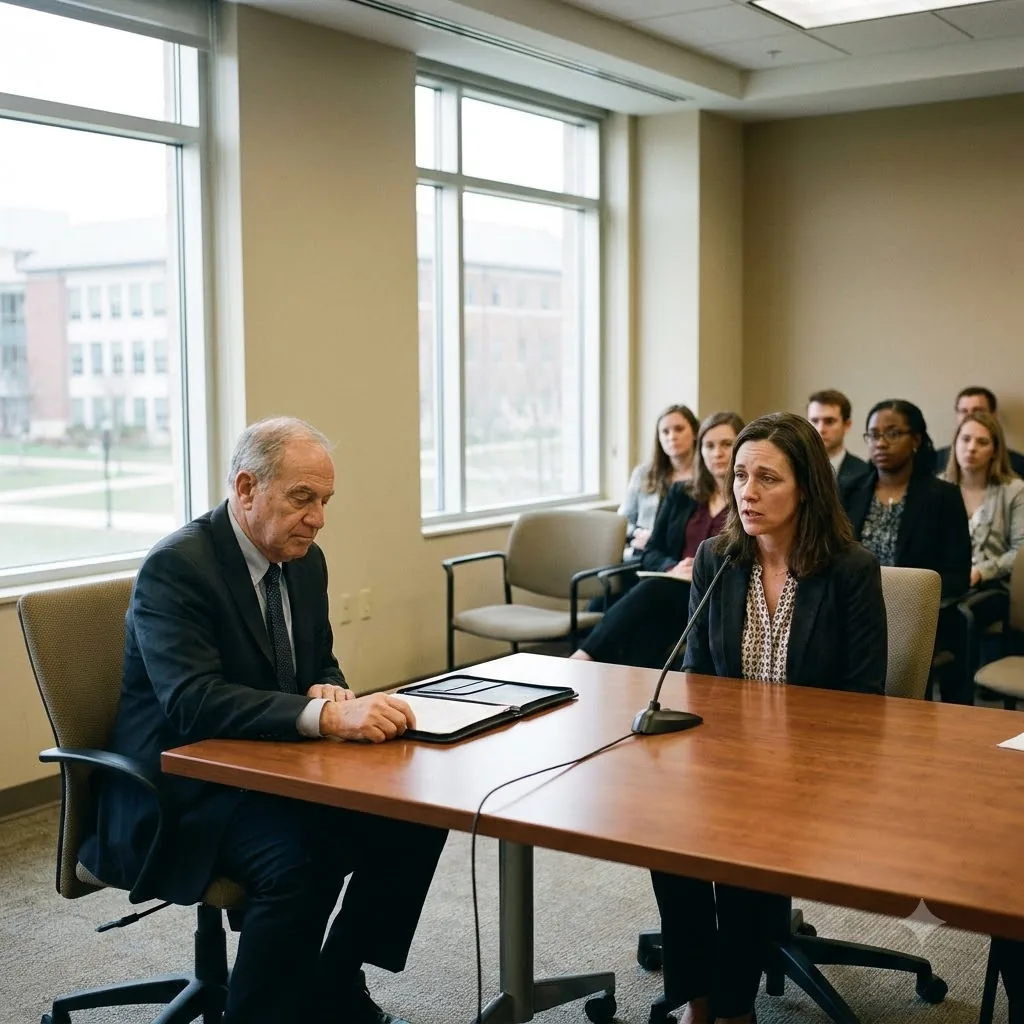
Grant looked down at the exhibit like it might rescue him by resemblance alone. It was a neat sheet, color coded, my block printing reduced into something that looked simple enough for a board packet. Anyone who had used the freezer knew it was only the surface.
He cleared his throat. “The current rack logic follows the updated segment grouping with protected holds placed by coded sequence and access priority.”
Eli Mercer waited a beat. “What coded sequence?”
Grant put two fingers on the paper. “The alphanumeric segment sequence reflected in the exhibit.”
I knew, before Eli said anything else, that he had stepped onto rotten floor. The exhibit was from before I changed the internal shorthand. It still used the old segment pairings, the ones that almost caused the March mismatch.
Eli lifted the sheet from Grant’s binder. “For the record, this exhibit is dated February twelfth. Ms. Ellison testified she changed placement logic during the March sequence. Are you saying the coding did not change?”
Grant’s mouth tightened. “The underlying system remained consistent.”
“Consistent with this sheet?”
He did not answer right away.
Naomi Pike looked over the rim of her glasses. “Dr. Voss, that is a yes or no question.”
“Broadly, yes,” he said.
That one word did more damage than anything I could have said for myself.
Eli turned toward me. “Ms. Ellison, did the coding remain consistent with February’s exhibit?”
“No,” I said. “I split the viability hold identifiers after the duplicate segment issue. The old sheet grouped by project segment. After March, the holds were marked by retrieval order inside the right middle banks, with a separate suffix for repeat-risk sets.”
The silver-framed board member spoke for the first time. “Repeat-risk meaning samples likely to be pulled more than once?”
“Yes,” I said. “The label wasn’t for science. It was for handling. It kept us from warming the wrong row while we were trying to move fast.”
Eli set the February sheet flat on the table between Grant and me. “Dr. Voss, can you explain the suffix Ms. Ellison just described?”
Grant looked at the sheet, then at me.
Not at my face, exactly. At the space where my notes would have been if I had brought any.
“That level of shorthand was maintained by staff,” he said. “I would not want to guess at an abbreviation outside full context.”
There it was. The room did not gasp. Nobody shifted dramatically. But a few pens stopped moving at once.
Naomi Pike said, “You testified earlier that you personally built the sample integrity system.”
“I built the system at the program level,” Grant said.
“That is not the phrase you used,” she said.
He sat back. “Then let me clarify the distinction.”
Eli did not let him widen the frame again. “Before we do that, I want one practical point established. Ms. Ellison, if someone opened the freezer today and followed February’s exhibit, would they reliably locate the March viability hold samples as handled during the period under review?”
“No,” I said. “They would go to the wrong section first, and if they stayed with the old labels they could misread the repeat-risk sets.” I kept my voice level. “The sheet looks clean because it was made for summary. It was never enough to run the freezer by itself.”
Tess Rowan, still seated in the witness row, lifted her head. Eli noticed.
“Ms. Rowan, one limited follow-up. When updates to hearing exhibits were needed, who usually sent them to your office?”
Tess folded her hands over her printouts. “For freezer materials? Ms. Ellison usually did. Sometimes the sponsor’s office forwarded them, but the revisions came from her.”
“Did you receive a March revision to this exhibit?”
She nodded once. “Yes. A replacement chart with handwritten notes in the margin because the typed version was still being cleaned up.” She looked at the board, not at me. “I remember asking whether the notes needed to be formalized, and Ms. Ellison said the hearing packet only needed the summary version unless somebody wanted the working map.”
Eli turned back to Grant. “Did you provide the February sheet to the board as the operative map?”
Grant placed both hands on the table. “I provided the exhibit I believed best represented the system.”
“Operative at what date?”
No answer.
Naomi Pike’s voice stayed even. “Doctor, if the board requested a live demonstration of the March placement logic using the freezer records and current map, could you perform that demonstration yourself?”
Grant’s eyes moved once toward the dais, then toward me again.
When he spoke, his voice was still polished, but thinner than before. “Not without Ms. Ellison’s assistance on the working notation.”
The sentence landed softly. That was the worst part.
Because it did not sound like a collapse. It sounded like a practical concession. But inside that one line was the whole thing: he had claimed ownership of work he could not perform without the person he had just reduced to assistance.
Eli closed his binder halfway. “Then I think the board needs the working map, and it needs the record to show who can actually interpret it.”
Naomi Pike looked at me. “Ms. Ellison, do you have that map with you?”
I did. It was in my hearing binder under a plain divider, where I had left it because I had not trusted this room to ask for it until now.
I put my hand on the tab and understood that whatever happened next, I would not be able to go back to the place I had come from.