Story code: ST-000697
Part 2: The Rule Started Spreading
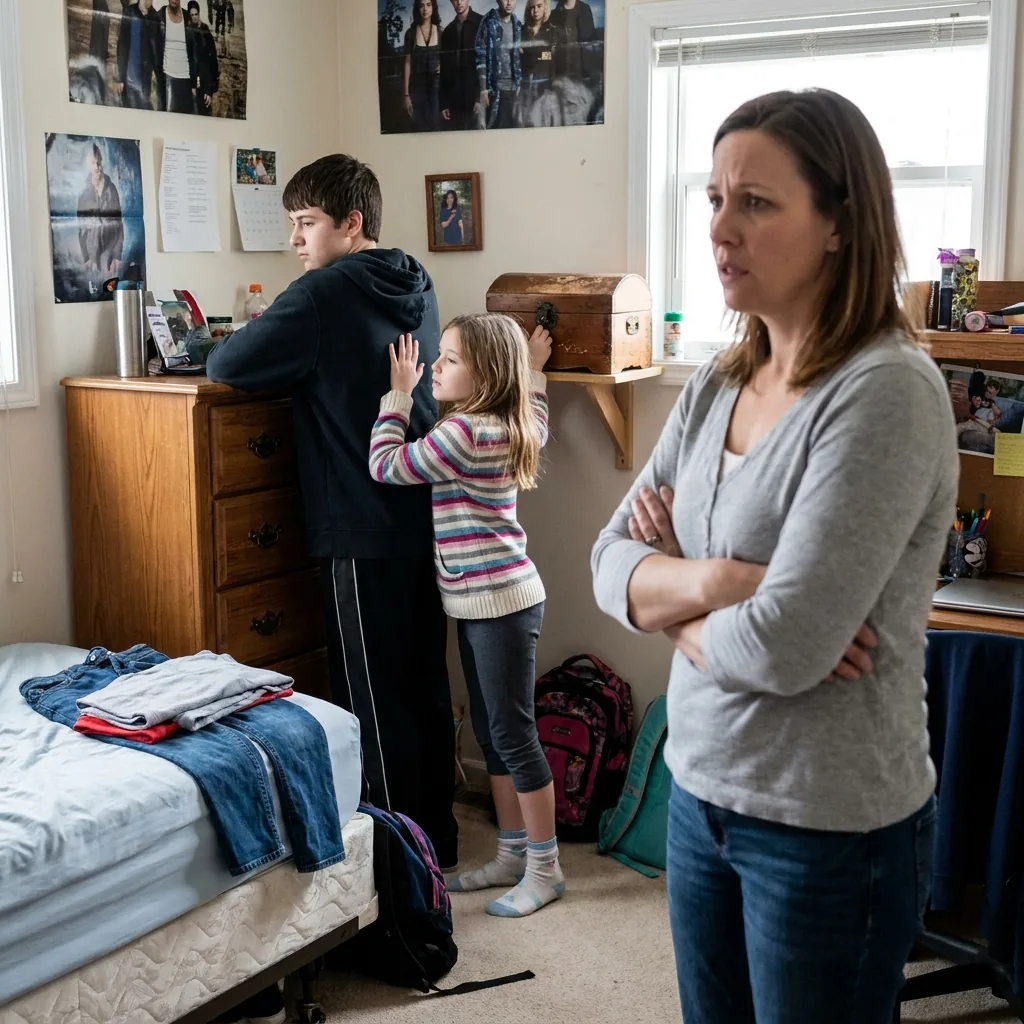
By the time Tessa Ruiz showed up after school, the memory box was still closed, the laundry from earlier was still on Alyssa’s bed, and Derek had moved from guarding one object to talking like he had authority over the whole room. That was when the claim stopped sounding strict and started leaving marks everywhere. He was not just blocking Alyssa from her box anymore; he was testing whether the same invented permission rule could be stretched across every ordinary thing in reach.
Tessa paused in the bedroom doorway with a tote bag on her shoulder and looked from Alyssa to Derek to the wooden box still sitting on the desk. “Did I walk in on something?” she asked.
Alyssa answered before Derek could frame it. “He says I need his permission to open my own memory box.”
Tessa gave the box a quick look, then Derek. “Why?”
“Because there’s a room system now,” Derek said.
“Since when?”
“Since it became necessary.”
The phrasing had the same problem it had before: it used a tone instead of a source. Tessa stepped inside anyway and dropped her bag by Alyssa’s chair. She was not there to referee anybody. That made what happened next harder to shrug off as sibling exaggeration.
Alyssa reached for the laundry hamper near the closet. Derek said, “Ask first.”
She held the hamper handle without lifting it. “For laundry?”
“It’s part of the room.”
A minute earlier he had claimed the rule was about opening things. Now he was extending it to moving them. Alyssa let go of the hamper and picked up her phone charger from the floor instead.
“That’s yours,” Tessa said, like she was helping sort out a misunderstanding.
Derek pointed toward the outlet. “It runs through the shared space.”
Tessa stared at him for a beat. “So what doesn’t?”
He answered too fast. “That’s not the point.”
But it was the point. The more objects came into view, the less stable his wording became. When Alyssa touched the top drawer of her desk, he said drawers needed approval because they affected room order. When she picked up a paperback from her pillow, he said books were fine unless they were stored in containers. When she reached toward the memory box again, he stepped in front of the desk and repeated that containers had to be cleared first.
Tessa looked around the room as if the walls themselves might explain what he meant. There was no posted list, no note taped to the closet, no text from a parent on anyone’s screen, nothing except Derek repeating versions of his own claim.
Marina came back when voices carried into the hall a second time. She did not ask for a recap from the beginning. She only asked, “Has the rule changed since I was here?”
Alyssa answered by pointing. “First it was my memory box. Then drawers. Then the hamper. Then not the lamp. Then maybe not books unless they’re in containers.”
Marina turned to Derek. “Is that accurate?”
He gave a short shrug. “It’s the same principle.”
“Say the principle.”
He said, “Shared room items need approval.”
Alyssa touched her phone charger again. “Mine?”
“That’s not shared.”
She put her hand on the memory box. “Mine?”
“That’s different.”
“Why?” Marina asked.
Derek tapped the desk with two fingers. “Because it’s being kept in the room.”
Marina looked at the desk, then at the tote bag stuffed with Alyssa’s papers, then at Derek’s own game controller lying under his chair. “Your controller is in the room too.”
He did not answer right away.
Tessa spoke carefully, not dramatically. “Do people need your permission to touch that?”
“No, because that’s obviously mine.”
The room held still for a second after that. His own sentence had cut straight across everything he had been saying about the box.
Marina moved one step inside. “Then ownership matters.”
“For some things,” Derek said.
“What things?”
“The things that affect the room.”
“The memory box affects the room how?”
He looked at the box, then the bed, then toward the hall where Ben had just come home and set his keys down on the entry table. He said, “It’s about maintaining order.”
Marina stayed on sequence. “Who told you that your authority over her box was part of maintaining order?”
No answer.
She tried again. “When was this announced?”
Derek rubbed the back of his neck and said, “People shouldn’t need everything spelled out.”
That was as close as he came to admitting there was nothing to point to. He had a rule broad enough to stop Alyssa at her own desk, narrow enough to spare his own controller, and slippery enough to change shape every time someone asked where it came from.
Ben appeared at the doorway then, still in his work shirt, and did what he usually did when a family argument was being told in circles. He did not raise his voice. He listened while Marina gave him the short version: memory box first, then drawers, hamper, charger, books, and no source anyone could name.
Ben’s eyes stopped on the box. “Nobody opens anything for a minute,” he said. Then he looked at Derek. “When I sit down with the notebook, you’re going to state your rule one time, show what it covers, and apply it the same way to your things and hers.”
Derek’s face changed at that line, not into apology, not into anger exactly, but into the look people get when a bluff has been asked to survive contact with details. And the worst part for him was already sitting there in plain sight: if the room really ran on his system, then the next object he would have to account for was his own.