Story code: ST-000818
Part 3: Then I Asked Her to Do It Again
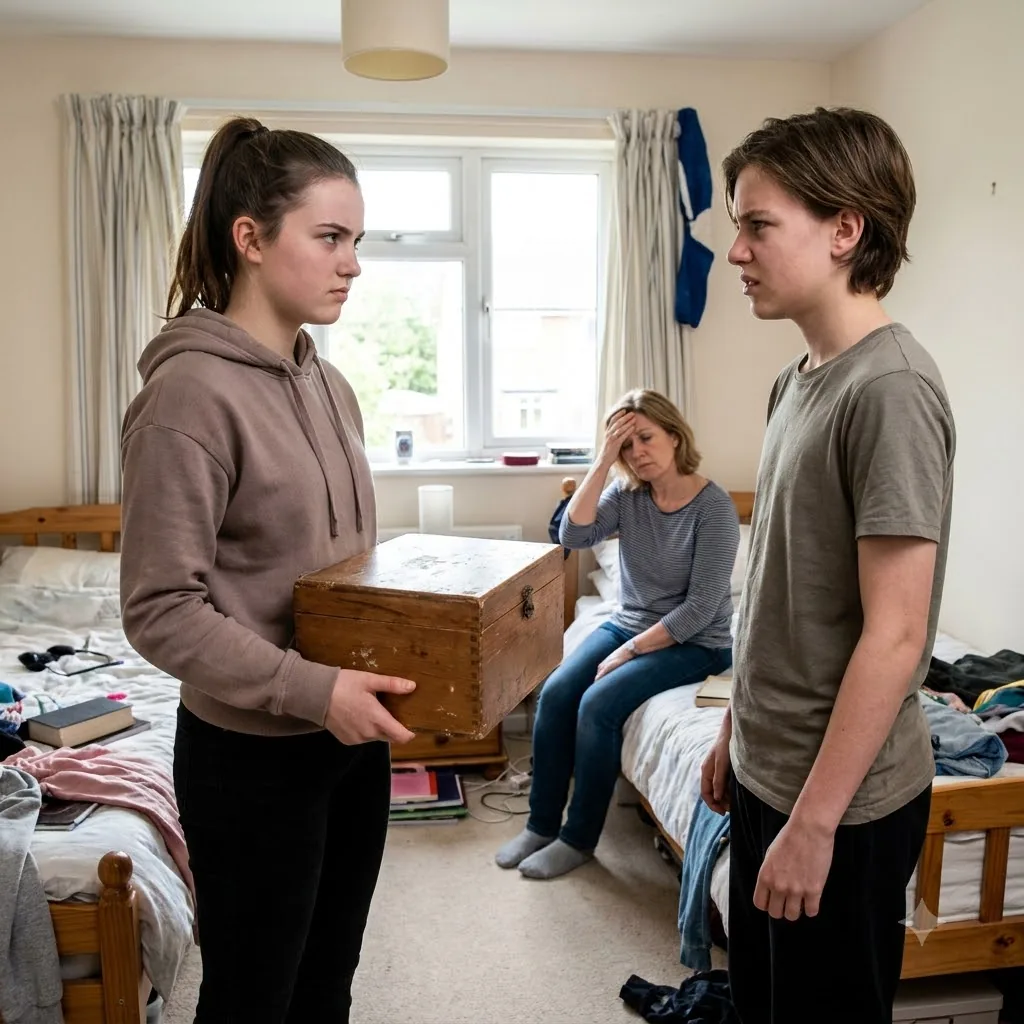
Nobody said much after Brielle admitted she had opened the box. Marcus stayed at the doorway with one hand on the trim. My mom set her purse on my bed and stepped farther into the room until she was standing between both of us, looking down at the half-open drawer.
She said, “Open it all the way.”
Brielle kept her hand on the plastic bin. “Right now isn’t ideal. It’s mid-process.”
“Open it,” my mom said again.
Brielle pulled the drawer out the rest of the way. The cedar box sat crooked now, not centered the way my mom always kept it on the shelf. One silica packet was lying loose against the brass latch. The vent was directly under the back corner.
I said, “You said shelf placement caused surface shock, but now it’s on top of a floor vent and next to a sneaker.”
She answered without looking at me. “Because this is controlled transition, not casual exposure.”
Marcus asked, “Controlled by what?”
Brielle lifted her phone a little. “By process.”
My mom crouched beside the drawer. She did not touch the box yet. She just looked at the lid, then at the drawer rails, then up at Brielle. “You said it had a memory seal. You said the item order inside could lose integrity. You said it needed guided recontainment. Show me what that means.”
Brielle gave a tight little smile like she was trying to keep the tone above the rest of us. “It’s not really a demonstration thing. It’s about informed handling.”
I said, “You made it a demonstration thing when you made rules for everybody else.”
She straightened. “I’m not performing for an audience.”
Marcus spoke in the same flat voice he used when a sink leaked or a bill was wrong. “Then stop using expert words at home. But if you’re saying the box can’t be touched unless somebody knows the process, and you already touched it, explain the process step by step.”
That changed the room. The dryer had stopped. The TV in the den was lower now. The only sound in our bedroom was the vent moving air under the drawer and Brielle’s fingernail tapping once on the phone case.
My mom stood up and moved my desk chair beside the drawer. “Fine,” she said. “Use the chair. Use your phone. Use whatever you need. Show me the settling window. Show me the memory seal.”
Brielle didn’t sit.
She said, “These terms don’t always translate literally.”
I nodded toward the notebook sign on her bedframe. “But they translated enough to tape a warning sign to your bed.”
She looked at me then, and her voice sharpened. “You don’t get to turn this into a game because you resent being corrected.”
“It’s not a game,” I said. “Open the box the way you said it has to be opened.”
My mom reached into her purse, pulled out a pair of reading glasses, and put them on. That made everything feel even plainer. No speeches. No raised voices. Just my mother standing in our cramped bedroom in work shoes, waiting.
Brielle finally sat in the chair. She set the phone on her thigh, picked up the cedar box from the drawer, and placed it on her lap. She touched the latch, then stopped. “The sequence has already been disturbed by the emergency relocation,” she said.
Marcus said, “By you.”
She kept going like he had not spoken. “So there isn’t a perfect restoration path now.”
“There wasn’t one before either,” I said.
My mom held out one hand. “Show me where the memory seal is.”
Brielle put two fingers on the lid seam. “It’s not visible like that. It’s relational.”
“Then show me how you know it’s there,” my mom said.
Brielle opened the latch. The brass clicked. She lifted the lid halfway, then shut it again almost immediately.
I said, “Why did you close it?”
“Because the room traffic is wrong,” she said quickly. “There are too many interruption variables.”
Marcus glanced around our tiny bedroom. “It’s four people standing still.”
My mom did not move her hand. “Open it.”
Brielle opened it again. Inside were the same things I remembered: photo envelopes, sympathy cards, folded discharge papers, my mother’s old hospital bracelet in a sandwich bag from years ago, and the blue silk scarf on top that my aunt had wrapped around a bundle of letters. Except the scarf was folded differently, and one photo envelope was tucked upright against the side instead of lying flat.
My mom noticed it too. She pointed. “Who changed that?”
Brielle looked down. “I adjusted the layering.”
“According to what guide?” I asked.
She picked up the scarf, then the envelope, then set them back down in the same order she had lifted them, only not in the same places. Her phone screen went dark on her knee.
My mom said, very quietly, “Do the guided recontainment process.”
Brielle held the scarf over the open box and said nothing.
The silence lasted long enough for the vent to lift one corner of the tissue paper on her bed.
Then Marcus said, “There is no process, is there?”
Brielle did not answer him. She set the scarf down wrong side out, missed the edge of the letter bundle, and one of the older photos slid sideways against the hinge.
My mom stepped forward fast enough to catch the lid before it dropped on the photo. She took the box out of Brielle’s hands and held it against her chest.
Brielle’s phone lit up again on her lap with a shopping page full of plastic bins. Nobody reached for it.
My mom looked at the open drawer, the vent, the freezer bags, and the sign taped to the bedframe. Then she said, “Get me the car keys. We’re buying a new container tonight.”