Story code: ST-000818
Part 2: Rules Started Growing Around It
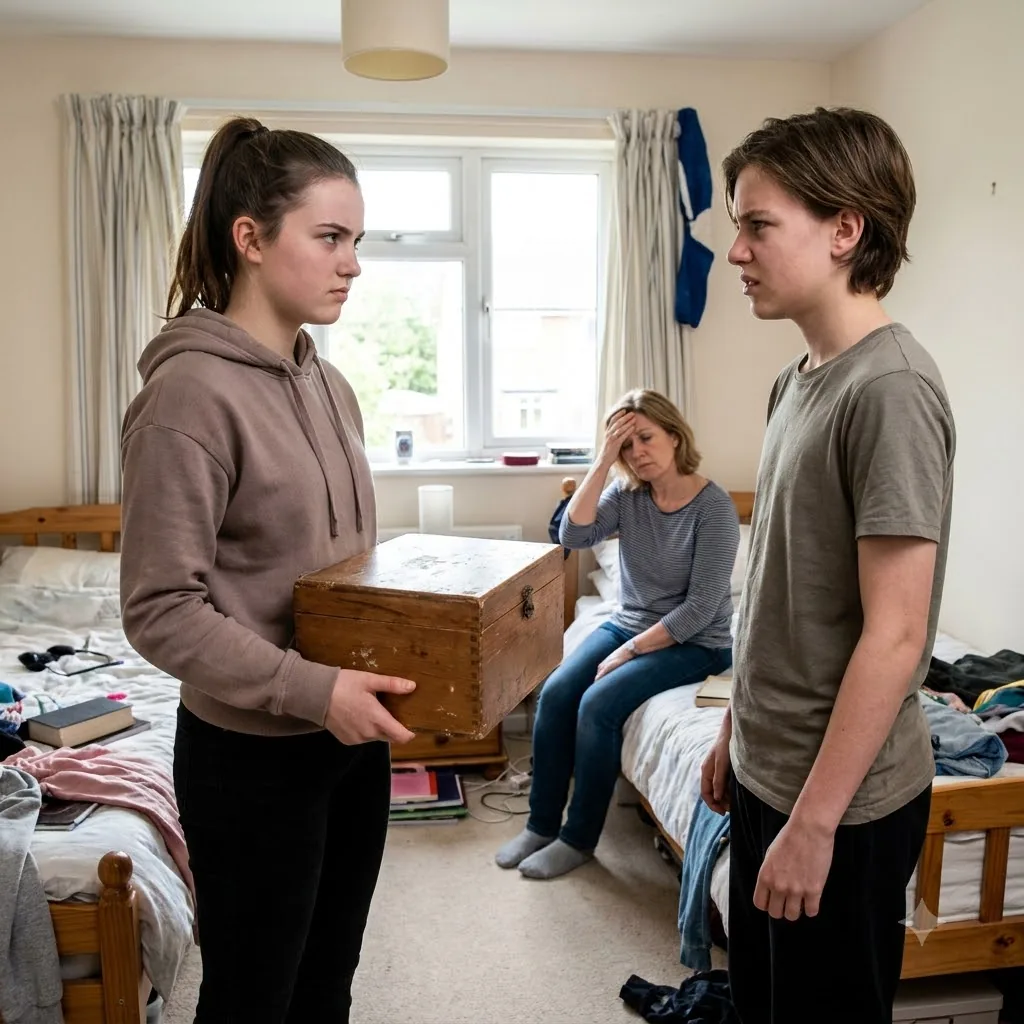
By dinner that same night, my stepsister had turned one fake term into a whole rulebook, and everybody in the house was adjusting themselves around a cedar box under her bed. She told my mom the box needed a “recontainment period,” told me I was contaminating the sequence by even asking for it back, and taped a piece of notebook paper to her bedframe that said DO NOT ACCESS DURING STABILIZATION. Our bedroom looked ridiculous with that sign hanging beside a pile of hoodies and a cracked full-length mirror, but nobody tore it down. I came back from switching the laundry and found Brielle on the floor with her phone in one hand and a pack of gallon freezer bags, tissue paper, and two little silica packets spread across her comforter like she was setting up a lab station. I said, “Why do you have freezer bags near Mom’s box?” She said, “They’re temporary barrier sleeves.” “They’re sandwich bags.” “You can call them whatever you want,” she said, not looking up. “That doesn’t change function.” That line was her whole method. Rename something ordinary, then act like the renamed version outranks everybody else. She had done it with my dresser drawers, my shelf space, even the fan direction at night. But this was my mom’s memory box, and now my mom was repeating Brielle’s words in a smaller, uncertain voice like she was trying not to make a mistake. Leah came in after work still holding her purse and asked, “Do I need to buy anything to protect it?” Brielle tapped at her phone. “Ideally, yes. Acid-free interleaving sheets, cotton gloves, a buffered archival tote, and a low-variance storage container. The under-bed setup is only emergency stabilization.” “How much is that?” my mom asked. Brielle gave a little shrug. “Depends how serious you are about preserving it. Cheap handling now becomes expensive regret later.” I was sitting on my bed matching pillowcases, and I stopped. “You still haven’t explained why the shelf was dangerous in the first place.” Brielle spoke over me. “Direct line-of-sight placement invites touch cycling.” My mom asked, “Touch cycling?” “Repeated casual access,” Brielle said. “Every time somebody gets sentimental and flips through items without protocol, the object loses structural trust.” I stared at her. “Structural trust isn’t a thing a box can lose.” She finally looked at me. “You keep proving my point by reducing this to a box.” My mom pinched the bridge of her nose and leaned against the doorframe. “I just don’t want those things ruined.” “Then stop letting her treat it like a shoe bin,” Brielle said. There was a pause after that because it was mean enough to land, and polished enough to pass as concern. I could feel the old familiar setup in the room: she says it cleanly, I answer plainly, and plain starts sounding weaker than polished even when polished is nonsense. Marcus showed up when he heard voices carrying down the hall. He stood at the threshold with his keys still in his hand and asked the question he always asked when room fights spilled into the rest of the house. “What’s the simple version?” Brielle answered before anyone else. “Mom’s memory box has been mishandled for a while, and I’m trying to prevent more degradation until it’s rehoused correctly.” I said, “Simple version is she moved it under her bed and keeps inventing phrases so nobody will challenge her.” Marcus looked at the sign on the bedframe, then at the tissue paper, then at Leah. “Do we know for sure it needs all this?” Leah didn’t answer right away. She adjusted the purse strap on her shoulder and looked at Brielle’s phone. “Can you show me where you’re getting this?” That should have been easy if any of it was real. Brielle turned the phone screen toward herself first, scrolled, then angled it out just enough for my mom to see blocks of text and product listings. I could only catch flashes from where I sat: storage bins, wedding keepsake boxes, scrapbook supplies, one article with a headline about preserving family photos. Nothing on the screen matched the words coming out of her mouth. “It’s all over preservation forums,” Brielle said. “Different people use different terms.” I said, “Then show one source that says memory seal. Or surface shock. Or structural trust.” She lowered the phone. “Specialists don’t all use consumer-facing language.” Marcus frowned. “Consumer-facing? For a family box in a bedroom?” Brielle stood up with the phone still in her hand and walked to the under-bed drawer. She didn’t pull it all the way open. She only slid it out a few inches, enough to make everyone look. The cedar box was inside beside one sneaker, a curling gift bag, and the floor vent that runs heat in winter and AC in summer. “See how insulated it is?” she said. I pointed straight at the vent. “That vent blows right there.” She answered fast. “Indirect airflow can be beneficial if the buffering is intact.” “What buffering?” I asked. She picked up one of the silica packets from her bed and held it between two fingers like proof. “Layer control.” Marcus stepped closer and crouched a little at the drawer. He didn’t touch anything. He just looked, then looked at the sign, then at the unopened pack of freezer bags on the blanket behind her. My mom asked, very quietly, “Have you already changed anything inside the box?” Brielle paused for half a beat. Then she said, “I performed a preliminary sequence check.” That was new. She had never said she opened it. I got off the bed. “You said nobody could open it during stabilization.” She kept one hand on the drawer and the other on her phone. “I said nobody should access it directly without protocol.” Marcus straightened up. “Did you open Leah’s memory box or not?” Brielle’s jaw set, and she gave the smallest nod. “To prevent further disorder, yes.” Nobody raised their.