Story code: ST-000860
Part 4: I Left Him With His Own Paper
I let his sentence sit between us without answering it right away.
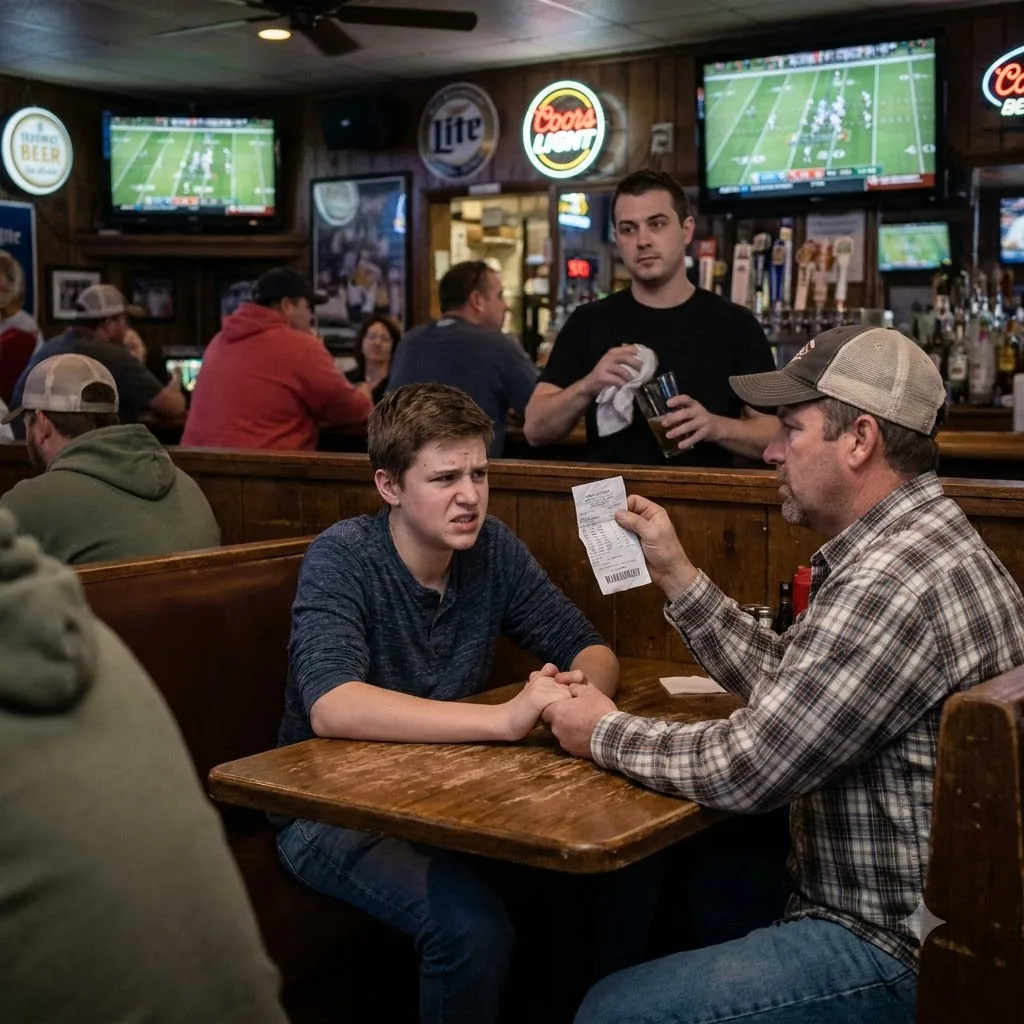
He kept his hand over the betting slip. The check presenter lay by my water glass. The game noise rolled on over our heads, bright and stupid and normal. Somebody near the bar cheered at a score update. Darren was carrying a stack of clean pint glasses from one end of the counter to the other. Nobody at Halftime Tap needed to know what Ray had just tried to make me accept.
I opened the presenter, pulled my card from my wallet, and slid it inside.
Ray watched my hands. “So that’s it?”
“That’s my tab.”
“Don’t play dumb.”
I looked at him evenly. “I’m not taking any part of your debt. Not the bet, not the account, not the story around it.”
His mouth tightened. “You think saying it like that changes what happened?”
“No. It keeps you from changing what happened.”
For a second he just stared at me. Then he tried one more time to smooth it over with that same family tone he had started with, like he could loop us back to the beginning if he sounded patient enough.
“Mia, listen,” he said. “Nobody’s trying to pin everything on you. I asked for one piece. One piece, because you’re my niece and you know I have shown up for people. That’s all I’m saying.”
“No,” I said. “You are saying I owe money because I gave you a ride after you’d already placed the bet and after you’d already funded the account for it. You left that out when you texted me. Then you changed the reason three times once I got here.”
I didn’t raise my voice. I didn’t turn to the room. I said it to him and only him, low enough that the sentence stayed inside our little square of table, water glass, paper slip, and check folder.
He glanced past me toward the bar and back again. “You don’t have to make it sound bad.”
“I don’t have to make it sound like anything. You already did that yourself.”
Tasha passed by, saw my card in the presenter, and picked it up with a quick nod. Ray didn’t say a word while she walked it to the service station. He looked at the slip, then at me.
“Family remembers things,” he said.
“So do I.”
He gave a short laugh under his breath. “You’ll really walk out over this.”
“I’m walking out because of this.”
That landed. He shifted back on the stool and reached for his beer, but the bottle was empty. He set it down harder than he needed to. “You could have handled this privately.”
“I am.”
His eyes flicked again toward Darren, toward the TVs, toward anywhere but the exact line he had been trying to drag me across. He still wanted my agreement more than my money. I could hear that now in every turn he took. If I had said yes to a little, he would have had the sentence he came for.
Tasha came back with the card reader. I tapped, took the receipt, and signed it. On the tip line, my hand stayed steady. I tore off my copy and slid it into my wallet.
Then I stood up.
Ray looked up at me. “You’re just leaving me here?”
“Yes.”
“After all that?”
“After all that.”
I reached into my bag, took out the spare key ring he had given me two months ago when I had watered his plants during a weekend trip, and set it on the table beside the betting slip. Metal against laminate, one sharp click.
He looked down at it. “What’s that supposed to be?”
“You don’t call me for favors anymore,” I said. “Not rides. Not keys. Not errands. Not emergencies that turn into invoices.” I nudged the key ring closer to him with one finger. “Find somebody else to keep access to your place.”
He stared at the keys, then at me. “You’re being dramatic.”
“No. I’m being done.”
I picked up my phone and stepped away from the table before he could stand with me and try to keep talking in my face. He did stand, but only halfway, one hand on the edge of the high-top, the other still over the folded slip like he couldn’t decide which thing mattered more to grab.
“Mia.”
I kept walking.
Darren glanced over as I passed the bar, not asking questions, just tracking movement the way bartenders do when a table changes shape. The front door gave me a blast of cooler air and parking-lot light when I pushed through. Behind me, the game noise dropped to a muffled wall of sound.
I didn’t stop under the neon sign. I kept going until I reached my car. Once I was inside, I locked the doors, plugged my phone in, and opened the contact screen while the windshield held the bar’s red-and-blue glow.
I changed Ray’s name to Do Not Answer.
Then I blocked his number before I could sit there arguing with myself about whether that was too much. The screen went still in my hand. No speech to answer. No family wording to untangle. No piece to negotiate.
Back at the window, Halftime Tap looked exactly the same as when I had walked in: TVs flashing, people moving, glasses catching light. Ordinary night, ordinary bar.
His debt was still in there with him. I wasn’t.