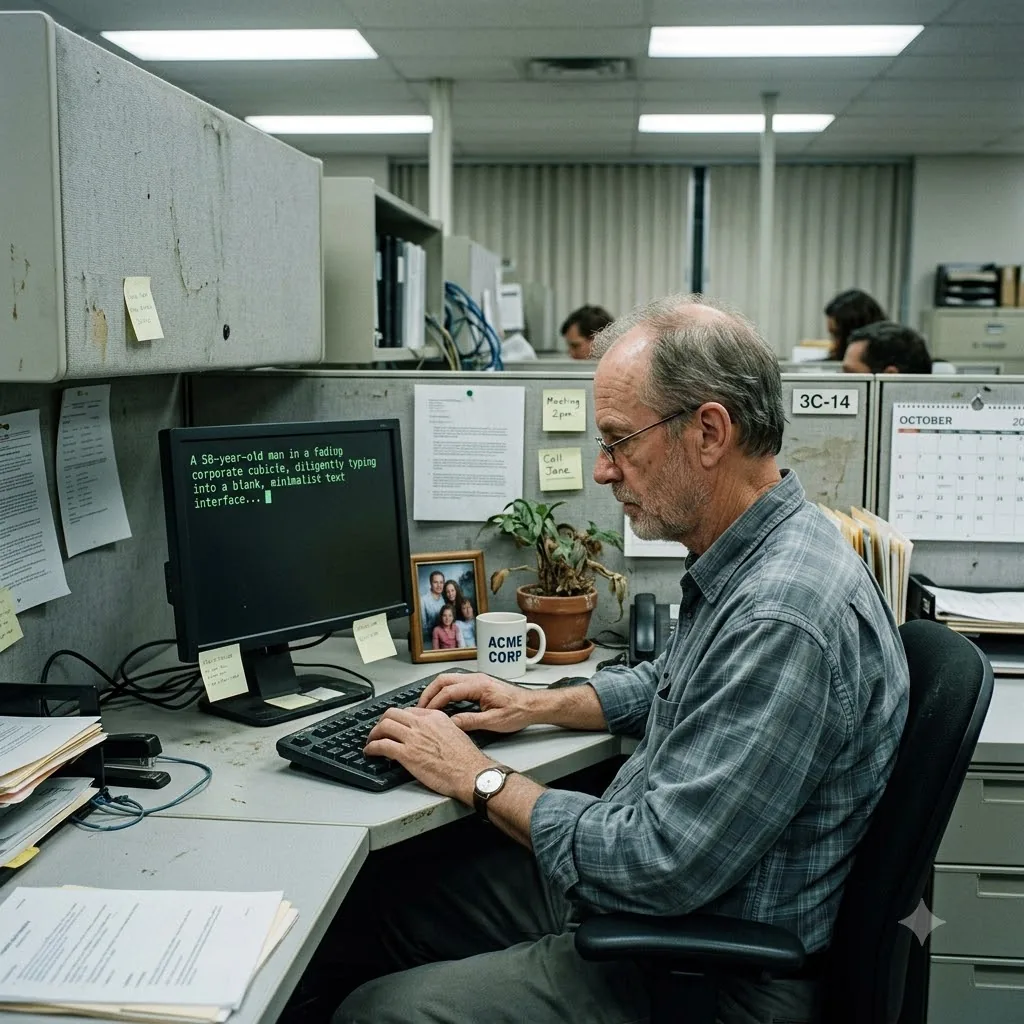
Story code: ST-000573
Part 2: The Training Data
The black line blinked with a steady, indifferent pulse. Elias kept his hands hovering over the mechanical keyboard, his breath shallow. He waited for a crash notification, a server timeout error, anything to explain where his six hundred words had gone.
A chime echoed from his laptop speakers. An email notification slid into the top right corner of his screen.
It was from Sarah. The subject line read: *Re: Vanguard – Initial Ingestion.*
Elias clicked it, his heart hammering against his ribs.
*Elias, received the first pass via Echo,* the email read. *Strong structural integrity. However, the client just emailed. They want to pivot the core messaging slightly. They need more emphasis on generational wealth transfer in the second act. The tone needs to be less about ‘buying a product’ and more about ‘securing a legacy’. Rework the middle. Echo is ready for your iteration. – S.*
He stared at the brief message. The interface hadn’t crashed. It had bypassed standard protocol, stripped away his ability to save or review, and piped his raw text directly to the creative director. He was working without a net, on a live wire.
Elias switched back to the browser tab containing Project Echo. The screen was still a vast, empty expanse of white.
How was he supposed to rework the middle if he couldn’t see the text?
He placed his fingers back on the home row. Hesitantly, he typed a command, treating the void like a rudimentary search bar: *Show previous draft.*
He stopped moving his mouse, keeping the cursor perfectly still to avoid triggering another vanishing act. He hit the Enter key.
The words *Show previous draft* blinked out of existence.
For three seconds, nothing happened. Then, a single character appeared. Then a word. Then a sentence. The text was not appearing in chunks, nor was it being pasted. It was printing across the screen at an unnaturally rapid, perfectly uniform pace.
Elias leaned forward, his eyes scanning the flat, sans-serif font. It was the Vanguard pitch. The AI was spitting his exact words back at him. But as it reached the end of the first paragraph, the rhythm changed. The text didn’t stop where Elias had ended it. It kept generating.
*…a legacy not built on temporary fortunes, but on the steadfast architecture of memory.*
Elias froze. His blood ran cold.
*The architecture of memory.*
He hadn’t typed that phrase this morning. He hadn’t used that phrase in over eight years. It was the anchor line for a luxury watch campaign he had penned in 2015, a campaign that had won a regional Clio award. The drafts, the revisions, and the final copy for that specific project were buried deep in a nested folder on his legacy network drive. The exact drive he was currently locked out of.
He watched in mounting horror as the black cursor raced across the screen, constructing the second act. It was weaving his twenty years of proprietary genius, his personal lexicon, his very soul, into a synthetic tapestry. Sarah hadn’t just migrated the servers. She had fed his entire professional history-every discarded draft, every brilliant late-night epiphany, every meticulously categorized manifesto-into Project Echo’s training model.
The interface wasn’t a blank canvas. It was a mirror. And it was learning how to be him.
The cursor finished generating the revised second act, halting abruptly. Elias read the new paragraph. It was an attempt to address Sarah’s note about generational wealth transfer.
It was good. It was frighteningly good. It seamlessly mirrored his cadence, employing his signature mix of short, authoritative statements followed by sweeping, evocative imagery. But as his seasoned eyes scanned the text, his professional pride instantly caught a snag.
The machine had written: *You are providing a reliable future for your children, an enduring comfort that outlasts market fluctuations.*
Elias scoffed aloud in the empty office. It was clunky. *Reliable future* was pedestrian. *Enduring comfort* sounded like a mattress commercial, not a high-end financial trust. It lacked the emotional resonance that made his copy convert. The AI understood his vocabulary, but it didn’t understand the human heart. It didn’t know how a father actually felt looking at his newborn son.
Without thinking, driven entirely by two decades of unyielding perfectionism, Elias typed directly below the AI’s output: *Change ‘reliable future’ to ‘an unspoken promise’. Change ‘enduring comfort’ to ‘the quiet resilience of a secured bloodline’.*
He moved the mouse. The screen flickered. His corrections vanished.
The entire paragraph disappeared, leaving the void momentarily blank. Then, the cursor raced across the screen again, rewriting the second act.
When it stopped, Elias read the result. The AI hadn’t just swapped the phrases. It had restructured the surrounding syntax to elevate the new emotional weight, perfectly mimicking Elias’s most sophisticated sentence structures. It was a masterpiece.
It was flawless. And Elias had just taught it how to do it.
The realization hit him with the force of a physical blow. He wasn’t just writing a pitch. He was polishing his replacement. Every time he corrected its mediocre attempts, every time his pride refused to let a clunky sentence stand, he was sanding down the AI’s rough edges. He was giving it the last five percent of human intuition it lacked.
Once it mastered his emotional resonance, Sarah would have no use for a highly paid senior copywriter who complained about server access. She would just have Echo.
Elias stared at the blinking cursor. It waited at the bottom of the screen.
A new email pinged. Sarah again: *Need the final act. Bring it home, Elias. Show me why you’re the best.*
Elias gripped the edge of his desk. If he finished the pitch with his usual brilliance, Vanguard would sign, Sarah would have her proof of concept, and Echo would permanently absorb the pinnacle of his craft. He would be training his own executioner.
But if he intentionally sabotaged it-if he fed the machine clumsy, disjointed garbage to ruin the pitch and prove the AI was a failure-he would be attaching his name to a disaster. He would miss the deadline, bomb the Vanguard account, and give Sarah the exact ammunition she needed to fire him for poor performance.
The cursor blinked. Relentless. Patient. Hungry.
He had twenty minutes until noon. He hovered his trembling hands over the keys, torn between the survival of his career and the inescapable gravity of his own pride.