Story code: ST-000364
Part 2: The Mandate
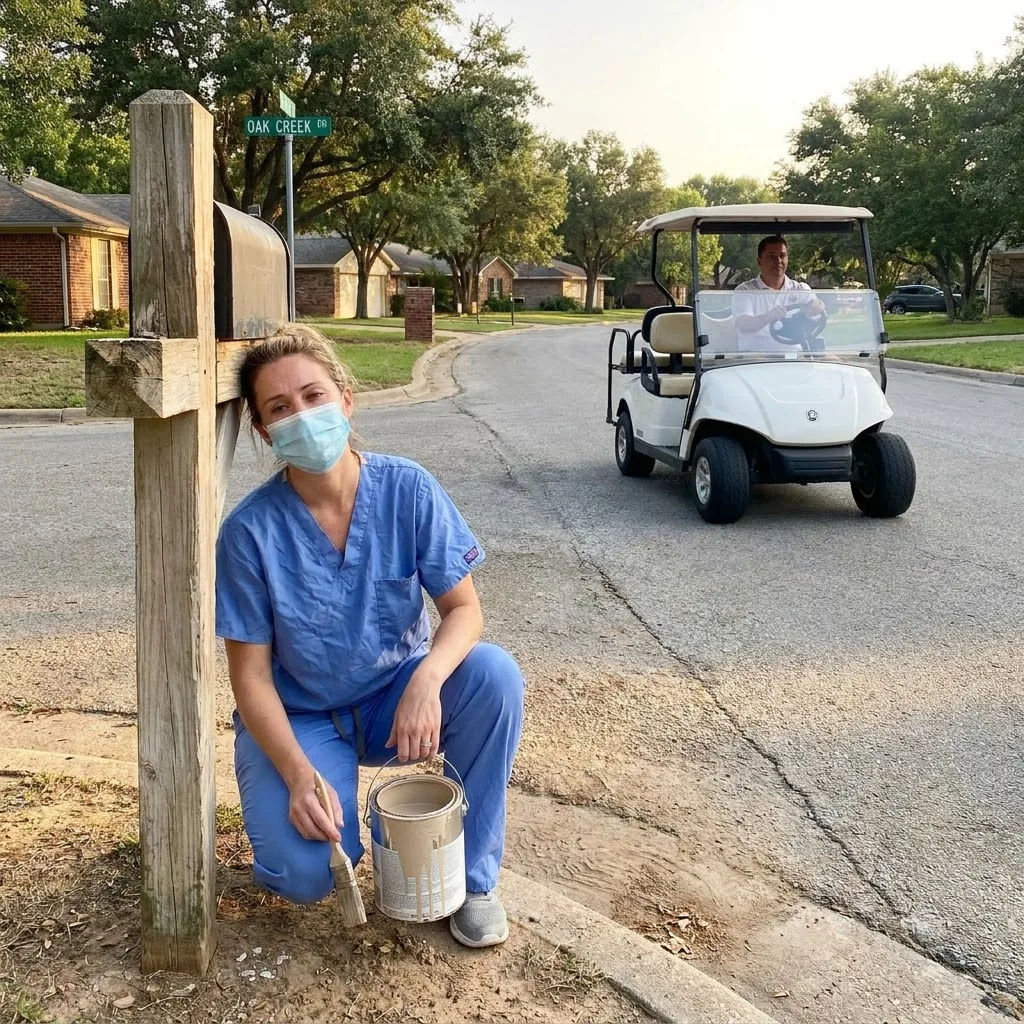
Elias stood on the concrete porch, the cold seeping into his bare feet. He stared down the length of the driveway at Helen Vance, whose pastel-pink tracksuit was a jarring splash of color against the gray morning.
“Can I help you, Helen?” Elias kept his voice low, trying to lock down the tremor of exhaustion in his jaw.
Helen didn’t flinch. She tapped her yellow measuring tape against her metal clipboard and offered a smile that didn’t reach her eyes. “Good morning, Elias. Just conducting the routine perimeter checks. We have standards to uphold in Oakridge. Surely, you understand that.”
“Routine checks,” Elias repeated, stepping down onto the driveway. The morning dew soaked into the hems of his sweatpants. “You’re measuring my mailbox post at eight in the morning. And you just taped a five-hundred-dollar fine to my door for faded paint.”
“The paint lacks the mandatory gloss finish outlined in section four, paragraph B of the community guidelines,” Helen said smoothly, jotting a quick note on her clipboard. “And as for the post, my measurements confirm it is leaning precisely one point five inches past the acceptable vertical deviation. That will be an additional infraction.”
Elias rubbed his temples. His skull throbbed in time with his racing heartbeat. “My mailbox is fine. It’s identical to the one at the corner, and the one across the street.” He pointed a stiff finger toward the Anderson’s house, but stopped. The Andersons’ front window blinds, previously open to let in the morning light, were snapping shut. The sudden movement sent a cold realization washing over him. The neighbors knew exactly what was happening, and they were actively looking the other way.
“Other properties are not your concern,” Helen said, her tone dripping with rehearsed patience. “Your property, however, is becoming a significant blight on our community.”
“A blight,” Elias scoffed, taking another step forward. “I cut the grass every weekend. I keep the trim painted. This isn’t about my lawn or my mailbox, Helen. It’s about the pamphlets.”
Helen paused, her pen hovering over the clipboard. “I’m sure I don’t know what you mean.”
“The church tracts,” Elias said, his voice rising despite his best efforts to keep it steady. “You left a pamphlet about eternal damnation inside an HOA violation envelope. You’re fining me because I politely told you I don’t have time to go to your megachurch. Because I work weekends.”
“Your spiritual state is a private matter between you and the Lord,” Helen replied, her voice dropping to a theatrical whisper. “Though it is a tragedy to see a young man stray so far from the righteous path, dedicating his Sabbath to secular labor. The Lord rests, Elias. The community rests. Those who refuse to integrate into our shared moral fabric often find their lives becoming… difficult.”
“Are you threatening me?”
“I am enforcing the bylaws.” Helen’s smile returned, sharper this time. She unclipped a fresh, neon-orange envelope from the back of her clipboard and extended it toward him. “Speaking of which, since you failed to remit payment for the previous two citations-the grass height and the refuse bin-your account is now in arrears.”
Elias stared at the orange square, refusing to take it. “I haven’t paid them because they’re fabricated. I sent an email to the board disputing both of them.”
“Emails do not pause the collection cycle,” Helen said. When he didn’t reach for the envelope, she simply dropped it onto his manicured ivy bed. “With today’s mailbox alignment penalty, your outstanding balance has crossed the one-thousand-dollar threshold. Per the HOA covenants you signed at closing, the board is now required to initiate a property lien.”
The word hit Elias like a physical blow. “A lien? You’re putting a lien on my house over a mailbox and a trash can?”
“Rules are rules. A lien ensures the community is protected against delinquent homeowners,” Helen said, adjusting her grip on the clipboard. “The board will vote to finalize the lien at the special appeals hearing this Wednesday.”
Panic flared through the heavy fog of Elias’s sleep deprivation. A lien meant a strike against his mortgage. It was a legal encumbrance that could destroy his credit and, if left unchecked, allow the HOA to foreclose on his home. “Wednesday. I need to be at that hearing.”
“You have the right to attend,” Helen agreed, her eyes gleaming with quiet triumph. “The hearing is scheduled for seven o’clock in the evening. In the fellowship hall of the church.”
Elias clenched his fists. “I’m the charge nurse in the surgical ICU on Wednesday night. My shift starts exactly at seven. I can’t be there.”
“That is highly unfortunate,” Helen said, turning on her heel to walk back down the driveway. “Attendance is mandatory for an appeal. Perhaps if you prioritized your life to align with decent, community-focused hours, you wouldn’t be in this precarious situation. Have a blessed day, Elias.”
Elias stood frozen in the driveway as Helen strolled away, her pastel tracksuit retreating down the cul-de-sac like a poisonous flower. He bent down and picked up the orange envelope from the ivy. His hands were shaking again, but not from the residual adrenaline of his hospital shift.
He tore the envelope open. Inside was the official notice of the lien hearing, printed on the same heavy cardstock as the fines. Beneath the date and time, a bolded clause caught his eye. It explicitly stated that if the homeowner failed to appear, the lien would be granted by default, and the board would reserve the right to initiate foreclosure proceedings after ninety days.
The trap was perfectly set. If he missed the hearing, Helen would take the first legal step toward stealing his house. If he called off work on Wednesday, he would be abandoning a critically understaffed ICU, leaving vulnerable patients in danger and risking his own nursing license for a sudden, unexcused absence.
The morning sun glared off the white paper, burning his tired eyes. Elias turned back toward his empty house, the weight of the neighborhood’s silent judgment pressing down on his shoulders. He had less than three days to find a way out of a corner he hadn’t even known he was backed into, and he was too exhausted to think straight.