Story code: ST-000210
Part 2: The Ecological Quarantine
Eleanor’s voice did not waver as she recited the text of the secondary laminated sheet. She read with the practiced cadence of a seasoned litigator, her enunciation crisp and carrying easily over the property line. “…and pursuant to Section 4, Paragraph 8 of the newly amended Oakridge Flora and Fauna Charter, any mechanized equipment staged within fifty feet of a Heritage Drip Line is subject to an immediate physical injunction, pending a Tier Three Ecological Impact Study.”
She lowered the sheet, elegantly smoothing a slight bend from the plastic coating. She informed Marcus that the HOA board had secured a blanket right-of-way easement during their midnight session, legally empowering them to erect the protective barrier on his deeded property to prevent imminent ecological trauma.
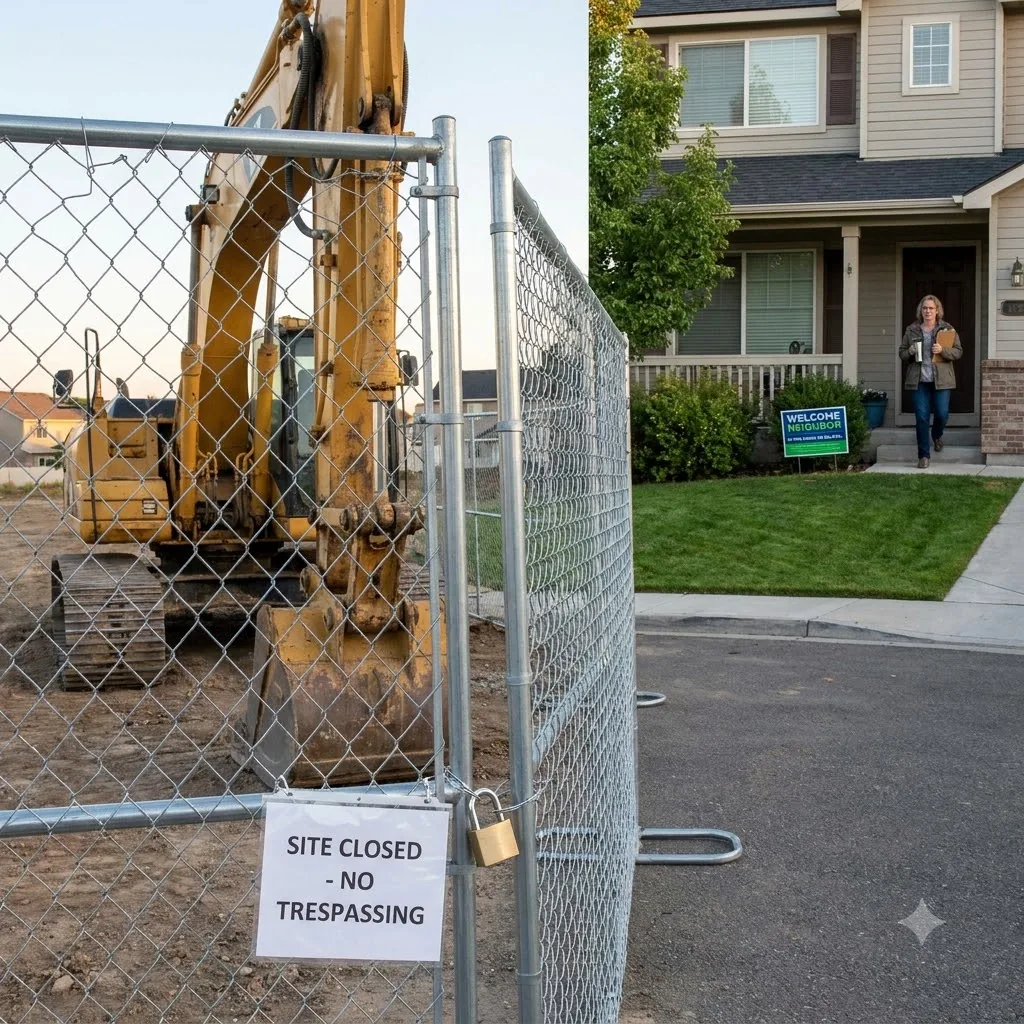
Before Marcus could point out the absolute absurdity of a midnight easement, the grinding roar of a heavy diesel engine overpowered the quiet morning. A massive flatbed truck hauling a skid steer, followed closely by a rumbling dump truck, turned onto the pristine suburban street. The air brakes hissed violently as the convoy parked parallel to Eleanor’s manicured curb. The excavation foreman, Dave, hopped out of the cab carrying a battered metal thermos and a clipboard. Dave walked up the sidewalk, took one look at the gleaming chain-link fence, the heavy brass padlock, and the neon sign, and stopped dead in his tracks.
Marcus approached the foreman, attempting to explain that the situation was a temporary misunderstanding and that he was getting the city on the phone to clear it up. Dave shook his head, tapping a heavy brass pen against his clipboard. He stated flatly that his crew was on the clock. If those steel gates didn’t open in twenty minutes, he was billing Marcus for a full day’s minimum-two thousand dollars-and pulling his men to another job site across town.
Marcus’s chest tightened. He pulled his phone back out and dialed the direct extension for the municipal planning department. He paced the narrow strip of asphalt between the bumper of his truck and the chain-link barricade, listening to the tinny, cheerful hold music echoing from his phone’s speaker. Through the steel mesh, his rented yellow excavator sat perfectly still, silently costing him four hundred dollars a day in rental fees alone. On the other side of the property line, Eleanor had casually returned to her garden. She knelt on a padded foam mat, meticulously pruning her rose bushes with her stainless steel shears. She hummed a soft, melodic tune, entirely unbothered by the thick diesel fumes billowing from Dave’s idling trucks.
The hold music stopped abruptly. A municipal clerk answered. Marcus recited his parcel number and permit ID, formally requesting the immediate dispatch of a city inspector to force the removal of an illegal HOA barricade blocking an approved construction site. Keys clacked loudly over the phone line. The clerk paused. She informed Marcus that his building permit had been temporarily suspended.
Marcus stopped pacing. He stared through the chain-link at the patch of dirt where his foundation was supposed to be dug. He told the clerk he had the fully approved, stamped permits sitting on the dashboard of his truck. The clerk’s tone dropped into a flat, apologetic monotone. She explained that a neighborhood coalition called the Oakridge Environmental Conservancy-which she noted was registered at Eleanor’s exact address-had filed an emergency grievance at 8:01 AM yesterday, claiming Marcus’s heavy machinery was actively leaking hydraulic fluid into the historic root system.
Marcus argued loudly that the excavator hadn’t even been turned on since it was dropped off. It was physically impossible for it to be leaking anything.
The clerk sighed, stating that the municipal environmental tribunal required a mandatory stand-down until an independent, city-approved Tier Three Arborist could officially assess the soil. Marcus demanded to know how long that would take. The clerk pulled up the county registry. She gave him the number of the only certified specialist in the region and warned him that the current assessment waitlist was three weeks long.
Three weeks. Marcus did the math, the numbers flashing in his mind like a foreclosure notice. Three weeks of excavator rental fees. Three weeks of high-interest bridge loan payments compounding daily. If he didn’t pour the foundation and pass a structural inspection by the fourteenth of the month, he would miss his first bank deadline, freezing his construction draw and throwing the entire commercial loan into default. He would lose the lot, the capital he’d already sunk into the permits, and potentially his business.
Dave honked the horn of the dump truck. He leaned out the window, pointing aggressively at his watch.
Marcus walked over to the street and told Dave to take the crew to their backup job. He signed the clipboard, officially burning two thousand dollars for absolutely zero progress. He watched the heavy trucks rumble away, the diesel exhaust slowly settling over the neighborhood’s progressive yard signs.
As the sound of the trucks faded, a small, white municipal vehicle turned onto the street. It bore the green seal of the City Code Enforcement division. The electric car rolled to a silent stop directly behind Marcus’s pickup. A uniformed officer stepped out, holding a ruggedized digital tablet.
Eleanor stood up from her rose bushes, delicately dusting off her linen wrap. She waved warmly at the officer, calling him by his first name.
The officer nodded to Eleanor, then walked directly up to Marcus. He didn’t look at the locked HOA fence, nor did he look at the neon sign. He looked straight through the galvanized mesh at the rented excavator.
The officer tapped his tablet screen and informed Marcus that he was issuing a citation for an unsecured environmental hazard. He explained that due to the pending grievance filed by the Oakridge Conservancy, the heavy machinery was currently parked inside a designated ecological quarantine zone.
Marcus pointed furiously at the heavy brass padlock. He stated clearly that he could not move the machine because the HOA had physically barricaded his property. He demanded the officer order Eleanor to unlock the gate so he could return the rental equipment and stop the financial bleeding.
The officer shook his head, printing a long paper receipt from a device clipped to his belt. He explained that property disputes, midnight easements, and HOA barriers were strictly civil matters, completely outside his municipal jurisdiction. However, leaving the excavator inside the newly designated quarantine zone was a direct municipal code violation.
He handed Marcus the printed ticket. It was a formal order to remove the machinery within twenty-four hours. If the excavator was not gone by tomorrow morning, the city would send a specialized hazardous-material towing crew to impound it, automatically billing Marcus a mandatory five-thousand-dollar extraction fee.
Marcus stared at the ticket in his calloused hand, then up at the heavy brass padlock securing the chain-link fence. If he cut the lock to remove his equipment, he violated the HOA bylaws and faced severe legal penalties for destroying a protected barrier. If he left the machine where it was, the city would impound it tomorrow and bankrupt him instantly.
Eleanor walked over to her side of the property line, holding a woven basket lined with a checkered cloth. She offered the code enforcement officer a fresh organic bran muffin, her serene, practiced smile brighter than the morning sun.