Story code: ST-001060
Part 2: Preliminary Assessment
The man’s heavy boots crunched onto the threshold. He didn’t even look up from his steel clipboard as the freezing wind whipped the hallway runner rug into a crumpled fold. “Unit B, preliminary demo assessment,” he mumbled to himself, clicking a heavy ballpoint pen.
“Get out,” Maeve said. Her voice trembled, not from the sudden plunge in temperature, but from the sheer adrenaline flooding her veins. She stepped squarely into the center of the narrow hallway, blocking his path to the living room.
The man finally looked up. He was young, maybe late twenties, with a neatly trimmed beard and a Bluetooth earpiece blinking blue against his ear. He didn’t look embarrassed by his intrusion. He looked inconvenienced. “You the tenant? Notice was posted this morning.”
“Thirty days,” Maeve said, crossing her arms tightly over her wool cardigan. “The notice said thirty days to vacate. Not thirty minutes. You cannot just unlock my door and walk into my home.”
The man sighed, a long, exaggerated sound that fogged in the frigid air between them. He pushed the door closed behind him with his heel, plunging the hallway back into dim shadows. “Look, lady, I’m just the project manager. Vanguard policy is to assess all units the day the transition notices go up. We have to map the structural footprints for the open-concept conversions. I just need to take some photos and measure the load-bearing walls. Take ten minutes.”
He didn’t wait for her permission. He raised a smartphone and snapped a photo of the hallway. The sudden flash temporarily blinded Maeve, leaving a purple ghost image floating in her vision. Before she could blink it away, the heavy tread of his boots moved past her, tracking gray, salted slush directly onto the hardwood floor she had mopped just the night before.
Maeve followed him into the living room. “I told you to leave. I have a child who lives here. I have a lease.”
“Lease transferred to Vanguard in the sale,” the man said, tapping his phone screen. “And Vanguard is offering an accelerated relocation package. It’s in the email you should have gotten. ‘Cash for Keys.’ You sign away the thirty-day window, pack up by Friday, and we cut you a check for fifteen hundred dollars. Otherwise, you get to live in an active construction zone for a month. We’re ripping out the asbestos in the roof tomorrow. Water is going to be shut off intermittently. Heating, too. Not exactly a great environment for a kid.”
Maeve’s chest tightened, the cold air suddenly trapped in her lungs. Friday. Three days. Fifteen hundred dollars wouldn’t even cover a security deposit on a new apartment in this city, let alone the logistics of moving a child’s entire life. They were going to freeze her out, physically and financially. She thought of Leo’s small, faux-fur hood, his quiet morning routine. They were going to bury him in drywall dust and freezing temperatures until she broke.
“I have custody papers,” Maeve said, turning back toward her bedroom to retrieve her shoebox. “I have legal rights.”
“Take it up with the acquisitions director,” the man said dismissively. He walked straight past the living room and down the narrow back hallway. “He’s doing the exterior walkthrough right now. I just need the bedroom dimensions.”
Maeve froze, the shoebox forgotten on her mattress. The man was already at the end of the hall. He pushed open the door to Leo’s room, snapped a quick photo of the twin bed and the dinosaur posters, and then pivoted to the closed door across the hall.
“Stop,” Maeve said, her voice cracking like thin ice. “Do not open that door.”
“Gotta document the whole footprint,” he replied, twisting the brass knob.
The door swung inward. The stale, suffocating air of the room spilled out into the hallway, smelling faintly of old perfume and the sharp, metallic tang of the biohazard chemicals the cleaning crew had used two years ago. The project manager stepped inside, raising his phone.
Then he stopped.
Maeve stood in the doorway, her nails digging into her palms until the skin nearly broke. The room was perfectly preserved, yet fundamentally shattered. The floral bedspread was still neatly tucked, but the dark, impossible stain on the carpet where her daughter had collapsed was fully visible, bordered by the ugly, hacked-away section of padding the paramedics had ruined. The nightstand was still cluttered with the ugly reality of it: the small lockbox, the rubber tourniquet she hadn’t been able to bring herself to throw away, the framed photo of a younger, smiling Maeve and her daughter, cracked down the center from where it had been knocked to the floor.
“Jesus,” the man muttered, lowering his phone. He pinched his nose. “We’re going to need a full bio-remediation crew for this floor. Probably rip out the subflooring. Place is a total hazard.”
He wasn’t looking at a tragedy. He wasn’t looking at the space where a young mother had lost a brutal battle with addiction, leaving a grandmother and a little boy stranded in the wreckage. He was looking at a line item on a spreadsheet. A temporary delay in the luxury suite conversion.
Maeve felt something snap in the deep, dark place where she kept her grief. The quiet, polite desperation she had worn all morning evaporated. It was replaced by a cold, terrifying clarity. They wanted to sanitize this space. They wanted to paint over the stain on the carpet with minimalist gray tones and rent it to tourists looking for a weekend getaway.
“You said the director is outside,” Maeve said. Her voice was no longer trembling. It was dead flat.
The project manager stepped backward out of the room, eager to get away from the oppressive atmosphere. “Yeah. Mr. Vance. He’s in the black SUV on the corner. But lady, he’s just going to tell you the same-”
Maeve didn’t let him finish. She turned and walked into her own bedroom. She didn’t grab the polite legal documents. She didn’t grab the lease or the toothless guardianship papers. She reached to the very bottom of the worn shoebox. Her fingers closed over the thick manila envelope she had kept sealed for two years. The coroner’s report. The crime scene photos. The ugly, unvarnished reality of what this property actually held.
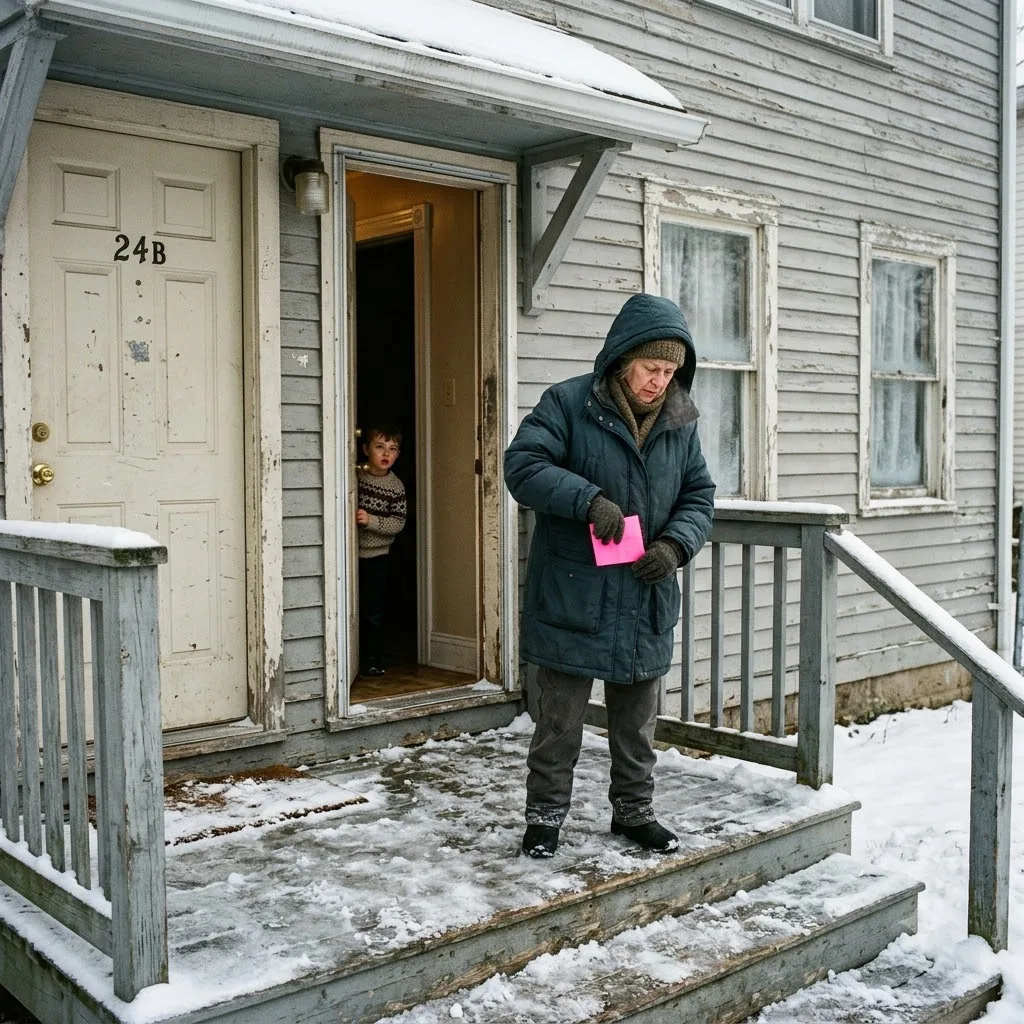
She pulled her heavy wool coat off the bedpost and slipped it on over her cardigan. She walked past the project manager, ignoring him completely as she marched toward the front door.
Through the frosted glass, she could see the silhouette of the idling luxury vehicle parked at the curb, its exhaust pluming thick and white in the freezing air. The corporate algorithm wanted a cheerful transition period. They wanted a sanitized eviction. Maeve gripped the manila envelope so hard it crinkled. She pushed the front door open, stepping out into the biting winter wind.