Story code: ST-000719
Part 2: The Enforcement Bounty
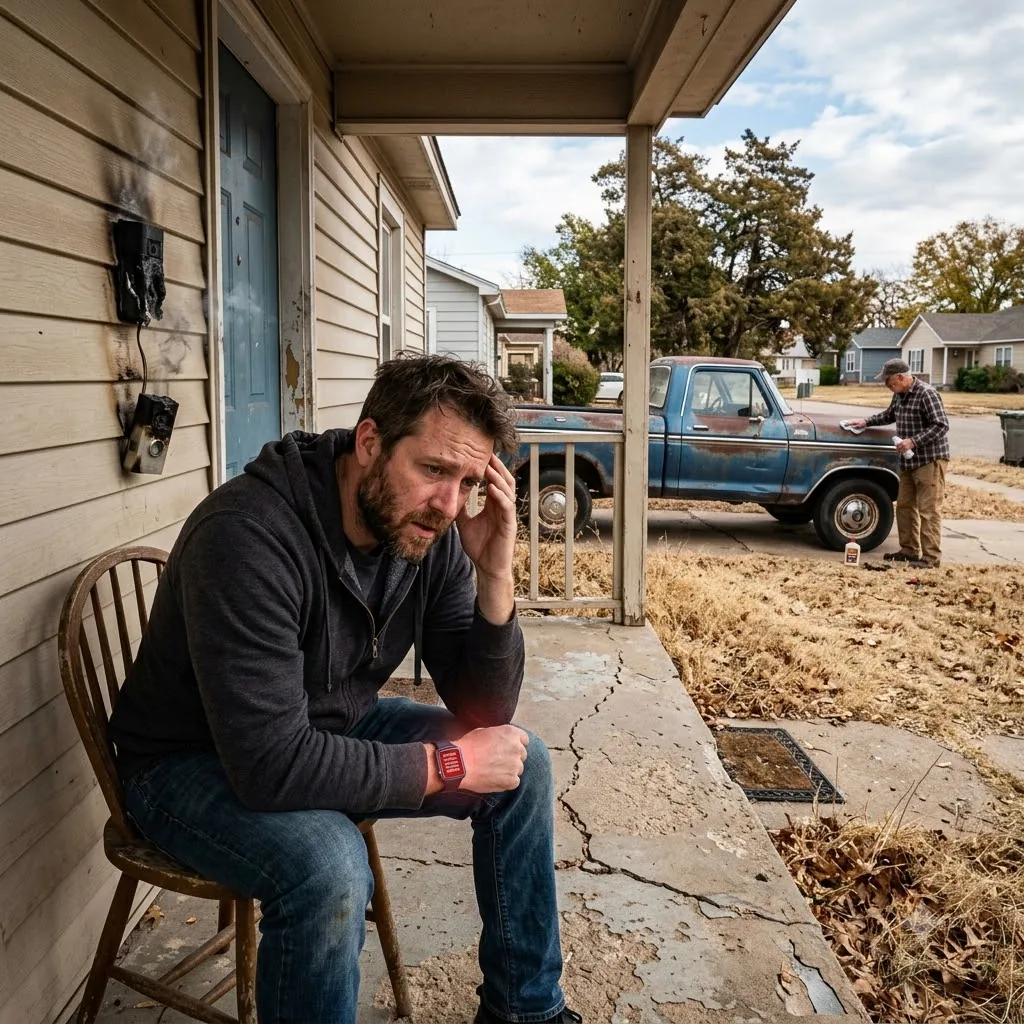
The high-pitched whine spiked into a painful, rattling frequency. Wade dropped the charred logic board and threw his arms over his face, instinctively twisting away from the open doorframe. A brilliant, blinding beam of violet light sliced through the evening shadows. It didn’t hit him. It tracked precisely past his front porch, cut through the bare branches of his dying oak tree, and struck the eaves of the house next door.
Sparks showered from the Martins’ gutter-mounted weather sensor. The small device was part of the same corporate mesh network as Wade’s doorbell, feeding hyper-local humidity and air quality data back to the underwriter’s servers. The violet beam held steady for exactly three seconds. The plastic housing popped, glowing a fierce, molten orange before dying out in a puff of acrid black smoke. The laser vanished. The whine spun down into total silence.
Wade stood frozen, his heart hammering violently against his ribs. His wrist pulsed again. The continuous stream of warnings from his smartwatch felt like a physical weight dragging down his arm.
*Grace Period: 3 Hours, 52 Minutes. Elevated Heart Rate Detected.*
Wade scrambled back inside and slammed his heavy front door shut, throwing the deadbolt. He leaned his back against the wood, sliding down until he hit the floor. The air in his living room felt suffocating. He pulled his phone from his pocket. The screen was still locked on the angry red suspension warning, but as he stared at it, the interface flickered. A new prompt pushed through the local Bluetooth connection, generated by the corporate diagnostic protocol running in the background.
*Tampering Detected. File Vandalism Report to activate Emergency Cellular Uplink.*
Wade blinked, his thumb hovering over the glass. He tapped the notification.
The screen shifted, displaying a dense wall of terms and conditions. He didn’t read them. He scrolled frantically to the bottom and hit accept. The app immediately opened his phone’s camera, overlaying a specialized targeting reticle on the live feed. A sterile, automated text box appeared at the bottom of the screen:
*Identify source of unauthorized hardware damage. Capture optical signature of directed energy weapon to authorize emergency override. Note: Successful identification will dispatch automated law enforcement and corporate recovery agents.*
Wade stared at the glowing words. The insurance company didn’t just want a report; they wanted a bounty hunter. They wanted him to document the neighbor in the act. If he captured the laser firing, the app would instantly grant him a forty-eight-hour extension and bypass his dead doorbell using a cellular micro-burst. His insulin copay would be safe. His health coverage would hold.
All he had to do was point his phone out the window and hit record.
He crawled across the carpet toward the living room window, keeping his head below the sill. He reached up, carefully parting the slats of the faux-wood blinds. Across the street, the neighbor’s house remained a fortress of shadow. The thick blackout curtains were impenetrable. But Wade knew the pattern now. The laser fired every ten minutes, systematically scrubbing the block’s surveillance grid.
Wade raised his phone. The targeting reticle glowed a pale, expectant green.
He thought about the neighbor. An older guy named Miller, a retired electrical engineer who rarely spoke to anyone. A month ago, Miller had stood up at a neighborhood association meeting and screamed about the new biometric zoning laws. He warned everyone that the parent company was secretly aggregating their street’s sleep schedules and diet purchases to justify a blanket twenty-percent premium hike. Everyone had called him crazy. Two days later, the neighborhood cameras started melting.
Miller was the only person fighting back against a system that held all their lives hostage. And now Wade was aiming a corporate targeting system right at the man’s front window.
“I’m sorry,” Wade whispered to the empty room. “I need my meds.”
His finger rested on the capture button. He waited. Five minutes passed. Then eight. His smartwatch buzzed. *Grace Period: 3 Hours, 40 Minutes.*
Suddenly, the high-pitched whine began to spool up again. Wade tensed, pressing his phone against the glass to steady it. But the sound wasn’t coming from across the street.
It was coming from his own backyard.
Wade whipped around. His phone slipped, clattering against the windowsill. He scrambled to his feet and ran toward the kitchen. The whine grew louder, vibrating deep in his teeth. He skidded to a halt in front of the sliding glass door that led to his small patio.
Through the glass, he saw a dark figure standing by his fence line, holding a bulky piece of shoulder-mounted equipment. It was Miller. He had crossed the street.
Miller wasn’t aiming at a doorbell. He was aiming the thick barrel of the laser rig directly up at the master fiber-optic junction box mounted on the utility pole behind Wade’s house. That box served the entire subdivision. If Miller melted the main line, the local network wouldn’t just be severed-it would be physically annihilated. No one on the block would be able to sync their biometrics for a week. The company wouldn’t just suspend Wade’s coverage; they would suspend everyone’s.
Wade unlocked the sliding door and yanked it open. “Stop!” he yelled, his voice cracking with panic.
Miller flinched, lowering the rig slightly. The whine died down into a low hum. He looked at Wade through the gloom, his face partially obscured by heavy thermal goggles. “Get back inside, Wade,” Miller hissed, his voice tight and breathless. “You don’t understand what they’re doing with the local nodes. The hub in your house is a repeater. They’re using our own bandwidth to run the enforcement algorithms.”
“I don’t care about the algorithms!” Wade stepped out onto the cold concrete of the patio, holding up his buzzing wrist. “My coverage is disconnected! If you blow that junction box, the repair crews will take weeks! I can’t afford my insulin tomorrow, Miller! You’re going to kill me!”
Miller stood perfectly still. The heavy equipment vibrated softly against his shoulder. “If I don’t blow it, they’re finalizing the zone reassessment at midnight. Everyone’s premiums double tomorrow morning. Half the block will default. You’ll lose your insulin anyway, Wade. Along with your house.”
Wade felt the blood drain from his face. “What?”
“It’s a localized risk pool,” Miller said, taking a step closer. “They aggregated the neighborhood data. We failed the metric. I’m trying to destroy the master transmission before the package uploads. If the data doesn’t reach the servers tonight, the automatic rate hike defaults to a manual review. That buys us thirty days.”
Wade’s phone burned in his hand. The insurance app was still open. The targeting reticle was pulsing, flashing a bright yellow warning across the bottom of the screen:
*Unauthorized Equipment Detected in Proximity. Capture image now to secure Tier 1 Status.*
Miller raised the heavy laser rig, resting the stock against his shoulder and aligning it perfectly with the junction box on the pole. “Go back inside, Wade. I’m doing this for all of us.”
The whine started again, climbing rapidly toward that agonizing violet pitch. Wade looked at the glowing junction box on the pole, then down at the screen of his phone. The corporate bounty was waiting. If he snapped the picture, an automated drone would drop from the sky in less than three minutes to arrest Miller, and the company would instantly restore Wade’s insulin subsidy. If he didn’t, Miller would destroy the entire block’s connection, throwing Wade into a terrifying thirty-day blind spot where his health coverage might completely evaporate.
His smartwatch buzzed against his wrist, violently shaking his arm as the final countdown locked in.