Story code: ST-000779
Part 3: The Progressive Facade
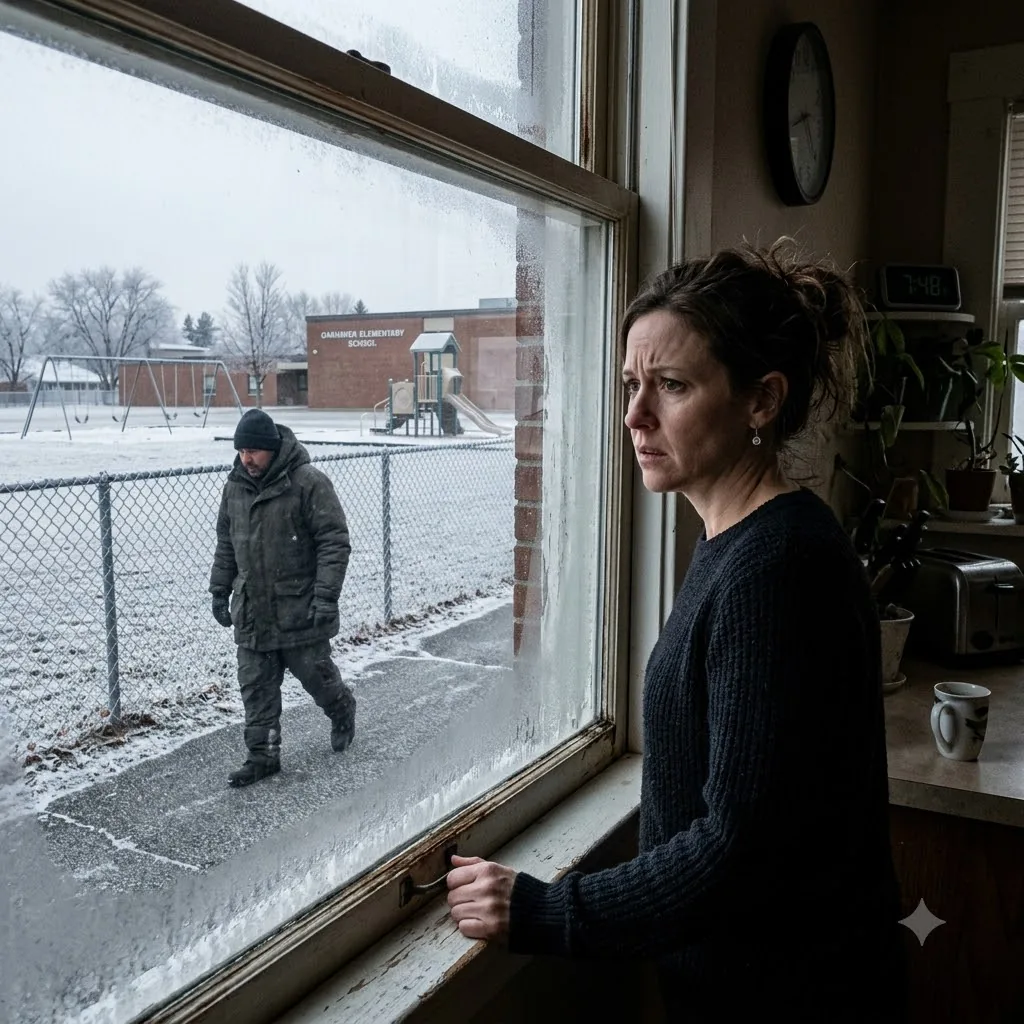
Maya’s bare feet slapped wetly against the freezing asphalt, leaving faint, bloody prints on the frost-covered street as she sprinted toward the idling white pickup truck. Every muscle in her body was coiled tight, running entirely on the blinding adrenaline of a mother defending her territory. She reached the passenger side, gasping for air. The window was rolled down, letting the heater’s warm air bleed out into the autumn morning. The laptop sat open on the center console, its screen glowing brightly with the digital blueprints of the integration project. The damning red lines crossing out the school’s boundaries stared back at her.
Maya raised the heavy, blood-smeared aluminum flashlight, preparing to bring it down through the window and shatter the screen, to destroy the digital files just as she had buried the physical ones in the mud.
“Maya?”
She froze. The heavy flashlight hovered inches from the window frame. She whipped her head around.
Stepping around the rear bumper of the idling truck was Silas Sterling. He wore a tailored wool coat over a crisp button-down and a lanyard bearing the HopeWorks logo. He held two steaming cups of coffee in a cardboard carrier. Maya knew him. Everyone on the local zoning board knew him. He was the charismatic director of the city’s urban development task force, the man she had smiled at and applauded during three separate charity galas for affordable housing over the past two years.
Silas stopped dead, his eyes dropping to her bare, bleeding feet, then traveling up to her thin, sweat-drenched nightgown, and finally resting on her pale, terrified face. Instinctively, Maya let her right arm drop, hiding the heavy aluminum flashlight behind her thigh.
“Maya, my god,” Silas said, his professional demeanor evaporating into genuine alarm. “What are you doing out here? Are you hurt?”
She tried to force her lungs to take a steady breath, struggling to control the wild tremors shaking her shoulders. “Silas. I… I saw someone pacing the fence line. A man in a heavy coat.”
Silas sighed, a smile of immense relief breaking across his face. “Oh, no, Maya, that’s just David! My surveyor. I was grabbing us coffee while he took the final perimeter measurements.” He stepped forward, looking past her toward the vacant lot. “Where is he? Did you see him head toward the cafeteria?”
Maya’s heart seized. The bloody flashlight felt like a block of lead in her grip. The groundskeeper was still somewhere over the brick wall. David was lying at the bottom of the muddy ditch just thirty feet away. “I didn’t… no. I didn’t see where he went.”
Silas stepped up to the driver’s side of the truck, setting the coffees on the roof. He reached through the open window and tapped the laptop trackpad, waking the screen fully. “I’m so glad you’re out here, actually. I know we missed you at Tuesday’s town hall, but the council pushed Phase One through. We’re finally building the unhoused village.”
He spoke with the warm, inclusive tone of a man talking to a trusted ally. Maya had spent the last three years carefully cultivating a reputation as a progressive, compassionate voice in the neighborhood. She had written op-eds advocating for equitable zoning and community integration-as long as those zones were placed safely in the downtown industrial sectors, miles away from her daughter.
“The village,” Maya repeated, her voice hollow, her eyes fixed on the screen.
“Right here,” Silas said proudly, gesturing to the vacant lot. “Integrating the shelter directly into the municipal footprint. And the best part-the real victory-is the open flow design. We are completely removing the school’s perimeter gating.”
“You’re taking down the fence,” Maya whispered, the suffocating horror bleeding through her carefully constructed, polite exterior.
“Destigmatizing the space,” Silas corrected gently. “The unhoused community needs to feel like they are part of the neighborhood, not quarantined from it. Tearing down the chain-link removes the psychological barrier between these displaced citizens and everyday life.”
Maya’s breathing turned shallow and rapid. “They are unvetted strangers, Silas. You are putting an open transient camp fifty yards from the doors where my daughter walks to gym class.”
Silas frowned, his warm smile faltering. He looked at her as if she had suddenly started speaking in a foreign language. “Maya, we’ve talked about this. You championed the equitable housing initiative. You know the statistics. The data is definitive.”
“I don’t care about the-”
“Integrating temporary shelters into municipal zones actually decreases localized crime by fourteen percent,” Silas continued, his voice taking on the polished, rehearsed cadence of a man used to defending his policies to hostile crowds. “We have the HUD reports to prove it. Unhoused individuals are statistically far more likely to be victims of violence than perpetrators. This village is going to be incredibly safe. You literally quoted these exact statistics at the March fundraiser.”
“That was for the downtown corridor!” Maya’s voice cracked, spiking into a shrill, hysterical register that echoed too loudly down the quiet, frosted street. She glanced frantically over her shoulder. “This is a middle school, Silas! Do you have any idea how long it takes a man with a rifle to cross fifty yards of open grass? Twelve seconds!”
Silas stared at her, his brow deeply furrowed in genuine shock. “A rifle? Maya, what are you talking about? These are displaced families. Veterans. People freezing in tents under the highway overpass.”
“They are an unknown variable!” Maya screamed, stepping toward him, completely abandoning the socially conscious persona she had worn for years. The sheer, primal terror of a mother protecting her young obliterated every progressive ideal she had ever claimed. “I don’t care about your data! I don’t care about your HUD metrics or your equitable zoning!”
Silas recoiled, pulling back against the door of his truck as if she had physically struck him. “Maya…”
“You do not tear down a fence!” she shrieked, the tendons in her neck straining. “You build it higher! I want a concrete wall, Silas! Ten feet high! I want it filled with rebar and topped with barbed wire! I want steel doors and armed guards at every entrance! I want every single person who steps foot within a mile of my daughter treated like an active threat until proven otherwise!”
The silence that followed her outburst was absolute, broken only by the low rumble of the idling truck engine.
Silas looked at her. His eyes dropped to her trembling, pale hands, taking in the manic, terrifying desperation radiating from her small frame. The political kinship, the respect he had for her, vanished entirely. It was replaced by a cold, dissecting disgust that made Maya’s stomach twist.
“A concrete wall,” Silas repeated, his voice devoid of any previous warmth.
“To keep them out,” Maya snarls, unapologetic.
Silas slowly shook his head, an expression of profound disappointment settling heavily over his features. “You don’t care about the community at all, do you? You’re just another terrified suburbanite playing pretend.”
“I am a mother keeping my child alive!”
“No,” Silas said, his voice dropping to a hard, unforgiving whisper. “You’re weaponizing dead children against the poor.”
He looked past her, his eyes narrowing at the deep, muddy ditch separating the vacant lot from the street. “You’re using the ghosts of school shootings as an excuse to build a fortress against people you deem undesirable.”
Maya’s grip on the heavy aluminum flashlight tightened behind her leg, her knuckles turning bone-white. She opened her mouth to scream back at him, to defend the primal necessity of her terror, but the words died in her throat.
From the muddy bottom of the ditch behind her, a low, wet, agonizing groan rose into the cold morning air.
Silas froze, his eyes locking onto the tall, dead weeds at the edge of the embankment.