Story code: ST-000714
Part 4: The Price of Sanity
Arthur sat at the far end of the sprawling mahogany conference table. The air conditioning in the district administrative building hummed a low, sterile note, a sharp contrast to the chaotic, echoing hallways of his middle school. Superintendent Higgins sat opposite him, flanked by two silent women from Human Resources. Between them rested a single, crisp manila folder.
“You understand why we are here, Arthur,” Higgins said, his voice carrying the practiced, somber weight of an administrator executing a mandate. “Your actions on Tuesday afternoon were a direct violation of district safety protocols. You willfully interfered with a board-sanctioned security exercise, compromised the integrity of the lockdown, and demonstrated gross insubordination toward Officer Miller.”
Arthur looked at the folder. He felt entirely calm. The blinding adrenaline of the drill was gone, replaced by a deep, settling clarity. “I turned on the lights and played a documentary about sea turtles,” Arthur replied, his voice level. “Because my students were suffering real, physical harm. Maya was slipping into a severe asthma attack. David was scratching his own arms until they bled.”
“The parameters of the Red Cell simulation required authentic panic responses,” Higgins said, rigidly adhering to the script. “By breaking the immersion, you invalidated tens of thousands of dollars of tactical consulting data. And your deliberate provocation of Officer Miller…”
“Provocation?” Arthur interrupted softly. “I sat at my desk and ate a fruit snack. Miller is the one who took a heavy steel pry bar to a solid oak door because he was angry that a classroom of twelve-year-olds wasn’t sufficiently terrified of him.”
Higgins’s jaw tightened. The superintendent glanced at the HR representatives before opening the folder and sliding a single sheet of paper across the polished wood. It was a separation agreement. A forced resignation in lieu of termination.
“If you sign this, the district will not pursue formal charges for obstructing a law enforcement exercise,” Higgins said. “Your pension contributions remain intact, and we will code this as a voluntary departure for personal reasons. If you refuse, we will move to terminate with cause, effective immediately.”
Arthur picked up the heavy brass pen resting beside the paper. He didn’t read the dense legal paragraphs. He knew exactly what it was: the price of keeping his humanity.
“I heard about the emergency school board meeting last night,” Arthur said, holding the pen suspended over the signature line.
Higgins shifted uncomfortably in his leather chair. The superintendent’s rigid posture faltered for a fraction of a second, revealing the immense, frantic pressure boiling just beneath the district’s bureaucratic facade.
“The parents didn’t care much for your tactical consulting data, did they?” Arthur asked.
He didn’t need Higgins to answer. The local news had covered it extensively. Over four hundred parents had packed into the middle school gymnasium. David’s mother had stood at the microphone, holding up a photograph of her son’s blood-smeared forearms. Maya’s father had slapped a hospital emergency room bill onto the podium. But the killing blow hadn’t been the medical trauma; it had been the cell phone audio recorded by a student in the hallway, capturing Officer Miller’s unhinged, screaming assault on a locked classroom door. The parents had demanded to know why a middle-aged school resource officer was attempting to crowbar his way into a room to terrorize children.
“The board has decided to suspend all unannounced tactical simulations,” Higgins said stiffly, staring at the polished table. “Apex Security Solutions has been released from their contract. Officer Miller has been placed on indefinite administrative leave pending a psychological evaluation. But none of that changes your insubordination, Arthur. You broke protocol.”
“I know,” Arthur said.
He pressed the pen to the paper and signed his name in smooth, looping cursive. He pushed the folder back across the table.
“I’d do it again,” Arthur said. He stood up, pushed his chair in, and walked out of the sterile boardroom without looking back.
Two hours later, Arthur stood in the gray gloom of his empty classroom. The Friday afternoon bell had rung, and the building was dead quiet. He held a cardboard box, slowly filling it with the accumulated artifacts of his teaching career. He packed his diagram of the Mid-Atlantic Ridge. He packed his coffee mug and his collection of dry-erase markers.
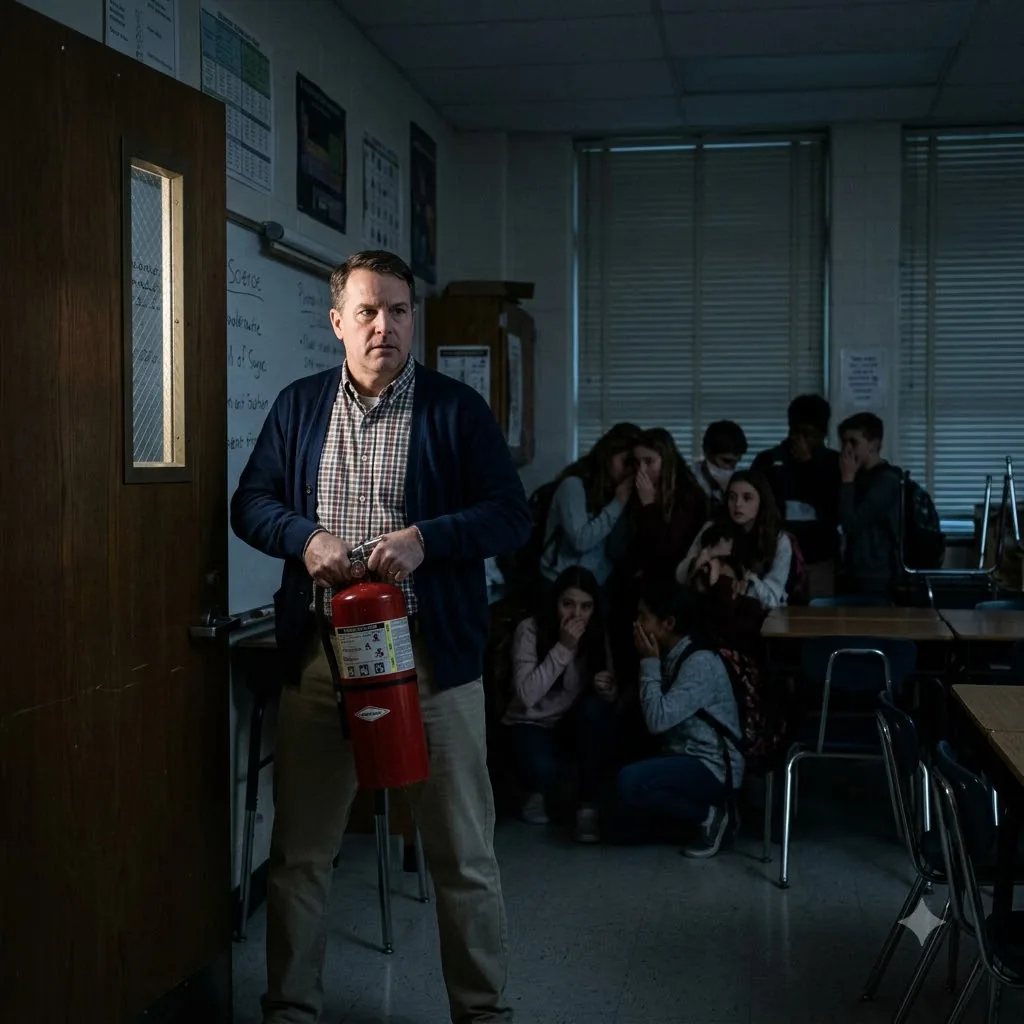
He walked over to the heavy oak door. The deep, jagged gouges from Miller’s pry bar were still there, pale, splintered scars marring the dark varnish. A permanent physical record of the madness that had tried to breach this room. Arthur reached down to the floor bracket. The heavy steel security bar rested in its cradle. He stared at it for a long moment, then picked it up and dropped it into the bottom of his cardboard box. He wouldn’t leave it for the next teacher. They wouldn’t need it.
Arthur looked back at the dim, quiet room. He would miss explaining tectonic plates. He would miss the chaotic energy of seventh graders. His career was over, his livelihood severed by a single, unforgiving signature. But as he turned off the overhead fluorescent panels for the last time, he didn’t feel a trace of regret. Maya could breathe. David’s arms would heal. And the terrifying monsters in the hallway were gone for good.
Arthur picked up the half-empty bulk box of fruit snacks from his desk, tore open a crinkling blue pouch, and walked out into the silent corridor.