Story code: ST-001498
Part 4: The Final Optimization
Three seconds.
Arthur’s trembling right hand slowly lowered, his fingers drifting away from the edge of the keyboard. He didn’t press the enter key. He didn’t trigger the Department of Labor export.
*Zero.*
The trailer’s speakers chimed a cheerful, synthesized jingle. The developer console vanished, and the primary monitor went entirely black, replaced by a bouncing green YieldMax padlock icon. The system had defaulted to its automatic lock, executing the week’s payroll exactly as Vance had designed it.
Vance let out a sharp, ragged breath and released his grip on Arthur’s crumpled shirt. He stepped back, smoothing the front of his expensive collar, the ugly flush of panic fading from his cheeks as his predatory smile returned. “Good choice, Artie. I’ll make sure corporate processes your check first thing Monday. Have a good life.”
But Vance had miscalculated the acoustics of a cheap tin box, and he had forgotten the sheer force of his own sudden violence.
When Vance had lunged across the aluminum sorting table to pin Arthur against the desk, his heavy boots had kicked the unlatched trailer door violently outward. The roar of the distant diesel tractor had masked the sound of the hinges squealing, but the staging yard outside was silent now. The tractor’s engine had been cut.
Standing at the bottom of the short metal stairs were Hector and four other veteran crew bosses. They hadn’t left for the fields. They had come back to the operations trailer to drop off their requisition radios. And standing just ten feet away, staring through the wide-open doorway, they had heard every single word of Vance’s screaming threat about ICE, and they had watched the regional director physically throttle a sixty-year-old payroll clerk.
Vance turned toward the open door, freezing as he saw the men. His corporate swagger evaporated instantly. The clean, unchallengeable authority of the federal compliance system meant nothing in this moment; he was brutally exposed, stripped of his administrative armor, looking like nothing more than a terrified thief who had to resort to back-alley violence to protect his secret.
“Hector,” Vance started, taking a clumsy step toward the doorway, his voice cracking. “Listen, that was just… a misunderstanding with the termination protocol.”
While Vance desperately tried to patch his shattered illusion of control, Arthur reached into his slacks and pulled out his company-issued smartphone.
The desktop terminal behind him was locked, and the payroll batch had been sealed. But HR hadn’t manually processed Arthur’s actual exit ticket yet. His mobile authenticator app still carried Level-1 Administrator credentials.
Arthur kept his eyes on his glowing screen, his thumbs moving with practiced, relentless precision. If he triggered an external federal audit now, Vance would still make the call to ICE out of pure spite. So Arthur didn’t go outside the YieldMax architecture. He used it.
He bypassed the locked payroll module and opened the regional discretionary ledger. There, sitting securely in Vance’s ‘Efficiency Bonus Pool,’ was the exact sum of the skimmed wages. Arthur couldn’t edit the completed timesheets, but he had the clearance to issue immediate, unchallengeable corporate disbursements.
Arthur created a new mass voucher. He typed the justification code: *Emergency Harvest Yield Adjustment*.
Destination: The digital pay-cards of Hector’s crew.
With two taps, Arthur transferred every single cent out of Vance’s bonus pool, routing the stolen money right back to the men who had earned it. The action bypassed the ICE-flagging risk entirely, classifying the money as an internal corporate bonus rather than a contested wage claim.
Then, Arthur tapped into the active user directory. He found Vance’s profile. With one final swipe, Arthur revoked all permissions, permanently wiping the director’s access from the YieldMax network.
By executing an unsanctioned, massive financial transfer during an active system lockdown, Arthur triggered his own immediate termination protocol. A cold, red notification popped up on his phone screen: *SEVERANCE CONTRACT VOIDED. UNAUTHORIZED SYSTEM USAGE DETECTED.*
Six months of pay. His full pension vesting. His daughter’s tuition money. Gone in a single tap.
Arthur didn’t hesitate. He confirmed the action, locked his phone, and dropped it into his cardboard bank box.
Down at the bottom of the stairs, Vance’s federal arm-tablet suddenly vibrated violently. The reinforced screen flashed bright red, threw an error code, and went entirely dead. A second later, Hector’s radio buzzed, followed by a chorus of digital chimes from the pockets of the crew bosses standing in the dust.
Hector pulled out his phone, staring at the instant deposit notification. He looked up, locking eyes with Arthur through the doorway.
Vance tapped his dead tablet frantically, panic returning to his voice. “Artie, what did you do? The network just kicked me. What did you do to my account?”
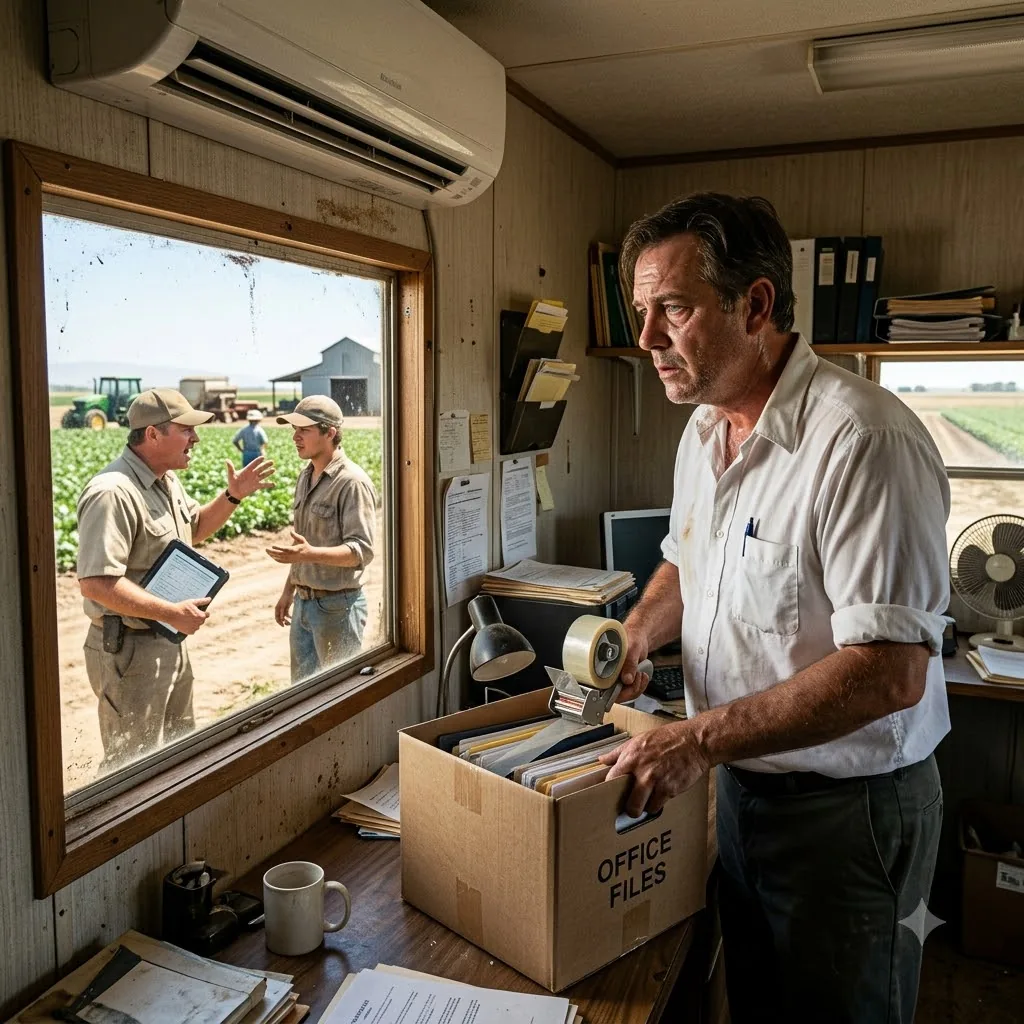
Arthur picked up his heavy cardboard box, adjusting his grip so the corner of his fifteen-year service plaque didn’t dig into his ribs. He walked around the dented aluminum sorting table, ignoring the man entirely.
“I optimized the efficiency pool,” Arthur said quietly.
He didn’t wait for Vance to respond. Arthur stepped out of the trailer and walked down the metal stairs into the dry California heat. Hector and the crew silently parted to make way for him, their eyes fixed on the man who had just traded his own security for theirs.
Vance was shouting something from inside the trailer, but his voice sounded remarkably small, trapped alone in the sweltering tin box. Arthur didn’t look back. He carried his box toward his car, walking away with empty pockets, but a completely clear conscience.