Story code: ST-001851
Part 2: Load Balancing
The blast of air conditioning from the lobby hit Marcus like a physical wall, flash-freezing the sweat on his face. The security guard was a heavy-set man in his fifties, his face flushed red as he reached for Marcus’s shoulder.
“Hey! I said move that piece of junk right now!”
Marcus didn’t break his stride. As the guard’s hand clamped onto his muddy shirt, Marcus’s shoulder dropped instinctively. Years of ingrained muscle memory flared to life through the chemical static of his withdrawal. He stepped into the guard’s center of gravity, twisted, and redirected the man’s momentum, sending him stumbling into the heavy glass door with a dull thud. Marcus didn’t throw a punch. He didn’t even look back. He just kept walking into the immaculate lobby.
The cavernous space smelled like citrus floor cleaner and expensive espresso. It was a cathedral of brushed steel and frosted glass, utterly silent except for the soft hum of the central air and the wet, heavy click of his waterlogged boots on the porcelain tile. He left a trail of dark, silty swamp water with every step.
Behind the sweeping arc of the front desk stood a young receptionist, her hands freezing above her keyboard. Next to her was a man in a tailored charcoal suit, holding a sleek tablet. The man looked up, his brow furrowing in profound distaste as he took in Marcus’s soaked jeans, the violent tremor in his jaw, and the foul odor of stagnant floodwater radiating from him.
“Can I help you?” the man in the suit asked, his tone laced with the kind of forced, sterile calm reserved for dealing with stray animals. A silver nametag on his lapel read: *E. Vance, Regional Coordinator*.
Marcus stopped a few feet from the desk. His hands were shaking so violently now that he had to press them against his damp thighs to keep them still. The muscles in his back spasmed, a sharp, twisting agony that warned him the real crash was imminent.
“I had a nine o’clock appointment tomorrow,” Marcus said, his voice a dry, gravelly rasp. It hurt his throat to speak. “Coastal VA Outpatient. Emergency psych.”
Vance sighed, a sharp exhalation through his nose. He tapped his tablet without breaking eye contact. “Sir, as the automated system stated, all coastal facilities are currently offline. We are in a state of emergency. You need to leave this building immediately, or I will have you removed.”
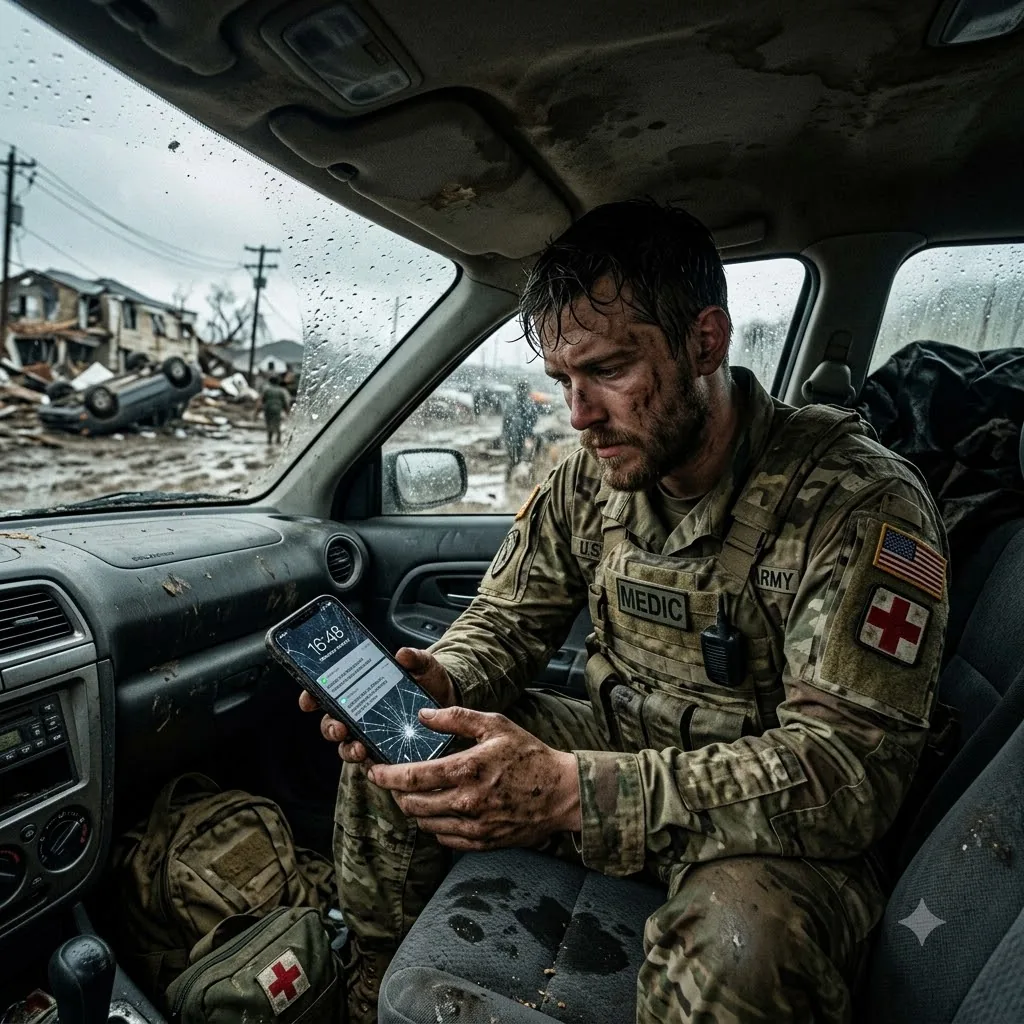
Marcus pulled his phone from his pocket, the screen still smeared with river mud. He held it up. “The text said you canceled it because of storm impacts and infrastructure damage. It said I was rescheduled for March.”
“That is correct,” Vance said, his eyes flicking toward the entrance where the first security guard was now scrambling to his feet, pulling a radio from his belt. “The system automatically reallocates patients based on available slots. Now, please-”
“Look around you,” Marcus interrupted, his chest heaving. He swept a trembling hand toward the pristine lobby, the dry ceiling, the glowing lights. “What infrastructure damage? The lights are on. The AC is cold. Your parking lot is full of luxury cars. You aren’t impacted. You’re fine.”
Vance’s expression hardened from annoyance to cold, bureaucratic detachment. “The regional network’s capacity is reduced. We had to load-balance the schedule to maintain our quarterly service metrics. We can’t have providers waiting in empty clinics down south, so we consolidated the roster. The algorithm pushes non-critical follow-ups to the next available quarter.”
*Non-critical.*
The words echoed in Marcus’s ears, competing with the rushing, high-pressure sound of his own blood. The withdrawal was screaming through his central nervous system, telling him that the absence of his medication was a mortal threat. His brain was misfiring, sending spikes of pure, unadulterated panic into his chest. He was drowning in his car, rationing stale water, while this man sat in a refrigerated palace, letting an algorithm decide who got to survive to protect a spreadsheet.
Behind Marcus, the heavy glass front doors hissed open.
“Hands where I can see them!” the first guard shouted. Two more men in dark uniforms jogged out from a side corridor, their hands resting on the heavy black flashlights at their belts.
“The police have been called,” Vance said, stepping back slightly, smoothing the front of his suit jacket. “You have about three minutes before they arrive. If I were you, I would get back in that biohazard of a vehicle and drive away.”
Marcus looked at the guards closing in around him. He looked back at Vance, and then at the locked glass double doors behind the desk, leading deeper into the administration wing.
If he walked out the front door, he went back to the sweltering heat of the Taurus. He would go into full seizures within twelve hours. He would die in a puddle of muddy water in a ruined parking lot. If he stayed and fought the guards, the police would arrive. They would arrest him. He would be thrown in a holding cell, where they would ignore his medical history, and he would still go into full withdrawal and die on a concrete floor.
There was no retreat. The system had closed every door except the one directly in front of him.
Marcus didn’t turn around to face the guards. Instead, he locked eyes with Vance. The regional coordinator’s smug, detached expression finally faltered as he recognized what he was looking at. He wasn’t looking at a disgruntled patient. He was looking at a soldier who had absolutely nothing left to lose, who had just realized that survival required taking the objective by force.
Marcus lunged.
He moved with terrifying, explosive speed, closing the distance to the front desk before the guards could even shout a warning. He vaulted the low marble counter, his heavy boots crashing onto the keyboards and scattering glossy brochures. The receptionist screamed and ducked beneath the desk. Vance stumbled backward, dropping his tablet, his hands coming up in a desperate, late defense.
Marcus hit him waist-high, driving the regional coordinator backward through the swinging glass doors that led to the inner office suites. They crashed onto the plush carpet of the executive hallway. Marcus grabbed the lapels of Vance’s expensive suit, hauled him to his feet, and shoved him hard against the drywall.
Through the glass doors, the three security guards slammed against the partition, fumbling wildly with their access cards to open the electronic locks.
Marcus reached out, grabbed a heavy solid-oak side table from the hallway, and jammed it brutally under the handles of the double doors, wedging it against the reinforced floor frame. The glass bowed outward as the guards threw their weight against it, but the makeshift barricade held.
Marcus turned back to Vance. The coordinator was pinned against the wall, his face pale, his breath coming in short, terrified gasps.
“March is too late,” Marcus said quietly, the tremor in his hands completely gone, replaced by a cold, singular focus. “Fix the algorithm.”