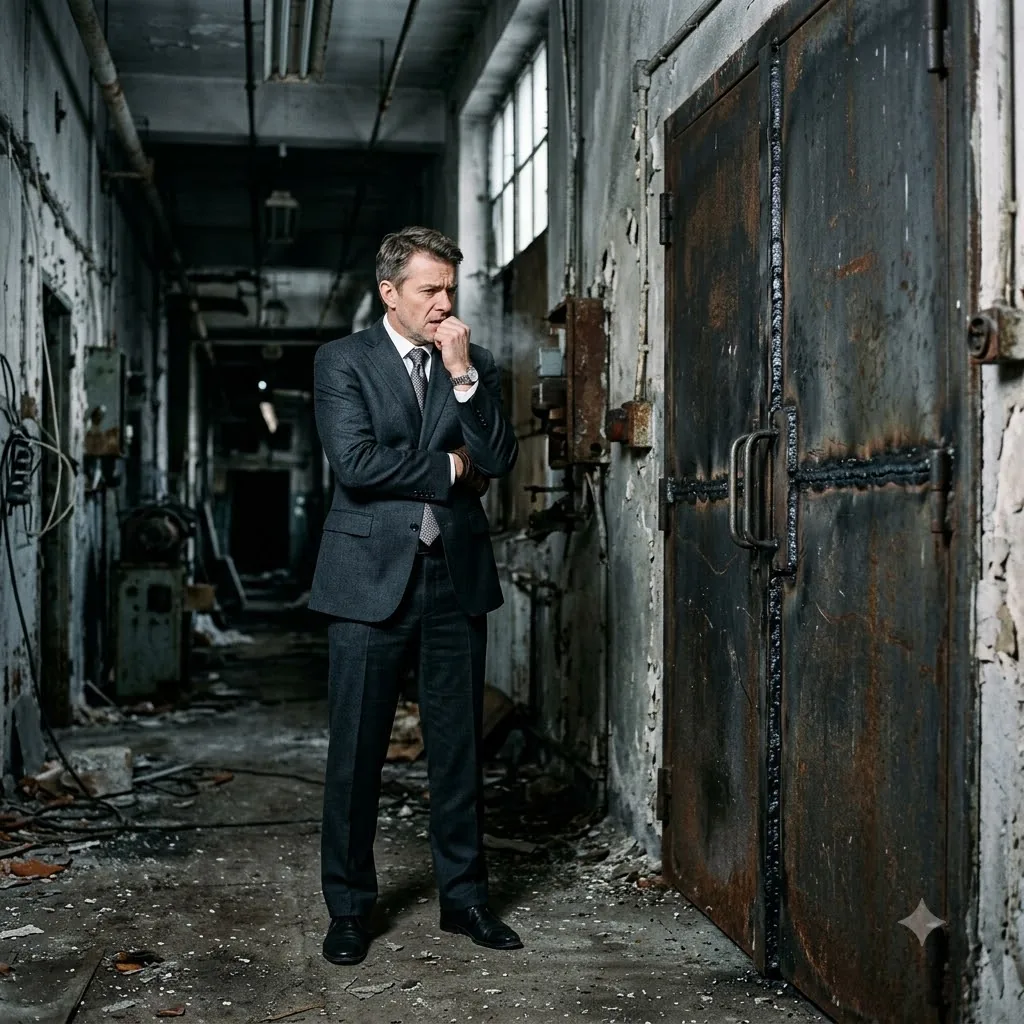
Story code: ST-000831
Part 2: The Inventory
The cherry-red seam held for precisely one second before it gave way with a concussive boom like a mortar shell detonating indoors.
Arthur threw his arms over his face, diving backward as a wave of blistering heat and localized pressure blasted into the hallway. He hit the concrete floor hard, his shoulder taking the brunt of the impact. The abrasive grit tore through the knee of his bespoke Italian trousers and chewed into the skin beneath. He gasped, rolling away as a shower of molten slag rained down where he had been standing only moments before.
Coughing violently against the sudden, suffocating cloud of ozone and vaporized coolant, Arthur scrambled to his feet. He frantically patted down his suit jacket, checking for embers, his hands shaking in a way they never did during high-stakes equity negotiations.
The heavy steel door had not simply swung open. The blast from within had warped the solid metal, bowing it outward and tearing it partially off its reinforced hinges. It now sat wedged in the frame at a jagged angle, leaving a two-foot gap that radiated heat like an open furnace.
Arthur stared at the gap, his polished corporate composure finally beginning to fracture. This was not a standard labor dispute. This was not a disgruntled employee staging a sit-in to demand a better severance package. Vance had just turned the high-value robotics hub into a blast zone.
Arthur checked his gold wristwatch. The crystal face was cracked, but he could clearly make out the time. Nine-forty-two.
Panic, cold and sharp, pierced his executive armor. The liquidation transports would idle at the loading bays at exactly noon. If they left empty, the four-million-dollar inventory would default to the bank’s receivership, his division would miss its quarterly target by a massive margin, and his Vice President promotion would evaporate instantly. He could write off the damage to the blast door, perhaps even file a rapid insurance claim for a few damaged hydraulic lines, but he needed to assess the surviving inventory right now.
“Vance!” Arthur yelled, his voice cracking, shedding its carefully practiced baritone. He stepped toward the smoking gap, raising an arm to shield his face from the intense heat. “Vance, answer me! What are you doing in there?”
There was no answer from the mechanic. Instead, the guttural, oscillating hum from inside the room shifted into a deeper, rhythmic thrum. It sounded like an enormous, mechanical heart beating in the dark.
Arthur leaned close to the gap, ignoring the heat searing his cheek. He couldn’t see through the dense, acrid smoke pouring out, and the passage was far too hot to squeeze through anyway. He needed another way in, and he needed it immediately. He could not run all the way back to the main office for a landline to call the police; doing so would burn thirty minutes and leave Vance completely alone to inflict more financial ruin on his spreadsheet.
His mind raced through the plant’s architectural blueprints, a schematic he had memorized to optimize the extraction routes. Sector Four had a secondary access point: the supervisory catwalks suspended thirty feet above the factory floor. They were designed for management to oversee the automated assembly lines without ever having to step onto the hazardous floor.
Arthur turned and sprinted down the corridor, his polished oxfords slipping dangerously on the dusty concrete. He reached the access stairwell at the end of the hall. The heavy chain-link cage door blocking the stairs was secured with a thick, rusted padlock. The liquidators hadn’t bothered clearing this section because the catwalks held nothing of financial value.
Arthur gripped the padlock, tugging furiously. It didn’t budge. He looked around the dimly lit hallway, his desperation mounting. A heavy steel shear-bolt lay discarded near a rusted-out forklift. Arthur grabbed the dense metal rod, feeling the thick industrial grease instantly stain his pristine white cuffs. The executive who had never lifted anything heavier than a Montblanc pen swung the heavy bolt with both hands, smashing it against the padlock.
Sparks flew. Pain flared up Arthur’s forearms, jarring his elbows, but he swung again, harder, driven entirely by the terrifying image of his vanishing corner office. On the third violent strike, the rusted locking mechanism shattered.
Arthur kicked the cage door open and charged up the metal stairs. The air grew significantly hotter and thicker as he ascended into the rafters. When he reached the catwalk level, he found himself in near-total darkness, the only illumination coming from the intermittent, violent flashes of blue arc-light flashing from the robotics hub far below.
He crept out onto the suspended metal grating, gripping the rusted handrail tightly. The catwalk groaned in protest under his weight. Dust and decades of industrial grime coated his hands and face, completely ruining his appearance, but Arthur no longer cared about looking the part of an executive. He only cared about saving his inventory.
He crawled toward the section of the catwalk that stretched directly over the enclosed robotics hub. The metal roofing of the hub had been removed years ago, leaving only a grid of wide ventilation louvers between Arthur and the room below. He reached the louvers, laid flat on his stomach against the filthy grating, and peered down through the metal slats.
Down on the floor, the smoke was beginning to clear, sucked away by the massive draft of the broken door. What Arthur saw below defied all logic, turning his blood to ice.
The twenty K-series assembly arms were not destroyed. They had been repurposed.
Vance, wearing a scarred welding mask, was frantically tightening heavy gauge cables to a massive, centralized chassis built out of the palletized hydraulic lifts. The K-series arms-precision tools designed for microscopic automotive welds-had been fused to the chassis at erratic, horrifying angles. It looked like a gigantic, mechanized insect, its multiple limbs twitching and flexing in jerky, uncalibrated movements.
Arthur clamped a hand over his mouth to muffle a gasp. At the very top of the construct, Vance had mounted the four high-precision laser calibration tables, stripping away their protective housings and wiring them directly into a rotating turret.
The mechanic stepped back, grabbing a heavy lever attached to a bank of massive industrial batteries. He threw the switch.
The oscillating hum peaked into a deafening shriek. The K-series arms slammed down against the concrete floor, tearing chunks of stone loose as the entire monstrosity lifted its immense weight up on its hydraulic limbs.
“Four million dollars,” Arthur whispered, horrified, his corporate mind struggling to process the absolute mutilation of his assets. This couldn’t be happening. He needed proof. He needed undeniable evidence for the board that this was an act of localized terrorism, not a failure of his oversight.
He fumbled in his torn jacket pocket, pulling out his smartphone. He maneuvered the lens over the gap in the louvers, his hands shaking so violently he could barely tap the record button.
As he adjusted his grip, his greasy fingers slipped. The phone didn’t fall, but his elbow slammed hard against the rusted ventilation slat. The metal screeched, a sharp, piercing sound that cut right through the heavy mechanical hum of the room.
Below, Vance’s head snapped upward, his dark welding mask staring directly at the catwalk.
Worse than the mechanic, the machine reacted. The array of calibration lasers on top of the chassis flared to life. Instead of measuring automotive tolerances, a blinding web of green light fanned out across the ceiling, sweeping the high rafters before locking perfectly onto Arthur’s face through the metal slats.
The machine’s heavy chassis rotated with terrifying speed. One of the massive K-series arms extended straight up toward the ceiling, its pneumatic joints hissing as its heavy industrial welding tip began to glow a brilliant, searing white.