Story code: ST-001876
Part 4: The Weight of the Rust
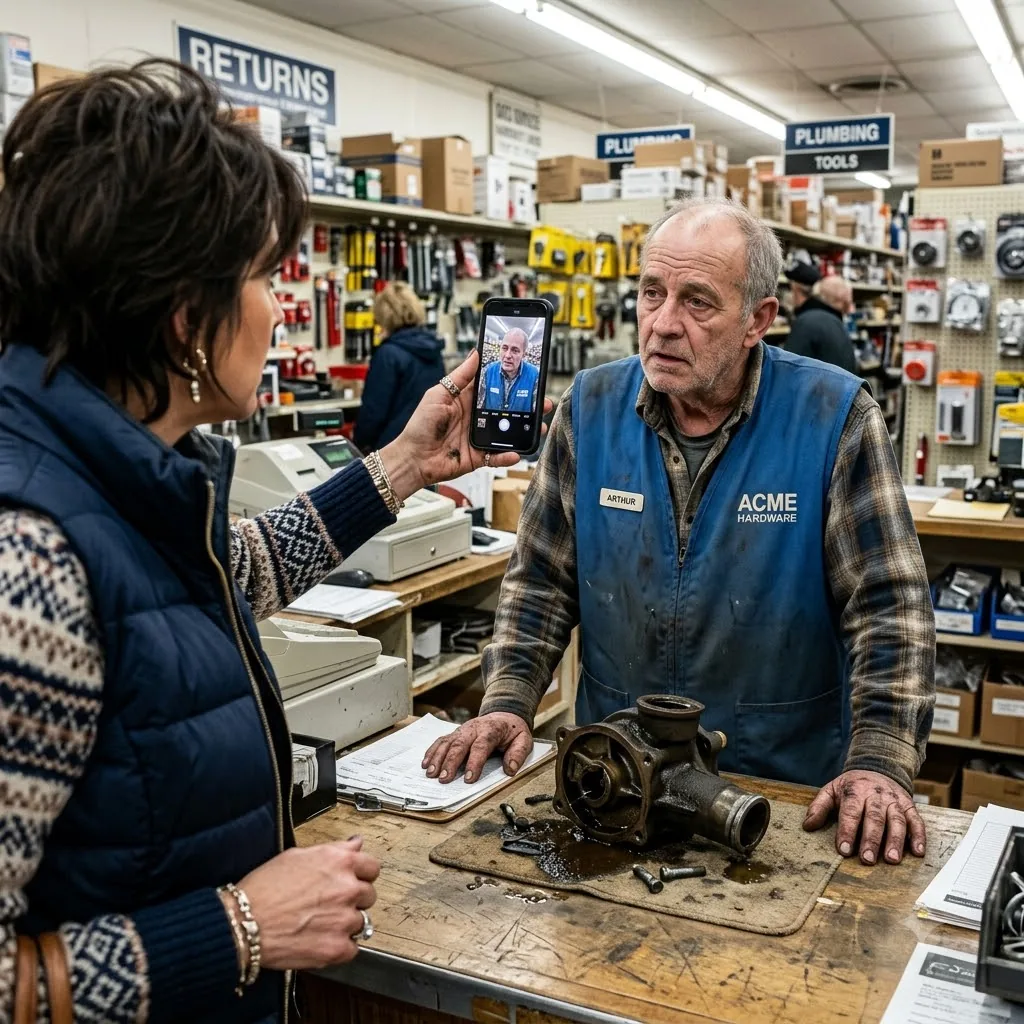
The humiliated customer did not say another word. The blotchy crimson drained entirely from his face, replaced by a sickly, bloodless pale. He snatched his forty dollars off the laminate counter, tucked his chin into his chest, and practically sprinted down the aisle, shoving his way out the front doors and into the rainy afternoon. He left the destroyed cast-aluminum water pump sitting on the counter like a monument to his own stupidity.
Bryce stared at the heavy, broken metal. Then he looked up at the other customers, who were all watching him with quiet, judgmental expressions. The young manager’s authority had been utterly shattered, and the realization made his face flush with defensive panic. He turned his frantic eyes back to Frank.
“You can’t do that,” Bryce stammered, his voice rising in pitch as he desperately tried to regain control of his store. “Corporate has a zero-tolerance policy for employee hostility. They monitor the security feeds. If a customer complains to the regional office about being publicly embarrassed, they’ll come down on me. I have to log this. I have to appease corporate, Frank. You leave me no choice.”
Frank looked at the young manager’s crooked clip-on tie and the sweat beading on his forehead.
“You’re fired,” Bryce declared, trying to inject a commanding bass into his trembling voice. “Clock out. I need your nametag and your vest right now. I have to protect the store from liability.”
Frank did not argue. He felt no anger toward Bryce, only a profound, heavy exhaustion. Without a word, he grabbed the torn plastic zipper of the red polyester vest and pulled the cheap fabric off his broad shoulders. He unclipped his brass nametag, set it gently on top of the folded red vest, and pushed it across the counter next to the sheared water pump. He was instantly relieved of the physical restriction, his chest expanding as he took his first full, deep breath of the day.
He stepped out from behind the counter, walked past the silent manager, and nodded to his daughter. “Let’s go, Maya.”
They walked through the sliding automatic doors and out into the damp, freezing autumn air. The rain had picked up, drumming a steady rhythm against the cracked asphalt of the shopping center. Across the lot, the police cruiser finally shifted into gear and rolled away, its blue lights dark. Frank watched it go. He had lost his job, and his parole status was now in immediate jeopardy, but he had not thrown a punch. He had not gone back to the cage.
Maya followed him to his rusted, fifteen-year-old pickup truck. She did not get into the passenger seat. Instead, she stood in the freezing rain, her dark hair plastered against her forehead, her green track jacket soaked through. She was shaking, but not from the cold. She was vibrating with pure, unadulterated fury.
“You are done doing this,” Maya said, her voice sharp enough to cut glass. “You are absolutely done letting these people treat you like an animal.”
Frank reached into his pocket for his keys. “I need a job to satisfy the board, Maya. It is what it is. I’ll find another one by Tuesday.”
“No, you won’t,” Maya snapped, stepping directly into his path and forcing him to look at her. “Because you aren’t staying in this dead-end city. I got the official acceptance letter this morning. The tech incubator in San Jose approved my spot, and the buyout money for my algorithm cleared the bank yesterday. It’s done, Dad. It’s my money. More than enough.”
Frank froze, the jagged edges of his keys digging into his calluses.
“I am paying off the rest of your state restitution,” Maya demanded, her eyes fierce and unwavering. “I am buying out your parole terms with the state lawyers, and we are moving to California. I’ll rent us a place in Palo Alto. You will never have to wear a cheap polyester uniform or take orders from a kid like Bryce ever again. I have the money. We leave next week.”
Frank looked down at his teenage daughter. He saw the brilliant, unstoppable force she had become. She had coded her way out of this struggling rust-belt city, building a future entirely on her own genius. He felt a massive, swelling wave of pride in his chest, so intense it physically ached.
But then, Frank looked past her. He looked out over the wet, decaying skyline of his hometown. He saw the distant, dark smokestacks of the steel mills, the rusted suspension bridges crossing the gray river, and the working-class neighborhoods where he had spent fifty years learning the hard, unforgiving language of engines and iron. He looked down at his own massive hands, reading the permanent map of black grease and raised white scar tissue that covered his knuckles.
He belonged here. He was a mechanic. In a pristine California tech hub, living off his teenage daughter’s newfound wealth, he would be nothing but a kept man, a useless relic out of place and out of time. He would not trade his blue-collar dignity for a comfortable cage built of her money.
Frank reached out and gently squeezed Maya’s damp shoulder.
“No, kid,” Frank said softly, his deep voice carrying a final, unbreakable resolve. “You earned that money. You go to California and build your empire. But this is my town. I’ll find a real shop on Monday. I’ll be just fine.”