Story code: ST-000336
Part 2: What She Did When I Watched Closely
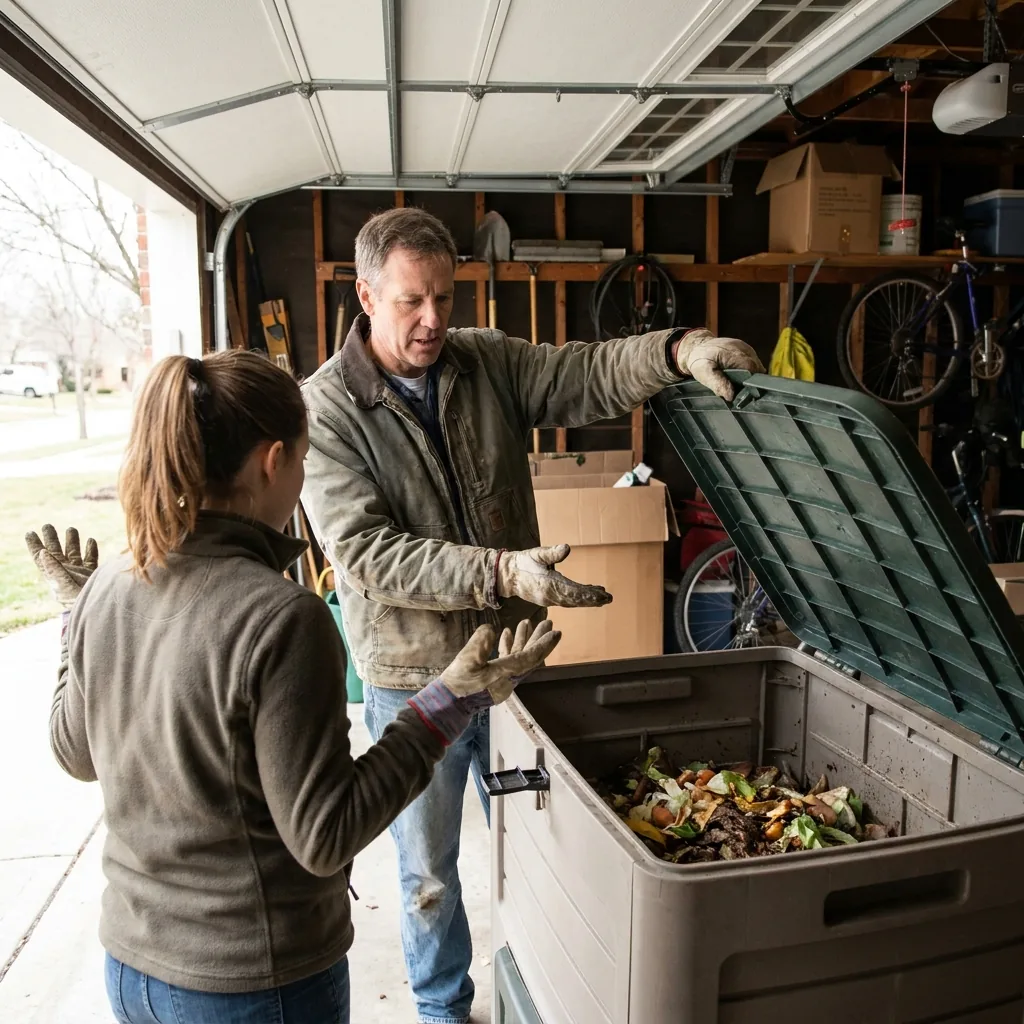
I did not hand the compost bin over right away. I kept it on the concrete between us and watched the daughter stand there with her arms loose at her sides, waiting for someone else to move first. The other adult had stepped aside to get a rag from the sink, and the garage got quiet except for the low buzz of the light above the shelves. The bin sat in the middle like evidence nobody wanted to name.
The daughter glanced at the latch again and said, “See? It’s kind of weird.” Then she reached down, pressed the pedal, and the lid opened on the first try.
That was the first clean contradiction. A minute earlier she had acted like the bin was confusing. Now her foot found the pedal without hesitation. She did not need my help to make it open. She did not need the other adult to wipe anything before she could touch it. She leaned in, tipped the bin, and dumped the last of the scraps into the larger outdoor container with a motion so smooth it looked practiced.
I watched the compost land where it was supposed to go. I watched her use the same grip she had pretended not to know. Then she turned the bin sideways and scraped the rim with the edge of the lid until the stuck bits came loose.
“There,” she said, and gave a quick smile that did not match the earlier confusion.
The other adult came back carrying a rag and a roll of paper towels. They stopped when they saw the bin already emptied.
“You got it?” they asked.
“Yeah,” she said, fast. “It was just sticking because it was full.”
That was not what I had seen. The latch had clicked. The lid had opened. The problem had not been the bin. The problem had been the story she was attaching to it.
She put the empty compost bin in my direction again, but this time she did not look at me. She looked past my shoulder at the workbench, where a stack of green-labeled liners sat beside a tote of garden gloves. Her hand hovered over the liners, and she asked the other adult, “Can you grab me one of those? I don’t want to make another mess on the lid.”
The other adult reached for a liner. The daughter took it, unfolded it, and lined the bin in one smooth motion. She folded the edge over the rim with a neat press of both thumbs. No fumbling. No questions. No pauses.
Then she stopped and rubbed her fingers together, pointing at a smear near the hinge that had already dried. “That part gets gross,” she said.
She said it while looking at the other adult, not at the bin. The line landed where it was meant to land. The other adult picked up the rag again and wiped the hinge. I saw the bin move from one hand to another three times in less than two minutes, and every time the wet part ended up in someone else’s reach.
I set my hand on the rim and turned the bin toward the garage door. The daughter stepped back, then forward again when she saw nobody was taking over. She took hold of the handle before I could set it down.
“I can carry it out,” she said.
She said it like a correction, but she was already doing the one part she had pretended not to know how to do. She lifted the compost bin with both hands, walked it to the open outdoor container, and tipped it cleanly into place. No spill. No struggle. No confusion.
She even reached back for the lid and clicked it shut on the first try.
The other adult watched the whole thing with the rag hanging loose in one hand. I watched the daughter set the bin down and wipe her palms on her jeans. She was moving like somebody who had rehearsed the mistake and then switched out of it the second the room got quiet.
What I could not explain yet was simple: if she knew how to do all of that, why had she left the wet seam, the broken setup, and the cleanup on the rest of us until I was the one holding the bin in the middle of the garage?