Story code: ST-000753
Part 2: The Explanation Keeps Changing
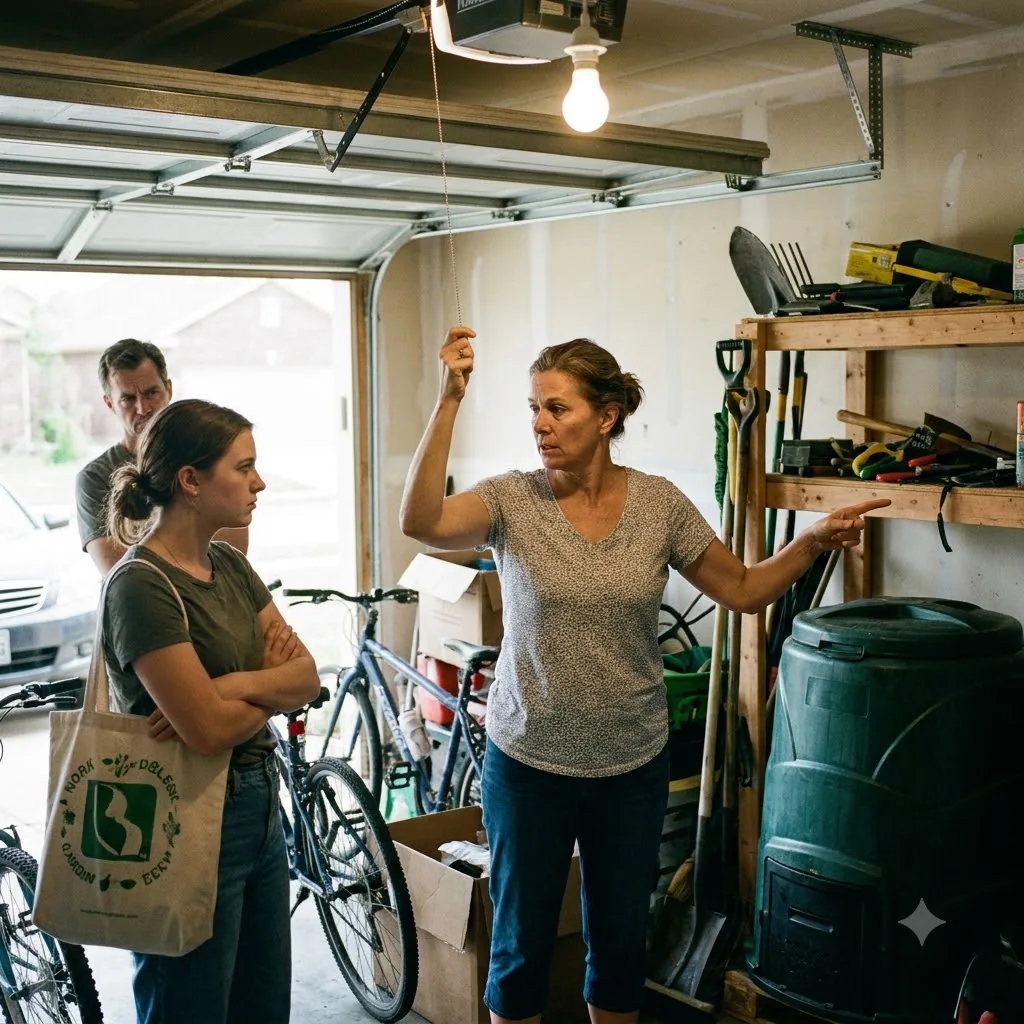
By the next afternoon the compost bin had a folded beach towel under it, and Tessa was telling Evan that the towel was there only because the concrete in that corner always sweated in warm weather. Marina stood in the doorway from the kitchen with a roll of trash bags in one hand and watched the towel spread out under the bin like a bandage nobody wanted to name. The garage was bright this time, side door open, bicycles throwing long shadows across the floor. Someone had stacked flattened delivery boxes by the recycling cans. The green-lidded bin sat in the same spot beside the spare fridge, except now the front edge rested on two narrow wood shims. Its white CLOSED LOOP label had started to curl at one corner. Marina set the trash bags on the washer shelf. “Concrete doesn’t sweat in a rectangle,” she said. Tessa did not look at her. She was adjusting the shims with the toe of her sneaker. “It does when air moves through a hot garage and hits a cooler patch.” Evan glanced down at the towel. A dark shape had bloomed through it from the middle, dense at the center and feathered at the edges. The pattern matched the footprint of the bin too closely to belong to the weather. “You said it was fine,” Marina said. “It is fine.” “Then why is it on a towel?” Tessa finally turned. “Because you won’t stop staring at one damp spot.” Marina pointed to the front of the bin. A brown fleck clung to the latch. Another had dried halfway down the side. A fruit fly moved over the label, paused at the curled corner, and lifted away. “That makes three different explanations,” Marina said. “Pressure. Old spill. Sweating concrete.” Evan held up one hand, not to stop anyone exactly, but to slow the pace. “Maybe this is still one problem with three causes.” “That’s not better,” Marina said. Tessa gave a short laugh without smiling. “Only if your goal is to make it sound worse.” Marina crossed the garage and opened the cabinet above the utility sink. She took down the paper towels, set them on the dryer, then looked back at the floor. The dark trail from the previous night had widened near the drain. It had dried at the edges into a thin irregular outline. Nothing about it looked old. “I’m not making anything sound worse,” she said. “The floor is doing that by itself.” Tessa folded her arms. “Mom, you are acting like compost is toxic waste.” “No. I’m acting like a container in my garage is leaking while you tell me not to believe my eyes.” The side door banged lightly in the wind. Evan stepped over the trail and crouched near the towel. He did not touch it. He leaned close enough to read something on the side of the bin, then stood again. “What’s today’s date?” he asked. Tessa’s face changed a fraction. “Why?” “Because this says TURN WEEKLY on the sticker.” The sticker was smaller than the main label, placed near the handle, and partly hidden by the curve of the bin. Marina had not noticed it before. In blue marker, under the printed words, Tessa had written a set of dates in a narrow column. Three had check marks beside them. The most recent line was blank. Marina looked at it, then at Tessa. “You said this kind doesn’t need to be opened.” Tessa answered too fast. “It doesn’t need to be opened open. It just needs to be aerated.” “How?” “Internally.” “How?” Tessa’s jaw shifted. She reached for the side handle of the bin and let go again. “There is a rod.” “Inside?” Evan asked. “Built in.” “Then why is TURN WEEKLY written on the outside like a reminder?” Marina said. Tessa moved past that. “Because if you don’t rotate it, material compacts. Everyone knows that.” Marina looked at the wood shims, the soaked towel, the dried flecks, the trail to the drain, and then back to the blank line under the most recent date. Yesterday Tessa had refused to open the bin because opening it would ruin the balance. Now the story required a weekly turning schedule and a hidden rod nobody had seen her use. Evan noticed the blank line too. “Did you miss a week?” “No.” “Then why isn’t it checked?” “Because I didn’t mark it yet.” Marina waited. Tessa did not move toward the bin. “Mark it now,” Marina said. “I’m not doing a demonstration every time you demand one.” “Not a demonstration. Your normal routine. The one this sticker says happens weekly.” Tessa pulled her phone from her back pocket and looked at the screen without typing. “I have somewhere to be in twenty minutes.” Marina’s voice stayed level. “Then this is simple. If the bin is sealed the way you said, show Evan the built-in turn rod. If it has to be turned the way the sticker says, turn it. If the wet trail is old, move the bin and we’ll see dry concrete under it.” Evan’s eyes dropped to the towel again. He was no longer standing back in the easy way he had the night before. He set the grocery receipt he had been holding on the workbench and said, carefully, “That seems fair.” Tessa’s hand tightened around her phone. “You two are making this weird.” Marina did not answer that. She waited beside the utility sink with the paper towels still under one arm. The garage had gone quiet except for the refrigerator motor and the soft tapping of the side door in the breeze. Tessa put the phone down on top of the freezer. She reached for the green lid, stopped, then gripped the side handle with both hands instead. The bin rocked once on the shims. A fresh dark bead slid from underneath the towel and tracked toward the same floor drain as before. Nobody spoke while they watched it move. If the.