Story code: ST-000315
Part 4: When the Ramp Finally Came Down
The second staff person was a man named Eric from the next route over. He came up with a clipboard-sized hard pad tucked under one arm and stopped where he could see the van door, the chair, the folded ramp, and all of us at once.
“Who’s touching what right now?” he asked.
“Nobody,” Rosa said.
He nodded. “Good. Start from current position.”
No speeches. No scolding. Just process.
Rosa pointed as she named each piece. “Passenger still seated and braked. Door open. Ramp not deployed. Latch already checked. No visible obstruction. Repeated interruption came from caregiver.”
Eric glanced at me. “You confirm?”
“Yes,” I said.
He looked at Luis. “You okay to answer one question?”
Luis gave a short nod.
“Do you want to unload now using the normal sequence?”
“Yes,” Luis said.
Eric shifted his eyes to Dana. “Then I need you clear of the doorway and off the ramp path.”
“I’m his caregiver,” she said.
“Not for ramp direction on this trip,” Eric replied.
He said it in the same tone somebody would use to read out a gate code.
Dana stood there another second. Rosa didn’t touch her. I didn’t touch her. Luis waited. Finally Dana stepped sideways to the curb, arms folded tight across her chest.
With the path clear, the whole thing took less than a minute.
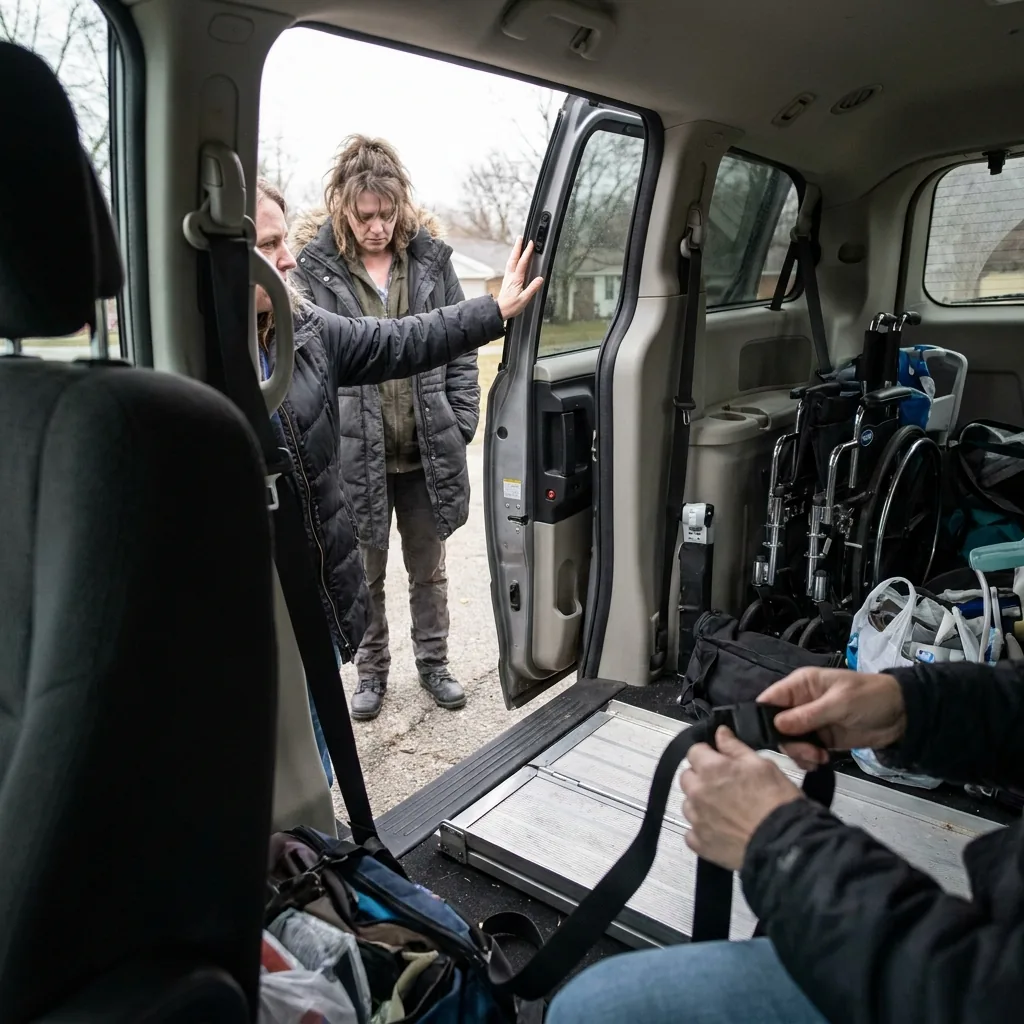
Rosa had Luis straighten his front casters. I released the latch. The ramp swung down clean, metal unfolding with that heavy hollow sound it always makes. Eric watched the hinge, then the landing angle, then gave one small nod. No scrape. No catch. No sudden problem. Just a normal ramp doing a normal job.
“Proceed,” he said.
Luis rolled down slow and steady, hands light on the wheels. When his chair reached the pavement, he turned clear of the path and stopped beside the van. The emergency Dana had been shouting about disappeared the second the doorway stopped belonging to her.
Eric wrote on the hard pad while Rosa reset the ramp. He asked for times. Rosa gave them. He asked who first requested immediate lowering. Rosa said, “Dana.” He asked who halted the sequence. Rosa said, “Dana, twice.” He asked whether any equipment fault had been found. “No,” Rosa said.
Dana broke in twice, then three times, trying to revise the wording while he wrote.
“Put that I was trying to protect privacy.”
“Put that staff escalated the situation.”
“Put that nobody explained this would become a restriction.”
Eric did not argue with her. He only asked, “Did you physically stop ramp deployment after requesting it?”
Dana’s mouth stayed open for a beat too long.
Rosa answered, “Yes.”
I answered, “Yes.”
Luis said, from beside the van, “Yes.”
Eric wrote that down too.
Then he tore the top sheet free, checked one box on the form, and read the consequence out loud so there was no confusion.
“Effective now, caregiver may ride but may not direct loading or unloading equipment until supervisor clearance is entered on file. Future ramp operations require staff-led sequence only. Note attached to transport account before next trip.”
Dana stared at the paper in his hand. “You’re locking me out over this?”
“I’m restricting ramp authority,” he said. “Transport can continue when staff is available to handle it.”
That was the money part hiding inside the cold language. She could still be there, but she had just lost the power to rush, interrupt, or bully the next transfer. And if she wanted another ride, it would move on staff timing, not hers.
Rosa folded the ramp back into place and checked the latch. Eric had her read the van number again and sign the time line. It wasn’t dramatic. It was worse for Dana than dramatic. It was ordinary.
Luis sat on the curbside pad beside the van, chair angled away from the traffic lane, and watched Eric clip the note packet to the route board. Dana reached once toward the board, then let her hand drop.
“So what now?” she asked.
Eric slid the board under his arm. “Now staff finishes the transport according to the note. If you want the restriction reviewed later, you contact dispatch after today’s route closes. Not here.”
No one argued with that. There wasn’t anywhere for the argument to go.
Rosa looked at me. “You ready to reload once he gives the okay?”
“Yep,” I said.
Eric gave the okay after one final visual check. This time when I reached for the ramp, nobody grabbed my wrist. Nobody shouted. Nobody said emergency. Dana stayed on the curb, silent, while Rosa helped me line Luis up and the van took him back the way it should have from the start.
The ramp came down clean. The straps clicked back into place. Eric marked the file and walked the note to dispatch over his radio before he even left the lot.
By then the crisis had shrunk to what it really was: a folded piece of metal, an open door, and one person who had lost the right to pretend panic was the same thing as control.