Story code: ST-000037
Part 3: The Rule Broke the Moment It Touched Anything Else
Denise hit call.
The routing desk picked up fast enough that everybody near the van heard the first line through her phone speaker. “County Access Transport, this is Michelle.”
Denise gave the van number, the stop, and the question without adding any drama to it.
“We’re at the day program loading area,” she said. “Driver says the wheelchair ramp can’t be deployed here without special approval. I’m trying to verify whether that’s an actual stop rule, equipment restriction, or route note.”
There was a short pause and the thin shuffle of papers on the other end.
“I don’t show any stop restriction,” the voice said. “Is the ramp out of service?”
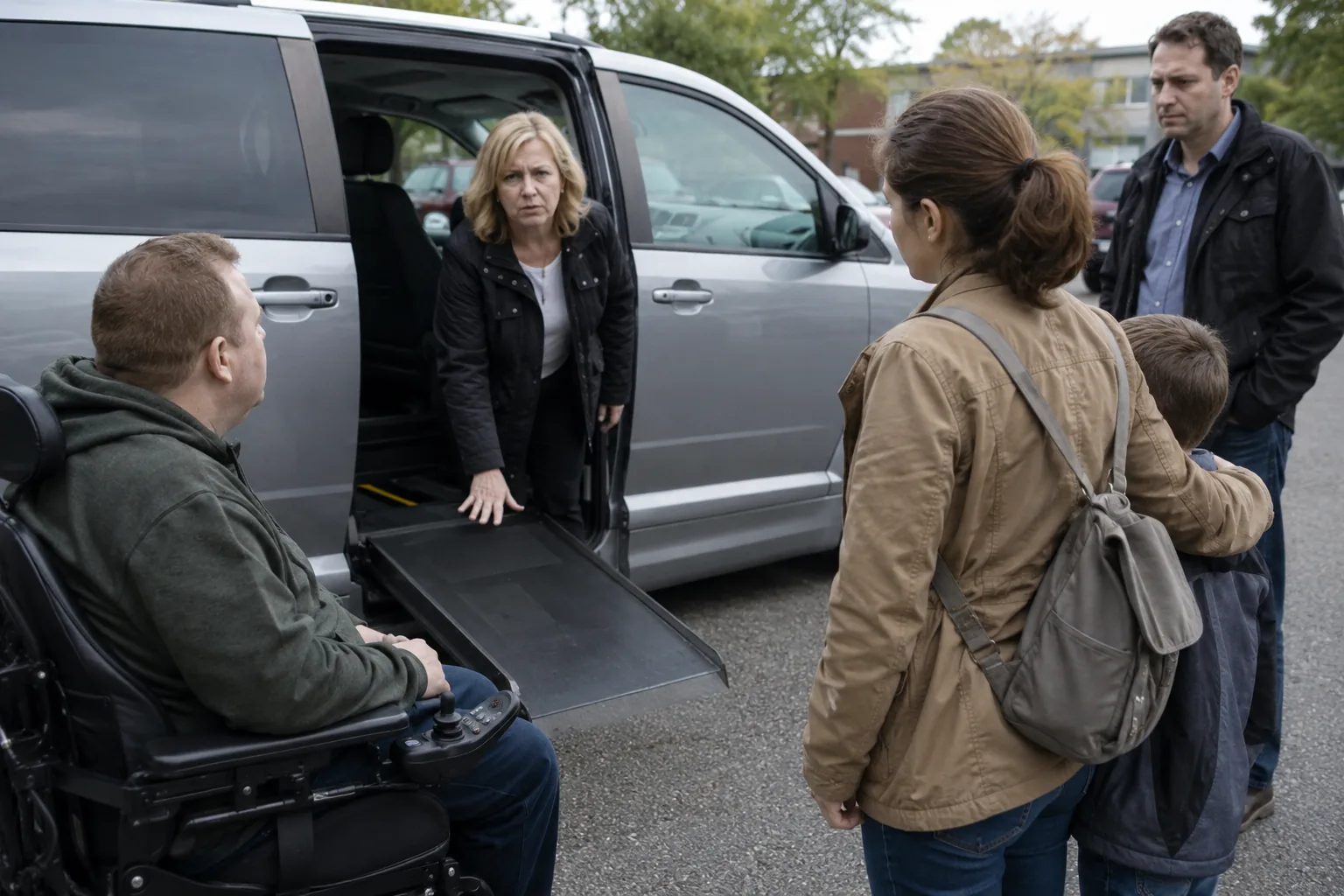
Denise looked straight at the metal housing by the van door. “No tag, no service notice that I can see.”
“Then the ramp is supposed to be used for boarding and unloading,” Michelle said. “If there’s a mechanical concern, the driver reports it and the vehicle is pulled. We don’t do spot approvals for normal deployment.”
Tessa did not say anything right away. She watched Marlene instead. Marlene’s jaw moved once before she spoke.
“That’s not the full situation,” she said toward the phone. “There’s also a safety exception issue.”
“For this passenger?” Michelle asked.
The question landed hard because it was so direct.
Marlene answered too slowly. “For this setup.”
“What setup?” Michelle said. “If you’re talking about passenger transfer needs, that would already be in the route notes. If you’re talking about the ramp, it goes down unless the equipment is unsafe.”
Denise flipped the route sheet back toward herself and ran one finger down the page again, as if the blank space might have changed while they were standing there. It had not.
Tessa kept her voice controlled. “She also said if Eli gets out here, he’d need special approval to get back in later.”
There was another pause from the phone. Then Michelle said, “Approval for reloading the same rider onto the same vehicle? No. That’s not a thing.”
The sentence cleared the air more than any accusation could have. It did not explain Marlene. It did not need to. It just took away the cover her wording had been living under.
Eli shifted in his chair and looked at Marlene, then at Denise’s phone.
“So this morning was normal until right now,” he said.
Nobody contradicted him.
Marlene tried once more to move the ground. “I was told to be careful with him at the stop.”
Michelle answered before Denise could. “Careful is not a policy. If you have a documented rider concern, name it. If you have an equipment problem, report it. If neither is true, complete the stop.”
Tessa noticed the order of that sentence. Name it. Report it. Complete the stop. Process had finally become specific.
Denise asked the next question with the kind of tone people use when they are preserving a record while still standing in the middle of a parking lot.
“Can you confirm on speaker that there is no special-approval requirement for deploying this van’s wheelchair ramp at this location?”
“Confirmed,” Michelle said. “No special-approval requirement for normal ramp use at that stop. If the rider is being denied unloading, I need the driver’s name and unit number.”
The loading area had gone quiet in a different way now. Not theatrical. Just attentive. The man with the supply cart had stopped pretending not to listen. A woman near the office door held it open with her elbow and did not move.
Denise gave the van number first. Then she looked at Marlene.
Marlene did not volunteer her name.
“Driver or caregiver on duty is Marlene Pike,” Denise said.
Marlene turned toward her. “You don’t have to do that.”
Denise’s mouth tightened. “He is still in the van because of a rule you cannot source. I do, actually.”
Michelle asked one more practical question. “Is the passenger still waiting to unload?”
“Yes,” Denise said.
“Then the stop needs to be completed now,” Michelle said. “And have Marlene call in before taking the next route movement. We need an incident note on the denial.”
Cold instructions. No speech. No argument left inside them.
Marlene’s hand stayed on the door frame. “I’m not comfortable doing it until somebody from transport is physically here.”
That was the furthest she had pushed it yet. Tessa saw what it did to the scene. The claim was no longer just unsourced. It was now resisting a direct answer from the office she had been borrowing authority from all morning.
Denise raised the phone a little higher. “Michelle, if she refuses?”
“Then note refusal to complete unloading after direct instruction,” the voice said. “Supervisor will handle it from there.”
Marlene looked from the phone to the ramp controls to Eli still waiting in the doorway of the van. Her shoulders had gone stiff enough to show through her jacket.
Tessa did not guess at what sat behind that stiffness. She stayed with what was visible.
Marlene had spent the whole stop talking as if the ramp required invisible permission. Now the actual office had said the opposite out loud, on speaker, with witnesses. And the next step was no longer a debate about fairness. It was a recorded choice.
Deploy the ramp, or make the refusal official.