Story code: ST-000091
Part 2: The Backup Plan Changed The Room
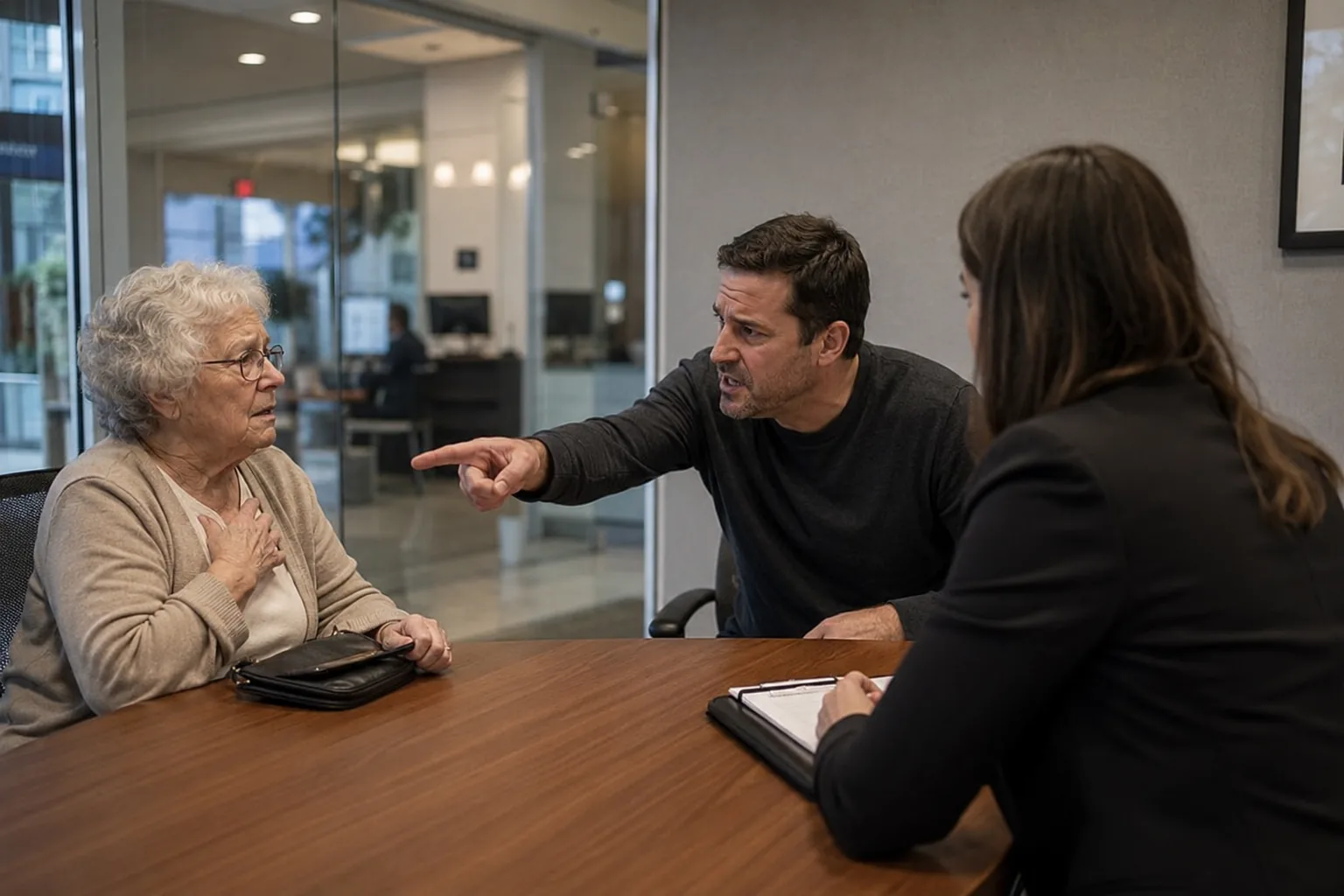
After Linda set the folded bank envelope on the table, Mark stopped talking for the first time since he walked in. He did not sit back. He did not relax. He just held the car keys lower, near his knee, and kept his eyes on the envelope while the counting machine outside rattled through a stack of bills.
I said, “We can go one item at a time.”
Linda gave a small nod without looking away from the table. “That would help.”
Mark reached for the envelope. Linda put two fingers on it first. Not dramatic. Just enough to stop him.
“It’s mine,” she said.
He pulled his hand back and laughed once through his nose. “Fine. Show whatever you want.”
She opened it carefully. Inside was a narrow slip of paper and a smaller card with handwriting on it. She slid both toward me, not toward him.
The slip was a branch transaction receipt from earlier in the week. The card held a list in neat blue ink: utility draft, pharmacy payment, apartment gate code update, auto transfer day, insurance phone line. A second line at the bottom said, in larger letters, ask before changing pickup schedule.
None of that was dramatic on its face, but together it told me something simple. Linda knew the order of her routine. She knew which pieces connected.
“Can you explain what you want verified?” I asked.
She pointed to the receipt. “Can he move money by phone if I tell him not to?”
Mark cut in immediately. “I’ve been helping her. That’s all.”
I kept my eyes on Linda. “If you are the only owner and there is no formal authority on file, then another person cannot be added to transact just because they say they help.”
Mark turned to me. “I know the account. I’ve handled the calls.”
“Handled is not the same as authorized,” I said.
Linda asked the next question before he could jump back in. “If passwords are changed and verbal access is removed, would that take effect today?”
There it was. Not loud. Not flashy. But it landed harder than anything he had said.
Mark’s chair moved a fraction backward. He shifted the keys from one hand to the other. “This is getting ridiculous.”
Linda still did not look at him. “Would it?”
“Yes,” I said. “We can review your access settings and update them while you’re here.”
For a second nobody spoke. The ordinary bank noise outside the room suddenly sounded sharp: receipt paper tearing, a pen chain tapping the counter, someone asking for quarters.
Mark pressed his thumb against the metal key ring. “So that’s what this is. You bring me here for help and then try to lock me out.”
Linda lifted her eyes to him at last. Her voice stayed level. “You said if I didn’t do this today, there would be no ride, no groceries, no pickup, no help. I heard you.”
“I said I’m not being used.”
“You also brought a paper that is not from this bank.”
He turned to me again. “Everybody makes drafts. That proves nothing.”
I set the page back on the table, separate from Linda’s envelope. “It proves only that it is not a bank document and cannot be treated as one here.”
He opened both hands then closed them again around the keys. “So now what? She strands herself to prove a point?”
Linda’s right hand rested on her note card. “No. I stop doing this under pressure.”
That sentence changed the shape of the meeting.
Until then, Mark had been acting like the room only had two options: sign or lose help. Once Linda said it that way, a third option sat in the middle of the table with the fake paper and the receipt. She could decline his paper and still use the bank. She could ask direct questions and get direct answers. And if access changed, the routine he kept describing as her dependence would change for him too.
I asked Linda whether she wanted private account review without Mark present. That is standard language, plain and neutral. I use it often.
Mark answered before she could. “No. We’re finishing this together.”
Linda turned her head toward me and spoke over him without raising her voice. “Yes. I want that.”
He stared at her. Then he looked at the fake document, then at the receipt again as if he had only just noticed it. “Who gave you that copy?”
She did not answer his question. She asked me one of her own. “If I update everything today, will the notes show that I asked without him speaking for me?”
“Yes,” I said.
Mark stood up so fast the chair rolled back and bumped the wall. A teller glanced through the glass and then away. He lowered his voice, but not enough. “You can’t do all of that and expect me to keep fixing everything after.”
Linda remained seated. “That is your choice.”
He looked down at the keys in his hand like he had forgotten he was holding them. Then he set them on the table, hard enough to make Linda’s pen jump inside her folder.
“Fine,” he said. “Let’s see how far you get without me.”
Linda did not reach for the keys.
She looked at me instead and asked, “If he walks out now, can we start with the verbal access and the transfer schedule first?”
I said yes.
Mark stayed by the door, hand on the handle, not leaving and not sitting back down either. He had come in acting like he controlled the exit, the ride, the timing, and the paper. Now he was the only person in the room waiting to hear whether Linda would keep the routine open for him.
And when she asked me to document that he had tried to present that paper during the meeting, he finally understood that the next move did not belong to him.