Story code: ST-000239
Part 4: The Ghost Town
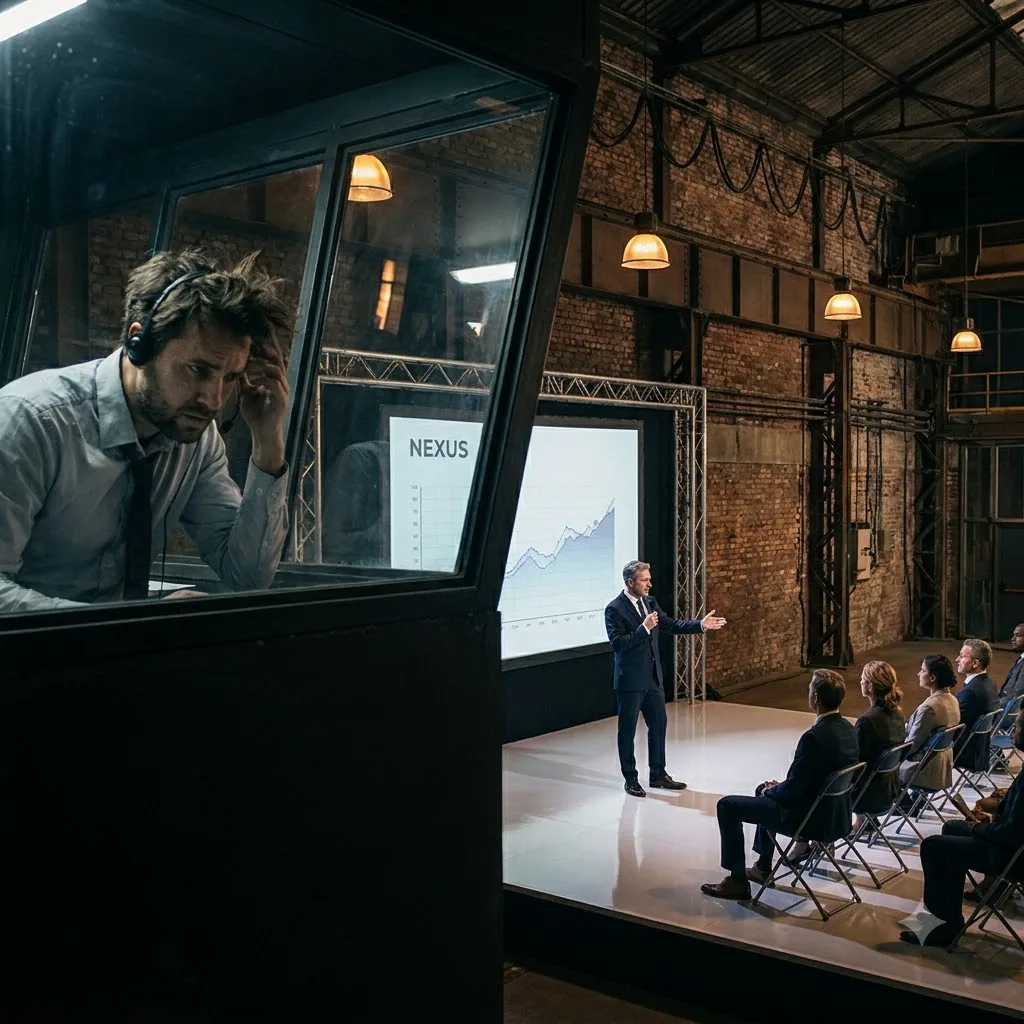
The silence in the cavernous steel mill stretched until it felt brittle. Caleb stood half-swallowed by the shadows at the edge of the stage, rubbing his bruised right wrist. He watched the silver-haired lead investor, whose cold gaze remained locked on the sixty-foot screen. The pathetic, flickering gray dots of the app’s actual user base continued to blink against the dark map, a dying pulse broadcasting Julian’s monumental fraud.
“Julian,” the lead investor repeated, his voice dropping to a terrifyingly quiet register. “I asked you a question.”
Julian swallowed hard. The charismatic veneer that had carried him through months of pitch meetings dissolved into raw desperation. “It’s a localized desync,” Julian stammered, raising the locked tablet as if it could somehow shield him from the towering projection. “The visualizer is pulling from an outdated repository. If you just give my team five minutes-”
“Don’t insult me,” the silver-haired man interrupted softly.
The lead investor didn’t raise his voice. He didn’t have to. The quiet dismissal carried more weight than a shouting match ever could. He simply turned away from the stage and looked at the woman in the cashmere sweater. She was already lowering her phone, her expression hardened from polite curiosity into deep, unapologetic disgust. She tapped her screen twice, stopping the recording, and slipped the device back into her designer handbag.
There was no dramatic argument. There were no furious demands for accountability. The venture capitalists operated in a world where time was capital, and they had just realized their time was being wasted. They moved in unified, dead silence. The lead investor adjusted his coat, turned his back on the stage, and began walking toward the heavy steel exit doors at the far end of the mill. The rest of the coastal cohort followed immediately.
Their expensive leather shoes echoed against the polished concrete floor, a rhythmic, hollow clicking that sounded like a countdown.
“Wait, please!” Julian stepped forward, his voice cracking. He abandoned the tablet, letting it clatter onto the stage floor. “We have the underlying architecture! The backend is fully scalable, we just need the Series B capital to push the marketing! We can acquire the users!”
The investors didn’t even break stride. They didn’t look back. The heavy exit doors swung open, letting in a brief blast of gray daylight before slamming shut behind them with a booming, final thud.
The Series B funding was gone. The frictionless miracle was dead.
Julian stood frozen at the edge of the stage, staring at the empty expanse of the refurbished factory. His shoulders heaved under his bespoke linen suit. Slowly, he turned his head toward the shadows, his eyes finding Caleb.
“You killed it,” Julian whispered, his voice trembling with a mixture of disbelief and absolute venom. “I built this empire, and you killed it for nothing.”
Caleb felt the heavy, suffocating guilt that had plagued him for months instantly evaporate. He looked at Julian, then looked up at the massive screen displaying the miserable, undeniable truth of their work.
“You didn’t build an empire,” Caleb said, his voice steady. “You built a ghost town.”
Caleb reached up to his chest and gripped the plastic ID badge hanging from his lanyard. He pulled it over his head. Without another word, he walked out of the shadows, stepped up to the polished wooden podium, and dropped the lanyard. The plastic slapped flatly against the wood.
Julian made no move to stop him. He was just a hollow man standing under blinding stage lights, staring at a broken dream.
Caleb walked down the metal stairs of the stage and crossed the vast, empty floor. He pushed through the same heavy steel doors the investors had used.
The biting Ohio wind hit him instantly, sharp and completely uncurated. It smelled of damp asphalt, distant exhaust, and incoming rain. Caleb took a deep breath, letting the freezing air fill his lungs. He walked past the row of black SUVs waiting for the investors and headed down the cracked, uneven sidewalk toward the center of town.
Ten minutes later, Caleb pushed open the glass door of a small, faded diner on Fourth Street. The bell above the door chimed-a cheap, tinny sound. The air inside was thick with the smell of old grease and burnt coffee. It wasn’t an aesthetic. It was just old.
He spotted his older brother sitting in a vinyl booth near the back, wearing a faded mechanic’s jacket and nursing a ceramic mug. His brother looked up, raising a dark eyebrow as Caleb slid into the booth opposite him.
“You’re out early,” his brother said, pushing a laminated menu across the scratched table. “Thought you had that big dog-and-pony show with the coastal money today.”
“It wrapped up early,” Caleb said.
A tired waitress walked over and silently filled a thick ceramic mug with steaming, pitch-black coffee, sliding it in front of Caleb before walking away.
Caleb wrapped his hands around the mug. It was scalding hot, entirely too bitter, and completely real. He looked out the diner’s foggy window at the rusting iron framework of the town he called home. There was no user interface to hide the decay, no slick animation to smooth over the rough edges. It was broken, struggling, and raw.
For the first time in a year, Caleb took a sip of his coffee and smiled, finding absolute peace in the honest, unfaked reality of it all.