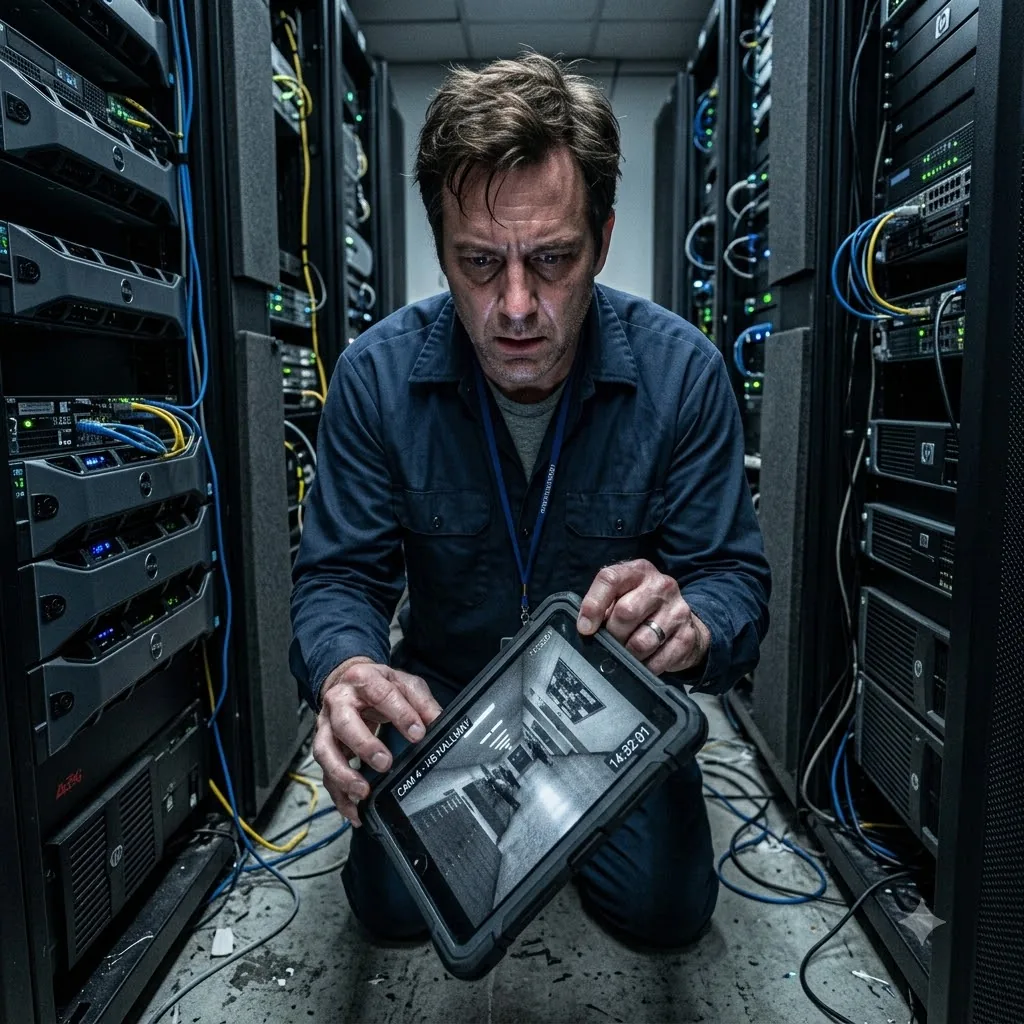
Story code: ST-000859
Part 4: The Blind Spots
The sirens died first, replaced by the heavy, suffocating silence of drawn lines. Sergeant Miller slung his riot shotgun over his shoulder and keyed his radio, requesting an EMT for a hypothermic minor. He didn’t even look at Vance. The local cops formed a loose, protective wall between Elias, Leo, and the sputtering insurance consultant. Vance didn’t try to give another order. He backed away, his polished shoes scuffing the linoleum, already pulling a cell phone from his tailored pocket to call his corporate fixers.
But exposing the truth to a few local cops didn’t dismantle a million-dollar financial apparatus.
Three days later, Elias sat in the stifling heat of the superintendent’s office, listening to the crushing sound of administrative self-preservation. The emergency school board meeting had happened behind closed doors that morning. The verdict was final.
“The Apex contract remains in place,” Superintendent Harris said, refusing to meet Elias’s eyes. Harris stared intently at a heavy brass paperweight on his desk. “We are keeping the cameras. We are keeping the de-escalation suites, though they will be rebranded and their climate controls manually restricted.”
Elias gripped the armrests of his chair, his knuckles turning white. “Vance admitted it in front of six police officers. The district stole the federal relief grant to pay Hanover-Creste’s insurance premiums. They’re hunting vulnerable students to balance the budget.”
“Vance has been reassigned by his parent company,” Harris interrupted, his voice tight and rehearsed. “He will no longer be allowed on campus. But the board’s hands are tied, Elias. If we breach the security contract, Hanover-Creste drops our property insurance completely. Without coverage, the state shuts the district down by Friday. Every student goes home. And you know as well as I do that half these kids, like Leo, don’t have a warm home to go back to right now.”
It was the ultimate corporate trap. The district had locked itself into a financial hostage situation, and they were using the very students they were tormenting as the ransom.
“So you just bury it,” Elias said, the disgust thick in his throat.
“We survive,” Harris corrected weakly. “And you still have a job. The board wanted your license for assaulting Vance. I fought to keep you here. But you are to focus strictly on standard counseling. There will be no more physical interference with the automated disciplinary tracks. Do you understand?”
Elias looked at the heavy oak door of the office. He could walk away. He could go to the local press, though Hanover-Creste’s corporate lawyers would tie him up in defamation suits for the next decade while the students suffered. If he left, the algorithm won. The machine would keep finding the shivering, the terrified, and the traumatized, processing them into neat, budget-saving expulsions.
“I understand,” Elias lied.
The following Monday, the D-Wing corridors smelled faintly of floor wax and ozone. The panoramic surveillance cameras still hung from the ceiling tiles, their black glass domes gleaming like compound eyes under the fluorescent lights. As Elias walked to his office, the motorized lenses whirred, tracking his shoulders with mechanical precision. The machine was still learning. Still watching.
But Elias was watching back.
Inside his office, safely away from the digital eyes of the corridor, Elias sat across from Leo’s mother. She looked exhausted, wearing a heavy winter coat indoors, her hands wrapped tightly around a styrofoam cup of tea. Leo was back in class, his severe hypothermia treated, his disciplinary record quietly wiped clean by Harris in a desperate bid to keep Elias placated.
Elias slid a small, unmarked envelope across his desk.
“What’s this?” she asked, her voice raspy from the lingering cold of the trailer park.
“It’s a direct contact for a legal clinic in the city,” Elias said, keeping his voice low, glancing reflexively at the gap beneath his office door. “Pro bono. They specialize in housing rights and federal disaster relief fraud. You don’t call them from the unpowered zone, and you don’t mention my name. But you tell them exactly what this district tried to do to Leo last week.”
She took the envelope, sliding it into her coat pocket with a silent, understanding nod. She wasn’t the first displaced parent Elias had met with this week. She wouldn’t be the last. The school board thought they had silenced him by keeping him on the payroll. They didn’t realize they had simply given the resistance a permanent office on the ground floor.
After she left, Elias stood and locked his door. He walked over to the large corkboard dominating the wall behind his desk. Officially, it was a messy schedule of counseling sessions and community mental health resources. Beneath a layer of innocent-looking district memos, however, was a meticulously detailed architectural blueprint of the high school.
Elias picked up a red marker. He had spent the last three days closely observing the cameras. He noted the precise pan-and-tilt latency of the lenses in the D-Wing. He marked the three-second delay in the facial recognition software whenever a student walked directly beneath the harsh glare of the emergency exit signs. He circled the intersecting blind spots near the temporary portable classrooms, where the Wi-Fi signal degraded and the AI’s predictive feed dropped frames.
He couldn’t smash every expensive tablet. He couldn’t fight a tactical squad every week. But he was a psychologist. He understood behavior, and he was beginning to understand the machine’s rigid, uncreative mind.
The board had voted to keep their mechanical monster to protect their bottom line. Elias capped the red marker, staring at the web of vulnerabilities mapped out across the blueprint. He was going to dismantle their algorithm shadow by shadow, blind spot by blind spot, until the entire system tore itself apart from the inside.