Story code: ST-000698
Part 2: She Performed for the Wrong Room
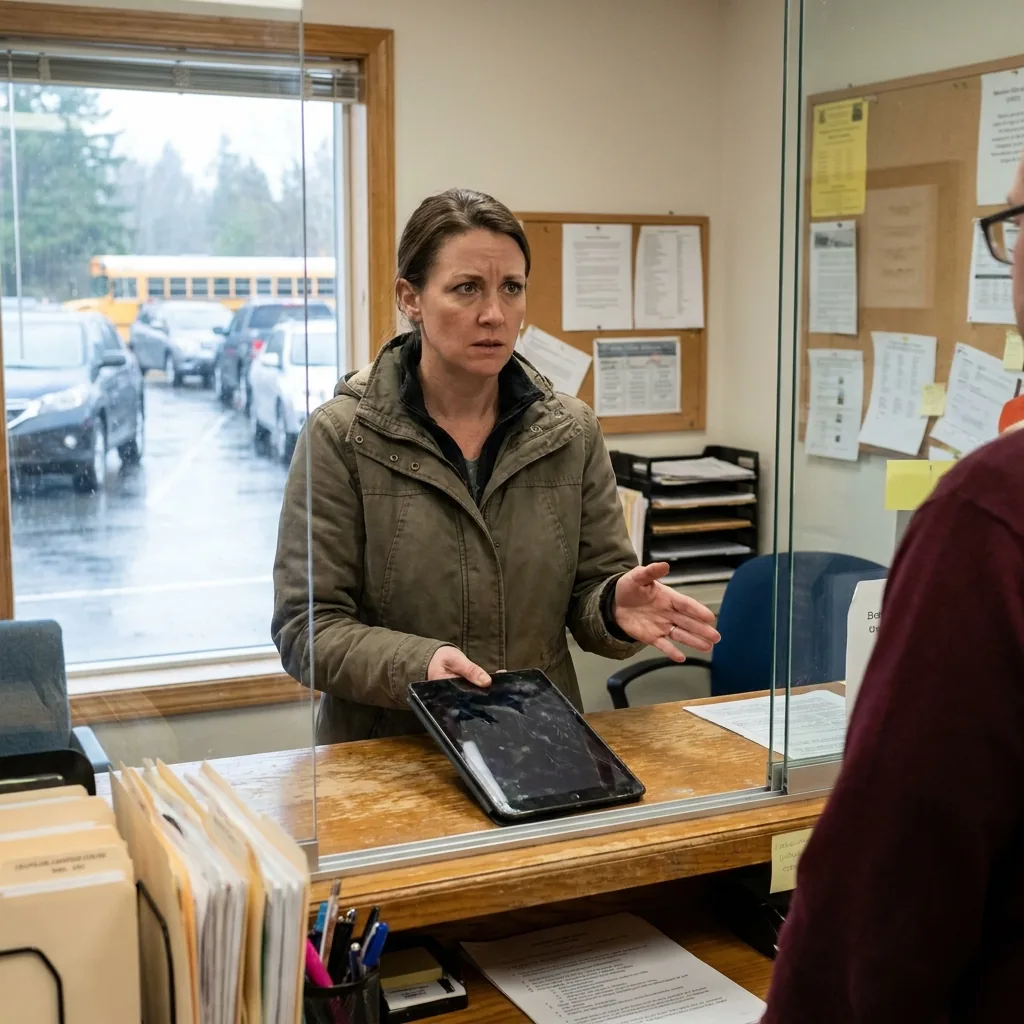
By the time we moved into the small specialist room beside the pickup lane, Heather had repeated “latent dock-memory” three times like repetition could make it standard. The pickup radios were still audible through the wall, names and car numbers bleeding into the room while Eli Navarro set a charger cable beside the keyboard. The cracked tablet stayed in my hands until he held one palm out for it, and Heather kept pace with us the whole way, talking over the transition like she was teaching a seminar instead of disputing a broken school device tied to her son.
The specialist room was not dramatic. One desk, two chairs against the wall, a monitor, a district label printer, a bin of chargers, and the check-in station we use for student devices. Eli took the tablet from me carefully, turned it once to read the asset tag, and set it down under the monitor light.
Heather watched his hands. “Please tell me you’re not going to hard-seat the cable before checking for dock-memory retention.”
Eli looked up once. “I’m going to identify the device first.”
“Right, but if the panel drift has already compromised the sync layer, then standard identification can overwrite the failure path.”
He did not answer that. He typed the asset number into the system. The keys clicked. The radio outside chirped again. Brayden stood by the door frame with his backpack still on one shoulder, his hand still looped through the strap.
I stayed near the side cabinet with the intake pad. From there I could see the tablet, the monitor, and Heather half-turned toward Eli, one finger lifted every time she wanted to interrupt.
“For the record,” she said, “I explained at the front counter that this presents as a sync-panel cascade followed by fracture expression. It is not student mishandling.”
Eli clicked into the device log. “Okay.”
That one word seemed to irritate her more than an argument would have.
“Okay as in you understand what that means?” she asked.
He kept his eyes on the screen. “Okay as in I’m checking the assigned device.”
There was a short pause. Then Heather smiled again, smaller this time.
“I just want to make sure we’re not collapsing a hardware event into a conduct issue because somebody here only recognizes visible impact signatures.”
She did not say my name. She did not have to.
Eli asked, “Brayden, was this in your possession at the end of last period?”
Brayden looked at his mother first.
“Answer the question,” Heather said quickly, before he had actually answered it.
“Yeah,” he said.
“And when it stopped working?” Eli asked.
Heather stepped in again. “It did not simply ‘stop working.’ The display destabilized. There was a flicker, then thermal lag, then surface fracture. That sequence matters.”
Eli finally turned his chair a few inches toward her. “What do you mean by thermal lag?”
She answered immediately, almost too quickly. “Heat retention inside the panel after a dock-memory hold. It’s common if people force a wake cycle at the wrong stage.”
The room went very still for a second after that, not dramatic, just a slight drag in the timing. Eli looked at her, then back at the monitor.
He asked, “What dock?”
Heather blinked once. “The learning dock. The internal one.”
“On this model?” he said.
She folded her arms. “On district-managed tablets generally.”
He rested one hand beside the cable and nodded once, like he had heard her. Then he clicked open the hardware page. I could not read every line from where I stood, but I saw the familiar verification layout come up on the screen.
Heather kept going. “This is exactly why parents get frustrated. Staff hears one crack and jumps straight to fault. There are whole failure chains behind these screens that front office people never get taught.”
I said, “That’s why we’re checking it live.”
She turned toward me with that same polished patience. “If it’s checked correctly.”
Brayden shifted against the door frame. The zipper on his backpack knocked softly against the metal plate. He still had not moved closer to the tablet.
Eli lifted the cable. “I’m connecting power and opening the device log. After that I’ll verify status, last check-in, and whether the screen responds enough for intake notes.”
Heather gave a short laugh with no sound under it. “If you connect before preserving latent dock-memory, you’re contaminating your own result.”
Eli held the cable in midair for one second and looked at her directly. “There is no latent dock-memory on these devices.”
No one said anything.
Heather’s mouth stayed slightly open, then closed. She adjusted the cuff of her sleeve and shifted her weight to the other foot.
“That may be what your department calls it,” she said.
Eli set the connector beside the charging port but did not plug it in yet. “Who calls it that?”
The question hung there longer than anything else had. Brayden looked down at the floor tiles. Heather glanced at the monitor, then at the tablet, then back to Eli.
Outside the wall, the pickup radio called another student name. Inside the room, Eli waited with the cable in his hand and the ordinary device log open on the screen, and for the first time since she came to my counter, Heather was the one who had to fill the silence.