Story code: ST-001310
Part 3: Courtroom 4
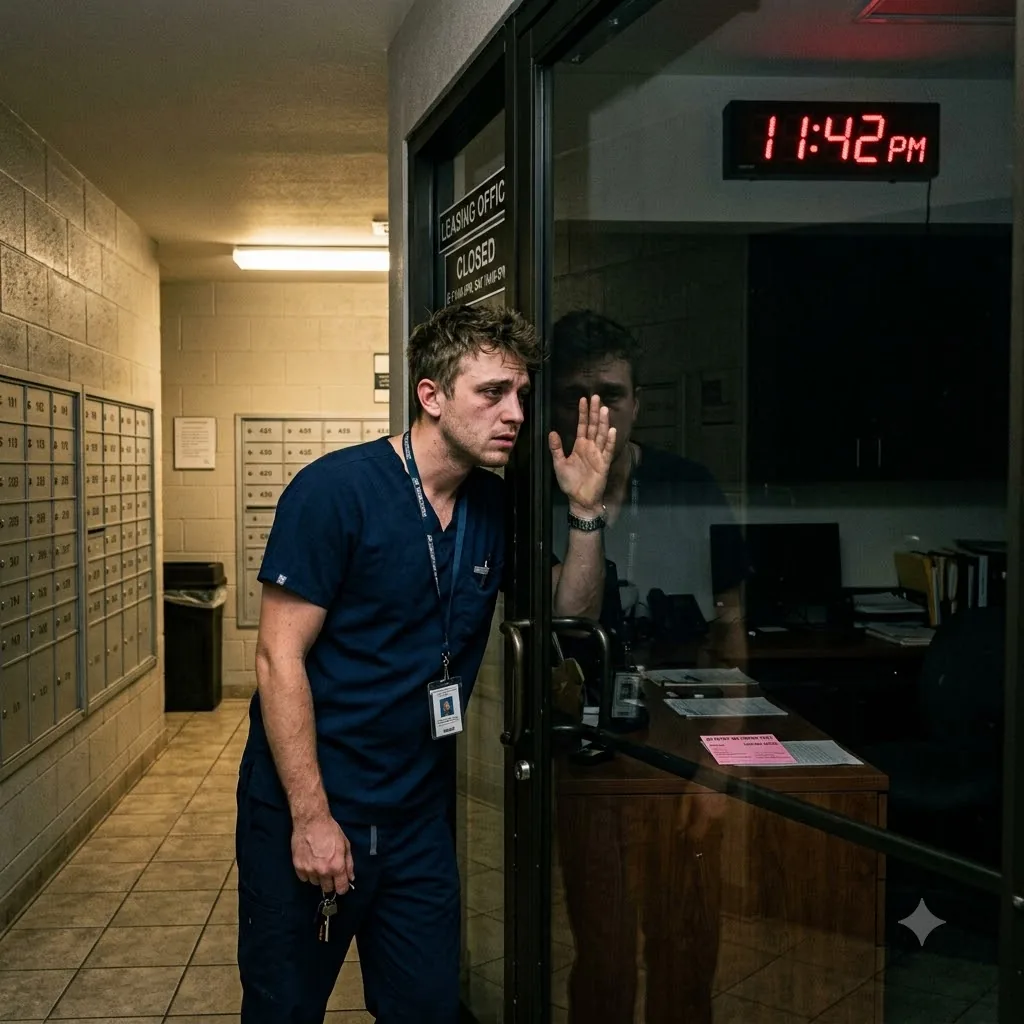
The fluorescent lights of Courtroom 4 hummed with the same hollow, indifferent frequency as the postal facility lobby from three months ago. Elias sat rigid at the respondent’s table, his hands folded over the cheap wool of his clearance-rack suit. Beneath the fabric, the jagged scar on his outer thigh gave a phantom throb, a permanent souvenir of the glass he had shattered in a desperate, ultimately futile, attempt to beat the clock.
At the prosecutor’s table, ICE Trial Attorney Vargas was already capping his silver fountain pen. Vargas had the relaxed, efficient posture of a man simply checking off a box. He had barely looked at Elias since the hearing began.
“The facts are not in dispute, Your Honor,” Vargas said, his voice echoing off the stark wood-paneled walls. “The respondent’s final deadline to submit his Request for Evidence to USCIS was midnight on Monday, June 19th. The certified mail receipt entered into evidence clearly shows a postmark of Tuesday, June 20th, at 8:14 AM. He was over eight hours late. Under INA regulations, failure to file within the statutory window constitutes automatic abandonment of the visa petition. We move for an immediate order of removal to clear this case from the quarterly docket. My office has a strict mandate on these overstays.”
Elias stared blankly at the seal of the Department of Justice mounted above the bench. He had gone back to the post office at dawn the very next morning. The daytime postmaster had taken one look at the typo on the pink slip, rolled her eyes at her night clerk’s pedantry, and manually stamped the envelope. But it hadn’t mattered. The automated government system had already flagged his file as delinquent at 12:01 AM, triggering the rapid deportation proceedings that had forced Elias onto administrative leave from the ER, cost him his apartment, and drained his remaining savings.
“Your Honor,” Elias’s legal aid attorney, a perpetually exhausted woman named Lin, stood up. She gestured toward the evidence binders. “My client was physically present at the postal facility before midnight on the 19th. We have submitted photographic evidence of his lacerated leg, the shattered leasing office door, and the erroneous delivery slip printed by the government. The delay was entirely caused by a clerical error on the agency’s part, dropping the last three letters of his surname.”
Judge Arthur Vance adjusted his wire-rimmed glasses. Vance was notoriously inflexible, a strict constitutionalist who treated the immigration code like mathematical gospel. He had coldly denied three asylum claims this morning before the ten o’clock recess.
“Counselor,” Judge Vance said, his voice dry and flat, devoid of any sympathy. “The government is not responsible for your client waiting until the eleventh hour to retrieve his mail and discover a clerical error. The statute is strictly construed. A broken door and a stubborn postal clerk do not toll a statutory deadline. I am bound by the hard dates on the page, not the dramatic narrative of how those dates were acquired.”
Lin sank back into her squeaking leather chair, defeated. “Yes, Your Honor.”
Elias closed his eyes. That was it. Three years of medical school, fourteen-hour trauma shifts, pulling patients back from the brink in Trauma Bay 2, all erased because a computer missed three keystrokes and he missed an arbitrary midnight cutoff.
“I am prepared to issue my ruling,” Judge Vance announced, pulling the heavy, red-tabbed stack of Elias’s case files toward the center of his elevated mahogany bench.
Vargas smiled faintly. He slid a blank, standardized Order of Removal toward himself, ready to tally another fast statistic for ICE’s end-of-month enforcement quota.
“The record reflects,” Judge Vance dictated to the court reporter, his eyes scanning the top sheet of the file, “that the respondent was issued a final deadline of Monday, June 19th, to respond to the agency’s request.”
The judge reached for his heavy signature pen. As his hand hovered over the paper, he paused. His eyes darted from the USCIS notice to the large, leather-bound desk calendar sitting adjacent to his wooden gavel.
Vance frowned, the deep lines around his mouth tightening. He flipped a page of the calendar backward, smoothing it flat.
The silence in the courtroom stretched. The hum of the air conditioner seemed to amplify, filling the dead air. Elias held his breath, the pulse in his neck thumping against his stiff shirt collar.
“Mr. Vargas,” Judge Vance said slowly, his pen remaining suspended in the air. “The stated deadline was June 19th.”
“Correct, Your Honor,” Vargas said briskly, eager to wrap up. “Which he missed.”
“June 19th was a Monday,” the judge continued, his brow furrowing deeper as he traced a manicured finger down the calendar page.
“Yes, Your Honor. The post office retail lobby was demonstrably open. The respondent was there. There is absolutely no excuse for the failure to-”
“Are you familiar with Public Law 117-17?” Judge Vance interrupted, his voice dropping a commanding octave.
Vargas blinked, his confident posture slipping slightly as he leaned forward. “Your Honor?”
“The Juneteenth National Independence Day Act,” Judge Vance said, looking up over the gold rims of his glasses directly at the prosecutor. “Signed into law recently. It establishes June 19th as a federal legal holiday.”
Vargas stood up quickly, his chair scraping loudly against the floor. “Your Honor, with respect, that is a newly observed holiday. Many local postal processing centers, including the one in question, maintained normal retail operations that evening. The respondent himself just admitted the facility was open and manned by a federal clerk.”
“The operational hours of a local postal vestibule do not override the United States Code, Counselor,” Vance said, his tone turning to absolute ice. “Under 8 CFR § 1.0, the computation of time for any statutory deadline in these proceedings is explicit. If the final day of a filing period falls on a Saturday, Sunday, or a legal federal holiday, the period shall run until the end of the next day which is not one of the aforementioned days.”
Elias sat up straight, his heart hammering against his ribs in a sudden, violent rhythm. He looked at Lin, whose mouth had slightly parted in pure shock.
Vargas’s face flushed a deep, mottled red. He scrambled for his tablet, swiping frantically through his digital case files. “Your Honor, ICE enforcement directives require us to process these abandonment claims strictly by the calendar date printed on the notice. The quota for this quarter relies on clearing these backlogs-”
“I do not care about your internal enforcement quotas, Mr. Vargas,” Judge Vance snapped, slapping his hand flat against the bench. The sharp crack made the ICE attorney flinch. “I care about the law. And the rigid application of the law dictates that because June 19th was a federal holiday, the respondent’s deadline legally rolled to 11:59 PM on Tuesday, June 20th.”
Vance picked up the certified mail receipt from the evidence pile and held it up to the fluorescent light. “This envelope was postmarked at 8:14 AM on June 20th. Which means Mr. Thornton did not file eight hours late. He filed with fifteen hours to spare.”
Vargas gripped the edges of his table, his knuckles turning white. “Your Honor, the agency already processed the termination in the system! The removal order is drafted. You can’t just throw out a federal mandate because of a calendar technicality!”
“The agency processed an illegal termination based on a failure to update its own automated calendar,” Judge Vance corrected coldly. He picked up his pen, grabbed the government’s Order of Removal, and drew a massive, thick black line diagonally across the page.
Vargas stared at the ruined paperwork, his mouth opening and closing, unable to form a single legal argument against the very bureaucracy he had just tried to weaponize.