Story code: ST-000647
Part 2: The Faraday Protocol
The siren was a short, sharp burst of sound that froze Marcus on the cracked pavement. The black-and-white cruiser angled sharply toward the curb, its tires biting into the scattered gravel. The passenger door opened before the car had completely stopped.
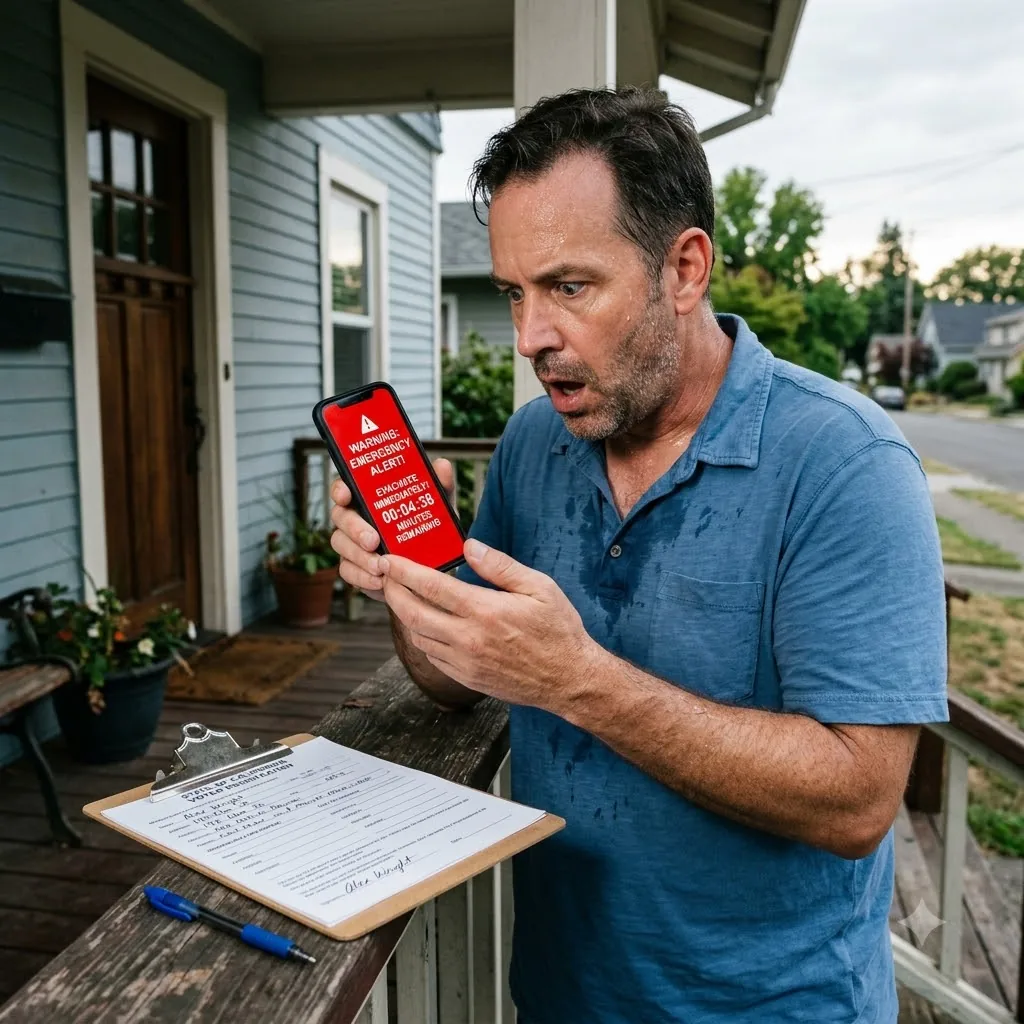
Marcus did not run. He did not let his shoulders tense. He kept his feet planted exactly where they were, letting his right hand hang loosely by his side while his left hand clamped the clipboard against his chest. Inside his pocket, the phone was a continuous, furious buzz against his thigh. He did not need to look at the screen to know the countdown was dropping past four minutes.
“Afternoon,” the passenger officer said, stepping onto the sidewalk. He was younger than Marcus, with a high-and-tight haircut and his thumbs hooked casually into his duty belt. The driver remained in the cruiser, his silhouette dark behind the glare of the windshield. “Got some ID on you?”
Marcus kept his voice perfectly steady. He stated that his wallet was in his back right pocket and asked for permission to reach for it.
The officer nodded. “Nice and slow.”
Marcus retrieved the wallet with two fingers, sliding out his state ID. He handed it over. The phone vibrated relentlessly against his leg, a physical reminder of the digital guillotine swinging down. If the officer ran his name through the system after the timer hit zero, the mobile data terminal in the cruiser would light up with a fresh felony parole violation. Once that happened, he was going into the back of the car. The clipboard holding the signed registration forms-forms that had to be at the city clerk’s office in less than two hours-would be tossed onto the passenger seat and eventually logged into a precinct evidence locker.
“Just out for a walk?” the officer asked, looking from the plastic card to Marcus’s face.
Marcus explained he was conducting a voter registration drive authorized by the municipal election board. He tilted the clipboard, offering to show the official paperwork clipped beneath the stacks of signed forms.
“We got a call about aggressive soliciting in the area,” the officer said, ignoring the offer. He keyed the radio microphone on his shoulder, reciting Marcus’s name and date of birth to dispatch.
The silence that followed was agonizing. Marcus shifted his weight, trying to ease the burning sensation in his pocket. The older mechanic was still standing on his porch, his hand resting on the screen door handle, watching the exchange with a hard, flat expression. The man did not step down to vouch for him. In this neighborhood, inserting yourself into a police stop was a risk no one took lightly. Marcus was entirely alone on the concrete.
Three minutes. Maybe two and a half.
The radio crackled. A dispatcher’s flat voice recited a ten-code that meant Marcus was clear of any active warrants.
The officer handed the ID back. “Alright, Marcus. We’re going to need you to move along. Take the clipboard somewhere else. People here don’t want to be bothered.”
Marcus slid the ID into his pocket. He desperately wanted to argue, to show his approved sector map and demand they document his location, but the officer was already turning back to the cruiser. A dispute now would only prolong the stop or give them a reason to detain him. Marcus nodded, keeping his movements deliberate, and watched the officer get back into the car. The cruiser idled for ten seconds-an eternity of wasted time-before pulling away from the curb and continuing down the block.
The moment the rear bumper cleared the intersection, Marcus pulled his phone out.
*01:42.*
One minute and forty-two seconds until the state board’s servers generated the automated warrant. He stared at the screen, the red light harsh against his palm. Officer Davies had told him the system showed him in a dead zone, but his phone clearly had a cellular connection. The app was actively communicating with the servers, pushing the countdown, receiving the GPS coordinates that it was somehow misinterpreting.
It was a hardware loop. The app relied on a continuous handshake between his phone’s GPS receiver and the state’s server. When the GPS threw a false coordinate outside Sector 4, the server initiated the countdown.
Marcus remembered a tiny detail from his parole orientation packet, a clause buried in the technical troubleshooting section. If the phone completely lost all cellular and satellite connections-if it could not shake hands with the server at all-the app could not issue an immediate violation. It would enter a ‘System Offline’ state, granting a twenty-four-hour grace period for the user to reconnect and resolve the discrepancy. It was a failsafe designed to prevent false arrests during subway rides or power outages.
He did not need to fix the GPS. He needed to blind it. Completely.
*01:15.*
He looked wildly around the street. Row houses, thin wooden walls, open air. None of it would block a modern 5G signal. He needed deep concrete, lead, or a Faraday cage.
His eyes snapped back to the mechanic’s property. Not the house. The detached garage at the end of the driveway. It was an old structure built from thick cinder blocks, topped with a heavy corrugated steel roof and wrapped in metal siding. It wasn’t a perfect vacuum, but a metal box surrounded by dense masonry was his only option to kill the signal.
*00:58.*
He could not run. The app’s accelerometer would register the sudden spike in speed, classify it as fleeing, and terminate the countdown immediately. He had to power-walk, keeping his strides unnaturally smooth and even, mimicking a casual pace while eating up the distance.
He turned up the mechanic’s driveway, moving quickly past the porch.
“Hey!” the mechanic barked, stepping off the bottom stair. “Cops just told you to beat it. Where do you think you’re going?”
Marcus did not stop. He held the clipboard up, speaking over his shoulder, stating loudly that he just needed to check something in the alleyway.
*00:40.*
The front garage doors were padlocked, thick steel chains wrapped tightly around the handles. Marcus cursed under his breath, moving to the side of the structure. There was a small personnel door, the wood rotting near the concrete foundation. He twisted the brass knob. It refused to turn.
*00:28.*
He pressed his back against the cinder blocks, looking at the phone. Three bars of cellular service. The metal roof was not enough while he was standing on the outside. He needed to be inside, wrapped in the interference.
He looked at the small, grime-caked window beside the side door. It was eye-level, the glass reinforced with wire mesh, but the wooden frame holding it was severely rotted.
“I’m calling them right back!” the mechanic yelled from the top of the driveway, pulling a cell phone from his pocket. “You’re trespassing, buddy!”
*00:15.*
Marcus jammed the phone deep into his pocket. He grabbed the clipboard with both hands, raised it high above his shoulder, and swung the heavy plastic edge directly at the rotting window frame.