Story code: ST-000413
Part 4: The Zero-Sum Game
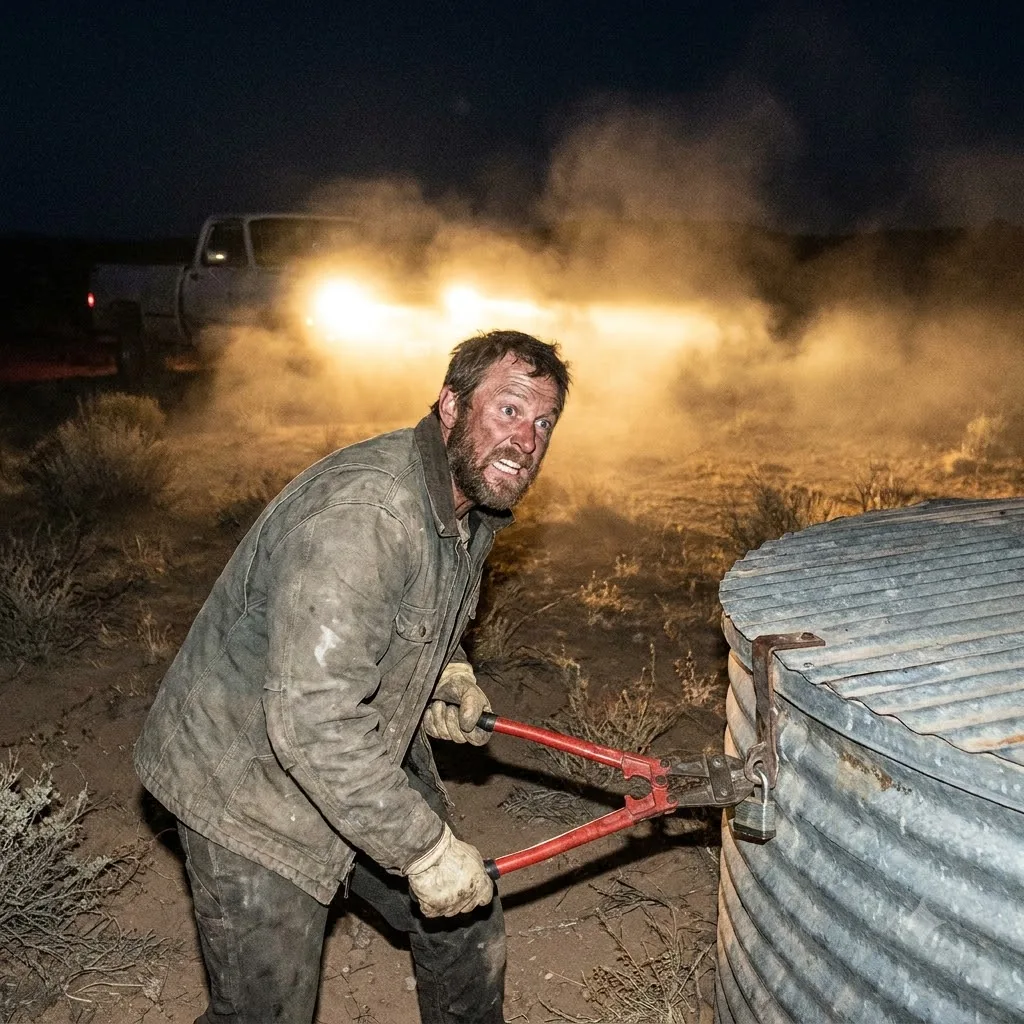
The heavy rusted pipe slipped from Elias’s numbed fingers before he even consciously decided to let it go. It struck the frost-heaved gravel next to the discarded bolt cutters with a dull, hollow clatter that seemed to echo for miles in the dead silence of the high desert.
The sound broke the spell. The monstrous shadow Elias had cast against the ribbed plastic of the water tank shrank back into the darkness. His shoulders caved inward, the sheer force of his desperation collapsing under the crushing weight of Sarah’s confession. He looked at his own hands, callused and trembling, sickened by what he had been fractions of a second away from doing. He had built this off-grid life to protect his family, to keep them safe from a collapsing world, and tonight, he had nearly assaulted a woman to steal back his own rain.
Sarah didn’t move immediately. She stayed pinned against the corrugated side of the cistern, her breath pluming in rapid, ragged clouds of white vapor. She clutched the heavy black flashlight against her chest like a shield, her eyes wide and wet, locked entirely onto Elias. She watched the fight completely drain out of him, replaced by a hollow, devastating defeat.
Neither of them spoke. The physical threat dissolved into a sickening mutual silence. The wind rushed through the dry sagebrush, howling against the stillness of two people who had just realized the true depth of their shared trap. The county hadn’t just taken Elias’s water; they had weaponized it. They had engineered a brutal game where keeping a seven-year-old girl hydrated meant signing a death warrant for a man hooked to a failing dialysis machine in town. There was no villain standing in front of him. There was only another victim, clinging just as desperately to the edge of the cliff.
“I’m sorry,” Elias whispered. His voice was scraped raw, barely carrying over the wind. The words felt utterly pathetic, a meager offering against the brutal reality of the night.
Sarah didn’t accept the apology, nor did she reject it. She just closed her eyes for a long, slow second, letting the terrifying spike of adrenaline finally recede. When she opened them again, the terrified woman was gone, replaced once more by the exhausted, brittle county inspector.
She stepped away from the tank, giving Elias a wide berth. Without taking her eyes off him entirely, she reached out toward the heavy brass padlock hanging from the main release valve. Her gloved fingers traced the deep, jagged gouges Elias had left with the cutters. The steel shackle was horribly warped, bent to the absolute limit, but it remained unbroken. She grabbed the stiff red cardstock of the condemnation notice, checking the twisted wire and heavy zip-tie to ensure the tag remained securely fastened to the scarred lock and the protective fencing around the tank’s base. It was a purely bureaucratic gesture, but it finalized the stalemate. The seal would hold.
Sarah backed away, her boots crunching rhythmically in the frozen dirt. She didn’t offer him the master key. She didn’t offer a compromise. They were both trapped by their desperate need to keep their families alive, and there was absolutely no extra water to give.
She reached the driver’s side of her idling diesel truck and pulled the heavy door open. For a brief moment, the interior dome light illuminated her face. Elias saw the profound, exhausted sorrow etched into her features-a perfect mirror of his own. Then she slammed the door shut, cutting off the light.
The truck’s engine revved, a low, mechanical growl that vibrated through the frozen ground. The blinding white headlights swept across the yard, casting long, frantic shadows across the brush as Sarah threw the vehicle into reverse. She turned the wheel hard, tires spinning briefly in the loose gravel, before accelerating down the steep, winding ridge. Within seconds, the red glow of her taillights vanished around the bend, leaving Elias entirely alone in the suffocating dark.
He stood frozen by the cistern for a long time, the biting cold seeping through his boots and stiffening his joints. He stared at the locked valve. Two thousand gallons of clean, life-saving water sat mere inches away, locked behind a piece of brass he could not afford to break.
A soft, miserable whimper pulled him back.
Elias turned slowly. On the porch, fifty yards away, Lily was still standing in her oversized cotton pajamas, shivering violently as she clutched her faded stuffed bear.
He forced his legs to move, crossing the frost-covered yard with heavy, defeated steps. When he reached the porch, he dropped to his knees and scooped his daughter into his arms. She was freezing, her small body trembling against his chest.
“Daddy?” she mumbled, her voice weak and raspy. “Water?”
Elias closed his eyes, squeezing her tightly to his chest to share what little body heat he had left. A dry, painful lump formed in his throat, choking off his air. “Not tonight, baby,” he whispered into her hair, his voice breaking completely. “I’m so sorry. The pipes are sleeping. We have to wait for tomorrow.”
“I’m thirsty,” she cried softly, burying her cold face into his neck.
“I know. I know.” He stood up, carrying her inside the pitch-black cabin, kicking the heavy wooden door shut against the howling wind.
He laid her back in her bed, pulling the heavy pile of wool blankets up to her chin, sitting beside her in the dark until her shivering subsided and exhaustion finally dragged her back to sleep.
Elias remained awake, staring blindly at the ceiling. The cabin, which he had built with his own two hands to be a fortress for his family, suddenly felt like a tomb. There was no miracle coming with the dawn. The reserve jugs were bone-dry. The taps were dead. By morning, the reality of the thirst would be absolute, and they would have to pack what little they could carry and abandon the mountain. The county had won. The physical threat of the night had passed, leaving behind nothing but the quiet, agonizing residue of a father who had done everything he could, and still lost.