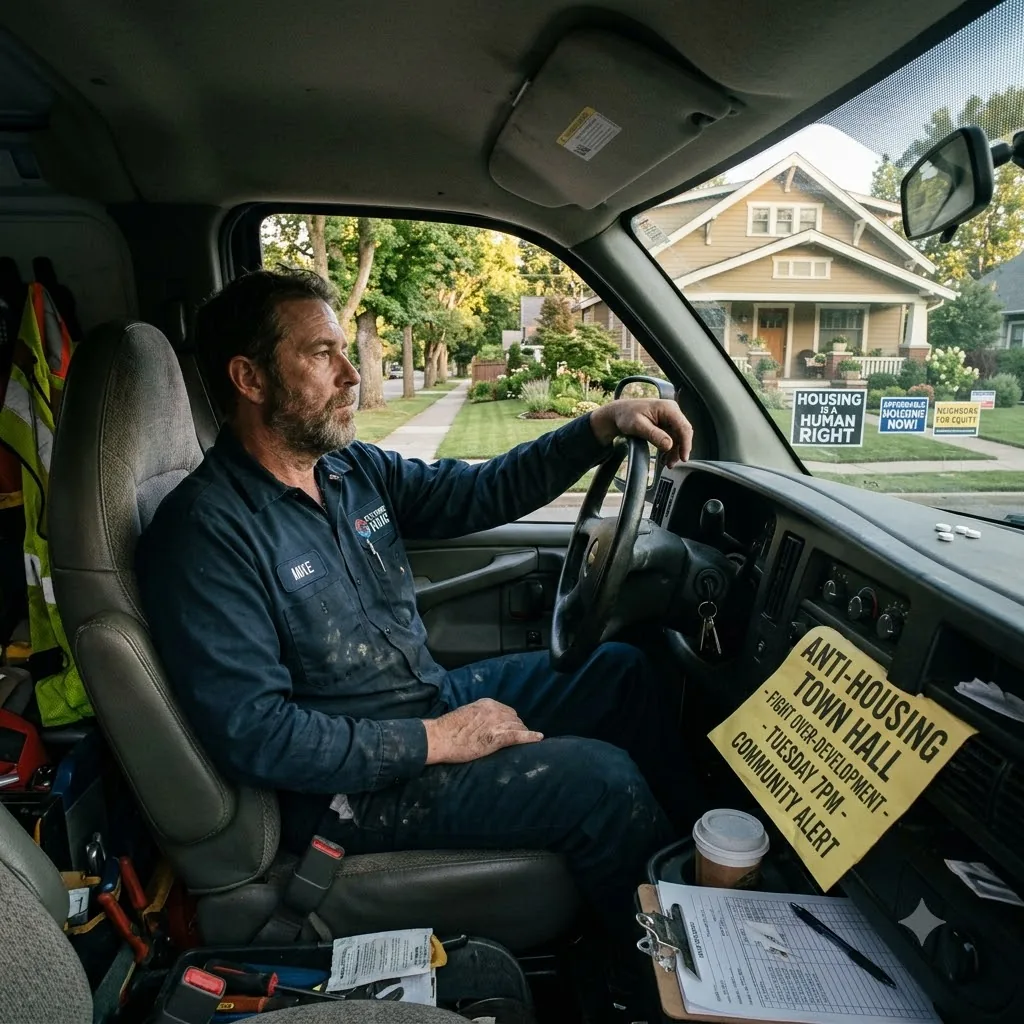
Story code: ST-001412
Part 3: The Waitlist
Marcus stared at the cheap plastic pen trembling in his grip. The bead chain rattled a frantic, tiny rhythm against the wooden clipboard. His home address. Unit 4B, 819 Miller Avenue. The east side. A crumbling duplex where the landlord painted over the black mold and the neighbors screamed at each other through paper-thin walls. He thought of Maya sitting at the chipped laminate kitchen table right now, her headphones on to drown out the sirens, diligently factoring polynomials in the sweltering heat.
If he wrote down his real address, Eleanor Vance would pull her blank check back so fast the breeze would ruffle his uniform shirt. She would see him not as a ‘preferred vendor,’ but as an infiltrator. One of the transients she was actively rallying to keep out. If he lied and wrote a fake address, the county clerk would eventually strike the signature, but more importantly, he would have stood in this sprawling, air-conditioned monument to wealth and explicitly disowned his own daughter’s reality for a paycheck.
The waitlist for Ordinance 4-B wasn’t just a political talking point for Marcus. He had spent three hours filling out the fifty-page application at the public library six months ago. The proposed complex wasn’t a luxury high-rise, but it promised miracles he couldn’t currently afford: dedicated high-speed internet for students, a secure parking garage so his work van wouldn’t get broken into, and a locked front gate. Maya was currently number fourteen on the county lottery waitlist. If the zoning passed and the apartments were built, she would have a quiet room of her own. A permanent, verified address securely inside the magnet school’s borders. It meant he wouldn’t have to swallow chalky ibuprofen and beg for high-velocity system deposits just to stave off eviction at the end of every month.
And it meant they wouldn’t ever end up back at the St. Jude Family Shelter.
The memory of the shelter hit Marcus like a physical blow to the ribs, stealing the conditioned air from his lungs. He remembered the suffocating, humid heat of the family ward. The bone-deep exhaustion that had hollowed out his wife, Sarah. The endless, grinding poverty that had worn down her hard-fought sobriety until it finally snapped under the weight of their eviction. He remembered the blinding blue and red lights of the ambulance flashing against the peeling stucco wall of the cheap weekly motel they had retreated to when the shelter became too dangerous for a toddler. He remembered the sterile, clinical way the exhausted EMT had pronounced the words *accidental fentanyl overdose*.
Sarah had died because they couldn’t afford a safe place to live.
Now, Eleanor Vance was standing in her imported marble kitchen, holding a two-thousand-dollar ransom, casually asking him to sign away the very housing project that would keep his daughter safe from Sarah’s fate. All so her property values wouldn’t suffer a statistical dip.
Marcus lowered his hand. He let the plastic pen drop. It hit the wooden clipboard with a hollow tap, swinging back and forth on its beaded chain like a tiny pendulum.
“I can’t sign this, Mrs. Vance,” Marcus said. His voice was suddenly remarkably steady. The desperate, anxious flutter of financial panic in his chest had vanished, replaced by a cold, heavy block of granite.
Eleanor’s perfectly arched eyebrows drew together. The warm, neighborly smile remained, but it looked pasted on, a rigid artifact of a previous conversation. “I don’t understand, Marcus. We just agreed this is about protecting the community.”
“Your community,” Marcus corrected, his voice low, scraping against the quiet hum of the massive refrigerator. “Not mine.”
Eleanor tilted her head, the gold fountain pen gleaming in her hand. “I thought you said you kept politics out of your business.”
“This isn’t politics for me,” Marcus said, looking up from the clipboard to meet her eyes directly. He didn’t blink, didn’t offer the subservient, practiced smile of a contractor. “You asked about my address. I live on the east side. Unit 4B on Miller Avenue. It’s exactly one of those complexes you want to build a wall against.”
The smile finally peeled away from Eleanor’s face, revealing the tight, bloodless line of her mouth. She took a half-step backward, her leather sandals scuffing the floor, instinctively putting a fraction more distance between her designer blouse and his sweat-stained uniform. “I see.”
“No, ma’am, you don’t,” Marcus said. He stepped forward and placed the heavy wooden clipboard onto the pristine marble island, right next to her blank checkbook. “That housing project you’re trying to block? The Ordinance 4-B apartments? My daughter and I are number fourteen on the waitlist for one of those units. If they build it, my little girl gets to stay in the STEM magnet program you’re so worried about her dragging down. If they don’t, we’re one bad week away from being on the street.”
“Marcus, your personal financial difficulties are not my responsibility,” Eleanor said, her tone rapidly icing over. The breezy, affluent lilt was entirely gone, replaced by the sharp, authoritative crack of a woman accustomed to reprimanding the help. “And quite frankly, your tone is becoming incredibly unprofessional.”
“Three years ago, my wife and I lost our apartment,” Marcus continued, ignoring her reprimand. The words were pouring out now, uncapped, burning his throat as they hit the air. “We bounced between overwhelmed shelters and weekly motels. The stress broke her. She relapsed trying to cope with the reality of raising a child in a room that smelled like bleach and despair. She died of a fentanyl overdose on the bathroom floor of a Motel 6 just a mile outside your subdivision’s property line.”
Eleanor recoiled, her hand flying to her chest, her eyes wide with a mixture of profound shock and deep disgust. “I… I do not need to hear this. This is completely inappropriate.”
“You asked me to sign a piece of paper that guarantees more women like my wife die in motels,” Marcus said, his voice rising, finally allowing the fifteen years of suppressed anger to echo off her high, coffered ceilings. “You asked me to sign away my daughter’s only chance at a stable home so your precious property values can go up another five percent. You want to pretend this petition is about test scores and infrastructure, but it’s about keeping people like me serving you in the attic and out of your sight on the sidewalks.”
Eleanor’s hand dropped from her chest. Her posture stiffened, her chin lifting as the shock dissolved into pure, concentrated hostility. She snatched the clipboard off the counter, shielding it from him.
“Get out of my house,” she snapped, her voice shaking with rage.
“The estimate for the air handler is still-”
“I wouldn’t let you touch a single vent in this house if you were the last contractor in the state,” Eleanor hissed, her eyes narrowing into cold, furious slits. She picked up the blank checkbook, snapped the leather cover shut, and shoved it back into her designer handbag. “You have no idea who you are dealing with. I am on the board of the local chamber of commerce. I play tennis with the owner of Apex Climate Control. By the time I am done making phone calls this afternoon, you won’t be servicing air conditioners in this zip code. You’ll be lucky to find work cleaning the gutters on the east side.”
Marcus didn’t reach for his tool bag. He just stood his ground in the center of the sprawling kitchen, the heavy silence stretching tight enough to snap.
“I expect you off my property in sixty seconds,” Eleanor demanded, her manicured finger pointing toward the heavy oak door in the foyer, her polite, welcoming facade entirely obliterated. “Before I call the police and tell them an unhinged transient is refusing to leave my home.”